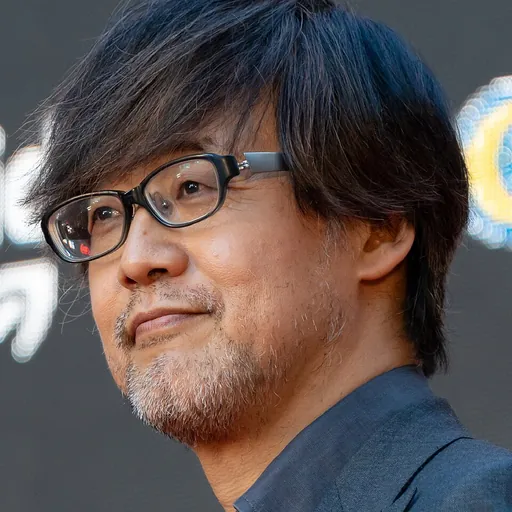
Takashi Yamazaki
Japanese filmmaker and visual effects artist
About Takashi Yamazaki
Born 1964. Takashi Yamazaki is a Japanese film director, special effects artist and screenwriter.
is a Japanese filmmaker and visual effects supervisor. Known for his blockbusters featuring advanced visual effects, he is considered a leading figure in the Japanese film industry. Yamazaki is the recipient of multiple accolades, including an Academy Award, eight Japanese Academy Awards, five Nikkan Sports Film Awards, two Hochi Film Awards, and an Asian Film Award. His films have collectively grossed over worldwide.
Yamazaki found employment at visual effects and animation studio Shirogumi in 1986, and has remained there throughout his career. His first directorial features were the science fiction films Juvenile (2000) and Returner (2002), for which he became known as the "Japanese James Cameron". He later gained further notice in Japan by directing film adaptations of popular anime, novels, and manga, including Always: Sunset on Third Street (2005), Space Battleship Yamato (2010), The Eternal Zero (2013), and Stand by Me Doraemon (2014); the latter two films both earned a total of nine awards at the 38th Japan Academy Film Prize. Yamazaki's career later advanced with The Great War of Archimedes, Dragon Quest: Your Story, Lupin III: The First (all 2019), and Stand by Me Doraemon 2 (2020).
His 2023 kaiju epic, Godzilla Minus One, became the most successful Japanese Godzilla film of all time and one of his highest-grossing films. Yamazaki and the visual effects team also became the first Japanese crew ever to receive the Academy Award for Best Visual Effects. In 2024, Yamazaki was included in Gold House's annual list of 100 Most Impactful Asians. He is currently working on Godzilla Minus Zero, the sequel to Godzilla Minus One, and his Hollywood debut.
Early life Takashi Yamazaki was born on June 12, 1964, in Matsumoto, Nagano, to Yoshisuke Yamazaki, a baker, and Kikuko. On his childhood, Yamazaki reflected: "My parents raised me by letting me do what I wanted freely. I think that has shaped a big part of who I am today".
Yamazaki was first introduced to film by the "Umbrella Program" as a child; in 2023 he reflected that Ishirō Honda's Matango (1963) and King Kong vs. Godzilla (1962) may have been among the first movies he ever saw. Growing up, Yamazaki was influenced to work in the film industry by monster movies and American films such as the 1977 American science fiction films Star Wars and Close Encounters of the Third Kind. He filmed his directorial debut on 8 mm film with the assistance of a friend during his third year at . This 1979 science fiction short, entitled Glory, was lost for 43 years until it was rediscovered in 2022 and screened in the director's hometown.
Career
1984–1999: Early career In 1984, Yamazaki began working as a miniature builder for . Following his graduation from in 1986, he officially became an employee at Shimamura's animation and special effects studio Shirogumi in Chōfu, Tokyo.
After working on the Eko Eko Azarak series and Parasite Eve (1997), Yamazaki and his team at Shirogumi started pre-production on their feature NUE. The team spent two years preparing the project in collaboration with Robot Communications and they even went location scouting in Australia. Yamazaki, who was still heading the visual effects for up to three commercials monthly at this point, concluded that the film would require him to create the film on a relatively enormous budget of , well above the average budget of usually given to first-time directors. Thus, Robot president Shūji Abe deemed NUE too expensive and requested that Yamazaki scrap it and attempt to make his directorial debut with a smaller scale. However, Abe decided to increase the film's budget to in order to allow Yamazaki to make it a "proper movie for the summer vacation lineup". It was also shown at the 2000 Giffoni Film Festival.
His next film, the science fiction actioner Returner (2002), follows the story of Milly, a young woman living in a war-torn future, who is recruited by a mysterious time traveler named Miyamoto. The film was distributed by Toho in Japan on August 31, 2002 and was later in American theaters in October of the following year, where it was critically savaged. Western critics accused Yamazaki of plagiarising from popular American science fiction films such as Close Encounters of the Third Kind (1977), E.T. the Extra-Terrestrial (1982), The Terminator (1984), and The Matrix (1999). After its release, Yamazaki proposed a sequel to Returner but Abe asked him to make a film set in the Shōwa era instead. In 2005, film critic Tadao Satō regarded the film as a milestone in the usage for computer-generated imagery and acclaimed Yamazaki's direction. At the 29th Japanese Academy Awards, the film won twelve awards, including Best Picture and Best Director. Yamazaki stated that he is a lifelong fan of the Godzilla franchise and incorporated the opening scene in order to "start with something fresh from the first film" and added that "having Godzilla destroy Tokyo Tower with his oral beam was a great way to surprise audiences". Upon its November 3 release, Always: Sunset on Third Street 2 became Yamazaki's biggest box office hit, ranking the third-highest-grosser at Japanese box office that year.
2008–2018: Directing film adaptations
In 2008, Yamazaki turned to assisting his fellow graduate and future wife, Shimako Satō, with the visual effects and screenplay for her action film, K-20: Legend of the Mask. Based on a novel by Sō Kitamura, K-20 is set in an alternate reality version of Japan during the 1940s and follows the mysterious masked antihero known as "K-20" who robs the rich and powerful, leaving behind a trail of dismay. K-20 was released in December 2008 and grossed , making it the eighteenth highest-grossing Japanese film of 2009.
In 2009, Yamazaki created the visual effects for Yōjirō Takita's Sanpei The Fisher Boy – based on the manga Fisherman Sanpei – and directed, wrote and made the effects for the live-action jidaigeki romance film – based on the 2002 anime feature Crayon Shin-chan: Fierceness That Invites Storm! The Battle of the Warring States –. Yamazaki was inspired to create Ballad after visiting the filming location of The Last Samurai (2003) and contemplating "Maybe Japan could make a historical drama centered around battles?".
In October 2009, Yamazaki started filming his first science fiction film since 2002's Returner, Space Battleship Yamato. it is an adaptation of famed manga artist Leiji Matsumoto's 1974 anime series of the same name. With a budget estimated at it was anticipated to become an "unprecedented science fiction blockbuster", and Toho spent an additional on New Years Day alone to promote the film and ensure it met their expectations. Space Battleship Yamato was released in Japan during December 2010 and grossed .
The first animated to be co-directed by Yamazaki and , Friends: Naki on Monster Island, was released in Japanese theaters in December 2011. Loosely based on Hirosuke Hamada's children's book Naita Aka Oni, the film is about a monster named Naki who is protecting a young boy, whom they found lost on the Monster Island, from the other, man-eating, monsters. The film was nominated for an Japan Academy Film Prize and VFX Japan Award two years after its initial release.
Always: Sunset on Third Street '64, the sequel to Always: Sunset on Third Street 2, was Yamazaki's next venture. At the film's premiere screening on January 17, 2012, Yamazaki said that "it was very difficult to make this movie" but nevertheless expressed his desire for a sequel set during Expo '70.
2018–present: Godzilla and other activities Yamazaki (right) with Godzilla Minus One star Ryunosuke Kamiki at the 36th Tokyo International Film Festival in October 2024. In July 2018, the production of Yamazaki's next film The Great War of Archimedes was announced; based on a manga by Norifusa Mita, this picture about the building of the battleship Yamato, and starred Masaki Suda in his first collaboration with Yamazaki. and was the sixteenth highest-grossing Japanese film of 2019.
After the release of The Great War of Archimedes, Yamazaki was given the opportunity to make a Godzilla film by Toho executive and film producer Minami Ichikawa. Ichikawa stated that he and Yamazaki decided to collaborate on the project during the COVID-19 pandemic in 2020 and Yamazaki spent three years writing the screenplay. The film, entitled Godzilla Minus One, was released in Japanese theaters in November 2023, and became one of the most acclaimed films in the franchise. For their work on the film, Yamazaki and his team became the first Japanese film to ever to receive an Academy Award nomination for Best Visual Effects, ultimately winning. Yamazaki himself was among the recipients of the Academy Award.
On December 27, 2023, Yamazaki began directing a kaiju web film in Ashikaga, Tochigi for a major food corporation, scheduled for a March 2024 release with a runtime of approximately one minute. Its visual effects were also made by the same team behind Godzilla Minus One. It was later revealed to be titled and produced by Ajinomoto.
Yamazaki declared in February 2024 that he has a new film in development. The following month, Variety reported that Yamazaki had recently enlisted with the American talent agency Creative Artists Agency (CAA); the agreement could potentially help Yamazaki to be employed for Hollywood productions. At Godzilla Fest in November, he disclosed that he had declined several offers in order to helm another Godzilla film. Deadline later reported that Yamazaki is set to make his Hollywood debut with Grandgear for Bad Robot and Sony Pictures. In addition to writing and directing the film, he will also serve as a producer alongside J. J. Abrams and Glen Zipper.
Personal life In 2012, Yamazaki married fellow filmmaker Shimako Satō, whom he had met at in the 1980s.
Filmography
Films
Don’t just read it —
keep it.
Full-length biographies made to live with: read them, listen on the way to work, watch them tonight.
- E-book
- Audio
- Video
Instant download · yours to keep · every purchase keeps this site free
Important facts
Family & relationships
People in Takashi Yamazaki's life
Named in this biography and alive at the same time







Related people
Same field, nearest in time



Contemporaries
People whose lives overlapped Takashi Yamazaki's


Frequently asked questions
Who is Takashi Yamazaki?
Japanese filmmaker and visual effects artist
When was Takashi Yamazaki born?
Takashi Yamazaki was born on 12 June 1964 in Matsumoto.
What is Takashi Yamazaki's occupation?
Takashi Yamazaki is a film director, special effects artist and screenwriter.
What nationality is Takashi Yamazaki?
Takashi Yamazaki is Japanese.
Sources & further reading
Cite this page
APA: Biography.guide. (2026). Takashi Yamazaki. https://biography.guide/takashi-yamazaki/
MLA: "Takashi Yamazaki." Biography.guide, https://biography.guide/takashi-yamazaki/.
Chicago: "Takashi Yamazaki." Biography.guide. https://biography.guide/takashi-yamazaki/.
Data last updated: 2026-09-22 · Spot an error? Report a correction.
Portrait: Wikimedia Commons · author & licence
Page generated 2026-09-27 04:58 UTC