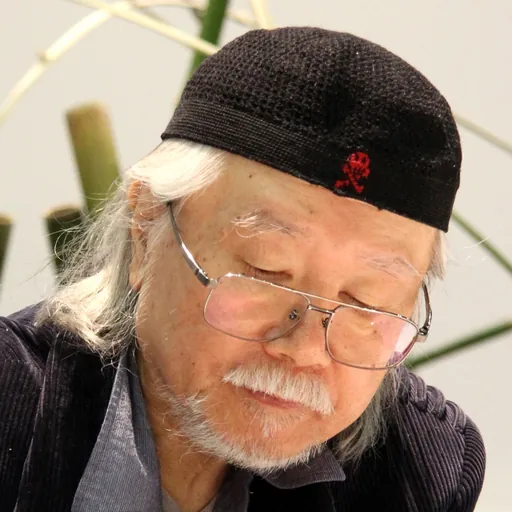
About Leiji Matsumoto
Lived 1938 – 2023 (aged 85). Leiji Matsumoto was a Japanese film director, mangaka, screenwriter, animator, cartoonist and writer.
was a Japanese manga artist, and creator of several anime and manga series. His widow Miyako Maki is also a manga artist.
Matsumoto was famous for his works such as Space Battleship Yamato, Space Pirate Captain Harlock, and Galaxy Express 999. His style was characterized by mythological and often tragic storylines with strong moral themes, noble heroes, feminine heroines, and a love of strange worlds and melancholic atmosphere. He was the middle child of a family of seven brothers, and, in his early childhood, Matsumoto was given a 35mm film projector by his father, and watched American cartoons during the Pacific War. During this time, he gained an interest in science fiction novels by authors Unno Juza and H. G. Wells. Matsumoto started drawing at the age of six, and began drawing manga three years later after seeing the works of Osamu Tezuka.
Matsumoto's big break came with Otoko Oidon, a series that chronicled the life of a rōnin (a young man preparing for university entrance exams), in 1971. In 1972 he created the mature-themed dark comedy Western seinen series Gun Frontier for the Play Comic magazine, which ran from 1972 to 1975. Around the same time he started a series of unconnected short stories set during World War II, Senjo Manga Series, which would eventually become popular under the title The Cockpit. Animated versions of Captain Harlock and Galaxy Express 999 are set in the same universe, which spawned several spin offs and related series, most notably Queen Emeraldas and Queen Millennia.
Matsumoto worked with Yoshinobu Nishizaki on Space Battleship Yamato (known outside Japan under various names, but most commonly as Star Blazers). Matsumoto created a manga loosely based on the series, and the Yamato makes cameo appearances (sans crew) in several of his works including the Galaxy Express 999 manga. As of 2009, Matsumoto and Nishizaki were working on independent anime projects featuring the acclaimed Space Battleship Yamato, with the conditions that Matsumoto cannot use the name Yamato or the plot or characters from the original, and Nishizaki cannot use the conceptual art, character or ship designs of the original.
In August 2014, to celebrate the 60th anniversary of his debut, Matsumoto launched the manga Captain Harlock: Jigen Kōkai (Captain Harlock: Dimensional Voyage), illustrated by Kōichi Shimahoshi, in the pages of Akita Shoten's Champion Red magazine.
Personal life Matsumoto was married to manga artist and Licca-chan creator Miyako Maki. However, he was considered to be out of danger two days later.
Death Matsumoto died of acute heart failure at a hospital in Tokyo on February 13, 2023, at the age of 85. Various manga artists offered condolences, including Yasuhiro Nightow, Nozomu Tamaki, and his wife Maki. Galaxy Express 999 voice actress Masako Nozawa and translator Zack Davisson also gave their condolences.
Style and themes Narrative structure Matsumoto's stories are influenced by the Bildungsroman tradition, i.e. tales of formative education and self-discovery. Scholar Darren-Jon Ashmore notes that Matsumoto viewed his own space opera sagas, such as Galaxy Express 999 and Captain Harlock, as narratives of growth and transformation, where characters "make choices for themselves and others, giving up much of themselves so that a greater goal is served." Ashmore further explains that Matsumoto was inspired by classic works like Charles Dickens's A Christmas Carol and Margaret Mitchell's Gone with the Wind, focusing on characters who are "initially the product of their times and circumstances, but ultimately come to be masters of their own fate." The concept of "Arcadia", an idealized, lost paradise of youth, is a recurring motif, stemming from Matsumoto's engagement with Johann Wolfgang von Goethe's Italian Journey.
A core philosophical concept in Matsumoto's interconnected "Leijiverse" is toki-no-wa (the wheel of time), representing a cyclical view of history and destiny where heroes and events echo across ages. Ashmore describes this as a reflection of both Buddhist concepts of rebirth and Norse cosmology, where characters function as "eternal champions" navigating repeated epochs of conflict and renewal. This cyclical nature allows for a mutable, non-linear canon where stories and character relationships are constantly re-explored and redefined across different manga and anime adaptations. Central themes across his work include a resistance to societal apathy and conformity, a melancholic nostalgia for a lost heroic past, and the sacrifice of the individual for a greater, often cosmic, purpose.
Visual style Matsumoto's artistic style is characterized by highly detailed mechanical designs, especially for spaceships, which incorporate numerous analog dials and gothic elements. His visual approach to characters creates a stark contrast between the delicate, elegant designs of his young women and the more grotesque or comedic appearance of secondary characters. The design of his female characters was refined in collaboration with his wife, manga artist Miyako Maki.
Don’t just read it —
keep it.
Full-length biographies made to live with: read them, listen on the way to work, watch them tonight.
- E-book
- Audio
- Video
Instant download · yours to keep · every purchase keeps this site free
Important facts
Family & relationships
People in Leiji Matsumoto's life
Named in this biography and alive at the same time





Related people
Same field, nearest in time




Contemporaries
People whose lives overlapped Leiji Matsumoto's




Frequently asked questions
Who was Leiji Matsumoto?
Japanese manga artist (1938–2023)
When was Leiji Matsumoto born?
Leiji Matsumoto was born on 25 January 1938 in Kyoto Prefecture.
When did Leiji Matsumoto die?
Leiji Matsumoto died on 13 February 2023 in Tokyo.
What was Leiji Matsumoto's occupation?
Leiji Matsumoto was a film director, mangaka, screenwriter, animator, cartoonist and writer.
What nationality was Leiji Matsumoto?
Leiji Matsumoto was Japanese.
Sources & further reading
Cite this page
APA: Biography.guide. (2026). Leiji Matsumoto. https://biography.guide/leiji-matsumoto/
MLA: "Leiji Matsumoto." Biography.guide, https://biography.guide/leiji-matsumoto/.
Chicago: "Leiji Matsumoto." Biography.guide. https://biography.guide/leiji-matsumoto/.
Data last updated: 2026-09-21 · Spot an error? Report a correction.
Portrait: Wikimedia Commons · author & licence
Page generated 2026-09-27 04:59 UTC