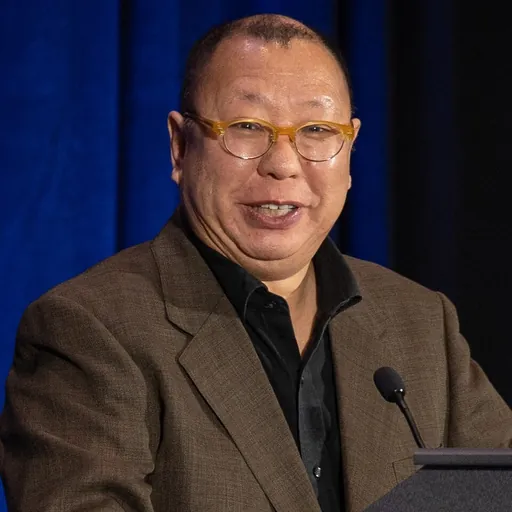
Takashi Tezuka
Japanese video game designer and producer
About Takashi Tezuka
Born 1960. Takashi Tezuka is a Japanese programmer, computer scientist, screenwriter and video game producer.
, nicknamed Ten Ten, is a Japanese video game designer, director and producer. Since 1984, he has directed, produced, or supervised development of numerous games released by Nintendo. He is currently a senior officer of their Entertainment Planning & Development division, and was an executive officer of the company board of directors between 2018 and 2026.
Tezuka assisted designer Shigeru Miyamoto on the platformer game Super Mario Bros. (1985) for the Nintendo Entertainment System (NES). The game was incredibly innovative and influential to the medium; it began the Super Mario game series, and revived the North American gaming industry after it had suffered a recession in 1983. Tezuka wrote for and helped Miyamoto design the action-adventure game The Legend of Zelda (1986), which began the Zelda series. The two have had a creative partnership on many projects in the four decades since.
While directing Super Mario Bros. 3 (1988) for the NES and Super Mario World (1990) for the Super Nintendo Entertainment System (SNES), Tezuka co-designed the dinosaur character Yoshi, who became a staple of the Mario and Yoshi series. He then directed The Legend of Zelda: A Link to the Past (1991) for the SNES, The Legend of Zelda: Link's Awakening (1993) for the Game Boy, and Yoshi's Island (1995) for the SNES. His last game design credit was for Super Mario 64 (1996) for the Nintendo 64. Tezuka has since worked in managerial roles on games, rather than as a hands-on designer. Such titles include Animal Crossing (2001) for the Nintendo 64 and GameCube, The Legend of Zelda: The Wind Waker (2002) for the GameCube, Super Mario Galaxy 2 (2010) for the Wii, and The Legend of Zelda: Breath of the Wild (2017) for the Wii U and Nintendo Switch. All the aforementioned titles are considered some of the best, most innovative, or most influential games ever released.
Early life Takashi Tezuka was born on November 17, 1960. His nickname is "Ten Ten", which he has been called in some game credits. In the 1980s, he studied at the Design Department of the Osaka University of Arts. He became skilled at designing packaging of consumer goods featuring branding of various characters. However, Tezuka was uninterested in jobs like advertising—where someone has to design a product according to a client's specifications—which design students in Japan typically entered after graduating. His friend, meanwhile, applied to work at video game company Nintendo, which made Tezuka interested in joining them too; he wanted to work in "jobs related to leisure and recreation", rather than necessarily work in gaming. Tezuka was not very knowledgeable about gaming when he applied, and was not even aware of Pac-Man (1980). at age 23, Tezuka got a part-time job at Nintendo, working on the sprites of the arcade fighting game Super Punch-Out!! (1984) while he was still in university. The company hired him despite his unfamiliarity with gaming. He worked only for a few weeks. Afterwards, Tezuka graduated from the university. He also joined the company as a full-time employee, his first game credit being assistant director of Devil World (1984) for Nintendo's Famicom home console. His rapid ascent from new hire to assistant director was due to the company's limited staff at the time. New recruits would be "employed across different projects in different capacities as needed", meaning Tezuka also made games' instruction manuals, arcade cabinet art, sprite art, and Nintendo's playing cards. Initially, it was designed solely by Shigeru Miyamoto, until partway through, when Tezuka started assisting him. Tezuka had much to learn about the Famicom's design at his job, as he did not own one before joining the company. He initially assumed it was a personal computer like its full name (Family Computer) suggested.
Super Mario Bros. (1985)
A sequel to the arcade game Mario Bros. (1983), the 2D platformer Super Mario Bros.released in 1985 for the Famicom and the console's redesign released outside Japan, the Nintendo Entertainment System (NES). Although Miyamoto already intended to use Mario as a mascot for many games following Mario Bros., it was Tezuka that first pitched a new game starring the character, after learning how consistently Mario Bros. was still selling on the Famicom a year after its release. Mark Langshaw writes for Digital Spy: The characters Bowser and Princess Peach also made their first appearance. In 2021, TheGamer wrote that Tezuka "has worked on pretty much every Mario game since the franchise's inception".
Super Mario Bros: The Lost Levels (1986) Tezuka and Miyamoto worked on a 1986 sequel to Super Mario Bros., which released for the Famicom as Super Mario Bros. 2. The game was Tezuka's directorial debut. The NES received its own "Super Mario Bros. 2": a reskin of an unrelated Famicom game, Yume Kojo: Doki Doki Panic. The Japanese Super Mario Bros. 2 came to the West in 1993 as Super Mario Bros.: The Lost Levels, part of the Super Mario All-Stars compilation for the Super Nintendo Entertainment System (SNES) console. The Legend of Zelda (1986) and Zelda II: The Adventure of Link (1987) Tezuka and Miyamoto developed The Legend of Zelda (1986), an action-adventure game for the Famicom and NES. Miyamoto designed its gameplay, while both worked on its story. The game began the Legend of Zelda series, and established its universe, which has been fleshed out with each subsequent entry, and a 2011 book. Tezuka's worldbuilding for the first game was influenced by high fantasy novels such as J. R. R. Tolkien's The Lord of the Rings. Zelda II introduced the Triforce of Courage, spiritually aligned with Power and Wisdom to make the singular Triforce. The game had a very long development cycle for an 8-bit game, at two and a half years. The number of people Tezuka worked with had grown to around 20 or 30. The player can also obtain the Frog Suit, which makes Mario slower on land, but agile in water; and Kuribo's Shoe, a giant shoe he sits inside of to jump onto enemies and safely land on obstacles.
Another staple of the franchise that debuted are the Boo species of ghosts. In Mario platformers, they fly towards him, and damage him if he touches them. They also freeze in fear when Mario looks at them, but fly towards him otherwise. They were designed by Tezuka, who was inspired by a reaction he once had to his wife. He says his wife is "very quiet normally", but one day, she "exploded" in anger at him regarding all the time he spent at his job; his rapidly frightened reaction led to the Boos' behavior.
The designers eschewed The Lost Levels difficulty, with Tezuka later saying "we couldn't do that again". He thus decided he had to differentiate Super Mario Bros. 3 from its predecessors by overhauling the series' visual design. The team initially tried to give the camera seen in the game's levels an angled, slightly overhead view of the gameplay. Yoshi became one of Nintendo's "core" characters, appearing in future Mario games and starring in his own titular series.
The Legend of Zelda: A Link to the Past (1991)
Tezuka directed The Legend of Zelda: A Link to the Past (1991) for the SNES. A debuting item is the Hookshot, a grappling hook that Link can shoot out of his hand and attach to certain surfaces he normally could not reach, sending him flying over to the target location.
A Link to the Past's story was more dramatic than prior Zelda games. Before core gameplay can start, the player has to complete a cinematic opening sequence involving breaking into Hyrule Castle on a rainy night, without Link's usual weapons. At key points in the story, he unlocks items that help him in his quest; during one such moment, he unlocks the Master Sword, which magically repels evil, and this brings begins the climax of the plot. The scene was formulated by the game's writer Kensuke Tanabe, and Tezuka's team decided it would be a great way to show players that "it's at this point that the game's real battle starts". A Link to the Past became immediately regarded as a masterpiece by players and critics, and for twenty years afterwards, Zelda games were built using its general structure.
Inspired by the American surrealist mystery TV series Twin Peaks (1990–1991)—which first broadcast in Japan at the start of development—Tezuka gave the game a surrealist story, creating a community of suspicious NPCs to replicate the residents of the show's titular town setting. Link's Awakening takes place inside Link's dream after going unconscious following a shipwreck; in it, he washes up on the shore of the strange island of Koholint Island. Despite the perceived advancements in Zelda's storytelling in A Link to the Past, Tezuka later stated that Link's Awakening is where the series started significantly focusing on its stories.
Super Mario All-Stars (1993) After the Zelda sequels, Tezuka directed the SNES title Super Mario All-Stars (1993).
Yoshi's Island (1995) Tezuka's last directorial role on a game was for the SNES platformer Yoshi's Island (1995). He worked with a team that included Shigefumi Hino, who later directed Pikmin (2001), and Hideki Konno, who would produce various Mario Kart titles and, in the 2010s, head Nintendo's mobile gaming department.
Super Mario 64 (1996)
Tezuka was an assistant director of Super Mario 64 (1996), a launch title for the Nintendo 64 home console. It was his last credit as a game designer, as he worked with a "dream team" that included Miyamoto. The Nintendo 64 was the company's first console to support fully-3D computer graphics, making Super Mario 64 one of the first-ever fully-3D platformers. Miyamoto felt that before the team started on level design, he personally needed to perfect Mario's controls in 3D space, which had a complexity never before seen in games. This contributed to a long development. Super Mario's controls had historically adhered to properties of real-life physics: mass, momentum, and inertia—paired with an unrealistic ability to move in mid-air—which the player has to consider before moving and jumping. Before Super Mario 64, 3D platformers did not include all of these properties, making them to difficult to play. Rich Stanton later wrote for Eurogamer that it was "the first 3D game that actually felt as good to play as a 2D game"; it therefore created the rules of 3D platforming movement that most games in the genre adhered to afterwards.
Mario uses the hub world of Princess Peach's castle to enter different levels; the player has to jump into the castle's many magical paintings that depict the levels to be teleported to them. This makes navigation in Super Mario 64 a more playful act than selecting levels from a menu, as in other games. The castle is also filled with numerous secrets to discover. Inside the levels, the player uses Mario's new controls to traverse complex 3D spaces: climbing and sliding down hills, pounding wooden posts into grass, and jumping over lava to reach platforms. He can grab certain objects and characters, and if he steps on a Koopa Troopa, he can use its shell like a surfboard, sliding around the level.
Animal Crossing (2001)
Tezuka produced the social simulation game Animal Crossing (2001), which released in Japan for the Nintendo 64's 64DD peripheral, and in other regions for the GameCube. In it, the player controls the only human resident of a town of animals, and can interact with them in various ways. The game has a virtual economy, and players earn money by completing villagers' tasks, or selling items to Tom Nook, a local raccoon businessman. The player starts the game in a small, "crummy" house bought with loans from Nook. To get out of debt and improve their house, the player must sell him items, as they cannot pay him upfront. Yoshi's New Island (2014) The original Nintendo 3DSTezuka produced Yoshi's New Island (2014) for the Nintendo 3DS handheld console. The development team included other members of the Yoshi's Island team. The game's mechanics and typical level structure are generally borrowed from the SNES game; however, as with Yoshi's Story the levels were made easier to complete. To make up for this, for players who wanted Yoshi's Island's difficulty, the team made it hard to obtain 100% of its collectible items such as stars or flowers. Yoshi's New Island introduced giant Yoshi eggs named Mega Eggdozers, which players need to collect to complete a level—as well as several items which make Yoshi transform and gain abilities, like being able to swim underwater for a long time, run very fast, or turn into a hot air balloon or submarine.
Similar to Yoshi's Island, the world of Yoshi's New Island looks like it has been made with crayons, oil paint, and watercolor paint. The game also makes use of the handheld's stereoscopic 3D display, showing the player physical depth in the game world when the 3D mode is active; the developers spent a significant amount of time making sure no visual bugs would result from this. Utilizing the 3DS' internal gyroscopic sensor, and while Yoshi uses binoculars, players can tilt the handheld left or right to reveal the areas of a level just outside the screen. the game also let them play levels that other owners of the game created and uploaded online. Tezuka's team started development wanting to utilize the Wii U GamePad's touchscreen display, and started on a sequel to Mario Paint (1992) that let players digitally paint with the guidance of the touch user interface. They eventually switched to making a simplified version of Nintendo's internal level creation software used on previous Super Mario games.
Nintendo World Report writes that Tezuka's fame among Nintendo fans increased in 2015, due to his publicized roles in creating Mario Maker and Yoshi's Woolly World (2015). Before then, "Miyamoto could barely walk two feet at E3 without getting mobbed", while Tezuka was "regularly spotted walking around the show floor with little to no fanfare." Mario Run sacrificed much of Mario's traditional moveset in Super Mario games—designed for controllers— to work smoothly on a touch user interface. The character automatically runs to the right in the game's levels, instead of the player controlling his speed and direction. To deter Mario from hitting obstacles, the player taps on the device's screen to make him jump—the longer they tap, the higher he jumps.
2018 promotion By 2018, Tezuka had been working for some time as senior officer of Nintendo's Entertainment Planning & Development (EPD) division. That year, the company announced he had been promoted to executive officer of Nintendo's board of directors, but that he would maintain his role at Nintendo EPD.
Super Mario Maker 2 (2019) Tezuka produced Super Mario Maker 2, which released for the Nintendo Switch in 2019. Compared to the Wii U Mario Maker, the sequel has an increased amount of mechanics that players can implement into their levels. It also introduced a story mode, and online multiplayer for any levels that users had uploaded.
In 2024, Tezuka said he felt some of the levels uploaded online on the Mario Maker games "were not very good", and that that helped him answer a question he discussed with Miyamoto prior to the game's release: if it was easier to make a good 2D platformer than a 3D one—the answer being no. He described the games as a "crowdsourced experiment" that taught him "even if design elements like controls and enemies are solid, 'whether they come alive or fall flat are dependent on the level designer'".
Wonder Effects were created as an attempt to replicate the developers' experiences of being surprised by the secrets they found within video games as children. As Super Mario Bros. Wonder was designed to be accessible to all ages—and thus, varying skill levels—the badge system was as a way to make the game's difficulty customizable by the player. The game's main designers solicited ideas for Wonder Effects and badges from the entire development team, and in total, they received two thousand different submissions.
Pikmin 4 (2023) Tezuka was the producer of the real-time strategy game Pikmin 4 (2023) for the Switch. Nintendo first announced the game in 2015, saying it was near completion, yet development continued for eight years afterwards.
Yoshi and the Mysterious Book (2026) Tezuka was producer on the title just like the previous Yoshi titles.
Leaving the board of directors On May 8, 2026, Nintendo announced as part of their financial results that Tezuka would be retiring from the company's board of directors on June 26, 2026 as an executive officer after being part of the board for 8 years. Tezuka would still remain in the company and continue working as a developer in Nintendo EPD as a senior officer in the division but without executive responsibilities in the board.
Works Year Title Role1984 Super Punch-Out!!Graphic artist Devil WorldAssistant director, graphic artistExcitebikeGraphic artist1985 Super Mario Bros.Assistant director, graphic artist 1986 The Legend of ZeldaDirector, graphic artist, writer Super Mario Bros.: The Lost Levels Director, graphic artist 1987 Zelda II: The Adventure of Link Writer 1988 Super Mario Bros. 3 Director, graphic artist 1990 Super Mario World Director 1991 The Legend of Zelda: A Link to the Past 1993 The Legend of Zelda: Link's Awakening Super Mario All-Stars 1995 Yoshi's Island 1996 Super Mario 64 Assistant director 1997 BS The Legend of Zelda: Inishie no Sekiban Supervisor Star Fox 64 Yoshi's Story Producer 1998 The Legend of Zelda: Ocarina of Time Supervisor 1999 Mario Golf2000 The Legend of Zelda: Majora's MaskMario TennisPaper Mario 2001 The Legend of Zelda: Oracle of Seasons and Oracle of Ages Luigi's Mansion Producer Pikmin Progress manager Animal Crossing Producer 2002 Super Mario Sunshine The Legend of Zelda: The Wind Waker 2003 Mario Kart: Double Dash 2004 The Legend of Zelda: The Minish Cap Supervisor The Legend of Zelda: Four Swords Adventures Pikmin 2 Producer Paper Mario: The Thousand-Year Door Supervisor 2005 Yoshi Touch & Go Producer Big Brain Academy General producer Animal Crossing: Wild World 2006 New Super Mario Bros. Yoshi's Island DS Senior producer The Legend of Zelda: Twilight Princess Supervisor 2007 Big Brain Academy: Wii Degree General producer Mario Party 8 Supervisor The Legend of Zelda: Phantom Hourglass Donkey Kong Barrel Blast Mario Party DS Link's Crossbow Training Producer 2008 Wii Music Animal Crossing: City Folk General producer 2009 Mario & Luigi: Bowser's Inside StorySenior producer New Super Mario Bros. Wii Producer The Legend of Zelda: Spirit Tracks Supervisor 2010 Super Mario Galaxy 2 Producer 2011 The Legend of Zelda: Ocarina of Time 3D Senior producer The Legend of Zelda: Four Swords Anniversary Edition Super Mario 3D Land General producer The Legend of Zelda: Skyward SwordSupervisor Fortune Street 2012 New Super Mario Bros. 2 Producer New Super Mario Bros. U Animal Crossing: New LeafGeneral producer 2013 Mario & Luigi: Dream Team Supervisor Super Mario 3D WorldGeneral producer The Legend of Zelda: A Link Between Worlds Supervisor 2014 Yoshi's New Island Producer 2015 Yoshi's Woolly World Super Mario Maker The Legend of Zelda: Tri Force Heroes Supervisor Mario & Luigi: Paper Jam 2016 Tank Troopers Paper Mario: Color Splash Super Mario Maker for Nintendo 3DS Producer Super Mario Run 2017 The Legend of Zelda: Breath of the Wild Supervisor Arms Production manager Hey! Pikmin Producer Mario & Luigi: Superstar Saga + Bowser's Minions Supervisor 2018 Mario & Luigi: Bowser's Inside Story + Bowser Jr.'s Journey 2019 New Super Mario Bros. U Deluxe Producer Yoshi's Crafted World Super Mario Maker 2 2020 Clubhouse Games: 51 Worldwide ClassicsPikmin 3 Deluxe 2023 Pikmin 4Super Mario Bros. WonderSuper Mario RPGSupervisor 2024 Princess Peach: Showtime!Senior supervisor Mario & Luigi: Brothership 2026Super Mario Bros. Wonder + Meetup in Bellabel Park ProducerYoshi and the Mysterious BookNon-gaming credits'''
Don’t just read it —
keep it.
Full-length biographies made to live with: read them, listen on the way to work, watch them tonight.
- E-book
- Audio
- Video
Instant download · yours to keep · every purchase keeps this site free
Important facts
People in Takashi Tezuka's life
Named in this biography and alive at the same time

Related people
Same field, nearest in time


Contemporaries
People whose lives overlapped Takashi Tezuka's



Frequently asked questions
Who is Takashi Tezuka?
Japanese video game designer and producer
When was Takashi Tezuka born?
Takashi Tezuka was born on 17 November 1960 in Osaka.
What is Takashi Tezuka's occupation?
Takashi Tezuka is a programmer, computer scientist, screenwriter and video game producer.
What nationality is Takashi Tezuka?
Takashi Tezuka is Japanese.
Sources & further reading
Cite this page
APA: Biography.guide. (2026). Takashi Tezuka. https://biography.guide/takashi-tezuka/
MLA: "Takashi Tezuka." Biography.guide, https://biography.guide/takashi-tezuka/.
Chicago: "Takashi Tezuka." Biography.guide. https://biography.guide/takashi-tezuka/.
Data last updated: 2026-09-23 · Spot an error? Report a correction.
Portrait: Wikimedia Commons · author & licence
Page generated 2026-09-27 05:06 UTC