
About Taharqa
Lived 720 BC – 664 BC (aged 55–56). Taharqa was an Egyptian statesperson.
Taharqa, also spelled Taharka or Taharqo (; ; Manetho's , ; Strabo's , , Septuagint's , ), was a pharaoh of the Twenty-fifth Dynasty of Egypt and qore (king) of the Kingdom of Kush (present day Sudan) from 690 to 664 BC. He was one of the Black Pharaohs – also called Nubian or Kushite Pharaohs – who ruled over Egypt for nearly a century.
Early life
Taharqa may have been the son of Piye, the Nubian king of Napata who had first conquered Egypt, though the relationships in this family are not completely clear (see Twenty-fifth Dynasty of Egypt family tree). Taharqa was also the cousin and successor of Shebitku. The successful campaigns of Piye and Shabaka paved the way for a prosperous reign by Taharqa.
Ruling period Taharqa's reign can be dated from 690 BC to 664 BC. Evidence for the dates of his reign is derived from the Serapeum stele, catalog number 192. This stela records that an Apis bull born and installed (fourth month of Season of the Emergence, day 9) in year 26 of Taharqa died in Year 20 of Psamtik I (4th month of Shomu, day 20), having lived 21 years. This would give Taharqa a reign of 26 years and a fraction, in 690–664 BC.
Irregular accession to power Taharqa explicitly states in Kawa Stela V, line 15, that he succeeded his predecessor (previously assumed to be Shebitku but now established to be Shabaka instead) after the latter's death with this statement: "I received the Crown in Memphis after the Falcon flew to heaven." The reference to Shebitku was an attempt by Taharqa to legitimise his accession to power. However, the text never mentions the identity of the royal falcon and completely omits any mention of Shabaka's intervening reign between Shebitku and Taharqa, possibly because Taharqa ousted Shabaka from power.
In Kawa IV, line 7–13, Taharqa states:
In Kawa V: line 15, Taharqa states
Therefore, Taharqa says that King Shebitku, who was very fond of him, brought him with him to Egypt and during that trip he had the opportunity to see the deplorable state of the temple of Amun at Kawa, an event he remembered after becoming king. But on Kawa V Taharqa says that sometime after his arrival in Egypt under a different king whom this time he chose not to name, there occurred the death of this monarch (Shabaka here) and then his own accession to the throne occurred. Taharqa's evasiveness on the identity of his predecessor suggests that he assumed power in an irregular fashion and chose to legitimise his kingship by conveniently stating the possible fact or propaganda that Shebitku favoured him "more than all his brothers and all his children."
Moreover, in lines 13 – 14 of Kawa stela V, His Majesty (who can be none other but Shebitku), is mentioned twice, and at first sight the falcon or hawk that flew to heaven, mentioned in the very next line 15, seems to be identical with His Majesty referred to directly before (i.e. Shebitku). However, in the critical line 15 which recorded Taharqa's accession to power, a new stage of the narrative begins, separated from the previous one by a period of many years, and the king or hawk/falcon that flew to heaven is conspicuously left unnamed in order to distinguish him from His Majesty, Shebitku. Moreover, the purpose of Kawa V, was to describe several separate events that occurred at distinct stages of Taharqa's life, instead of telling a continuous story about it. Although Taharqa's reign was filled with conflict with the Assyrians, it was also a prosperous renaissance period in Egypt and Kush. The empire flourished under Taharqa, due in part to a particularly large Nile river flood, abundant crops, The Nile valley empire was as large as it had been since the New Kingdom. Taharqa and the 25th dynasty revived Egyptian culture. Religion, arts, and architecture were restored to their glorious Old, Middle, and New Kingdom forms. During Taharqa's reign, the "central features of Theban theology were merged with Egyptian Middle and New Kingdom imperial ideology.". Taharqa continued the 25th dynasty's ambitious program to develop Jebel Barkal into a "monumental complex of sanctuaries...centered around the great temple of...Amun." Taharqa built the largest pyramid (~52 meters square at base) in the Nubian region at Nuri (near El-Kurru) with the most elaborate Kushite rock-cut tomb. Taharqa was buried with "over 1070 shabtis of varying sizes and made of granite, green ankerite, and alabaster."
War between Taharqa and Assyria
Taharqa began cultivating alliances with elements in Phoenicia and Philistia who were prepared to take a more independent position against Assyria. Taharqa's army undertook successful military campaigns, as attested by the "list of conquered Asiatic principalities" from the Mut temple at Karnak and "conquered peoples and countries (Libyans, Shasu nomads, Phoenicians?, Khor in Palestine)" from Sanam temple inscriptions. There are various theories (Taharqa's army, disease, divine intervention, Hezekiah's surrender, Herodotus' mice theory) as to why the Assyrians failed to take Jerusalem and withdrew to Assyria. Historians claim that Sennacherib was the overlord of Khor following the siege in 701 BC. Sennacherib's annals record Judah was forced into tribute after the siege. However, this is contradicted by Khor's frequent utilization of an Egyptian system of weights for trade, the 20 year cessation in Assyria's pattern (before 701 and after Sennacherib's death) of repeatedly invading Khor, Khor paying tribute to Amun of Karnak in the first half of Taharqa's reign,
Death Taharqa died in the city of Thebes in 664 BC. He was followed by his appointed successor Tantamani, a son of Shabaka, who invaded Lower Egypt in hopes of restoring his family's control. This led to a renewed conflict with Ashurbanipal and the Sack of Thebes by the Assyrians in 663 BCE. He was himself succeeded by a son of Taharqa, Atlanersa.
Nuri pyramid The ruins of the pyramid of Taharqa at Nuri. It is the earliest and largest pyramid of the Nuri site.
Taharqa chose the site of Nuri in North Sudan to build his pyramid, away from the traditional burial site of El-Kurru. It was the first and the largest pyramid of Nuri, and he was followed by close to twenty later kings at the site.
Biblical references Mainstream scholars agree that Taharqa is the Biblical "Tirhakah" (Heb: תִּרְהָקָה), king of Nubia (Kush), who waged war against Sennacherib during the reign of King Hezekiah of Judah (2 Kings 19:9; Isaiah 37:9). although this is disputed. According to the egyptologist Jeremy Pope, Taharqa was probably between 25 and 33 years old in 701 BC and, following Kushite custom to delegate actual leadership in combat to a subordinate, was sent by his predecessor Shabaka as a military commander to fight against the Assyrians. Concerning Taharqa's successor, the sack of Thebes was a momentous event that reverberated throughout the Ancient Near East. It is mentioned in the Book of Nahum chapter 3:8-10:
Depictions Taharqa, under the name "Tearco the Aethiopian", was described by the Ancient Greek historian Strabo. Strabo mentioned Taharqa in a list of other notable conquerors (Cyrus the Great, Xerxes, Sesotris) and mentioned that these princes had undertaken "expeditions to lands far remote." Strabo mentions Taharqa as having "Advanced as far as Europe", and (citing Megasthenes), even as far as the Pillars of Hercules in Spain: Similarly, in 1534 the Muslim scholar Ibn-l-Khattib al-Makkary wrote an account of Taharqa's "establishment of a garrison in the south of Spain in approximately 702 BC."
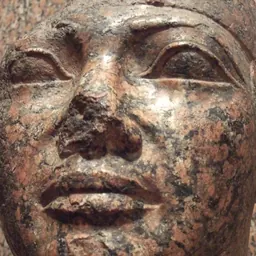
The two snakes in the crown of pharaoh Taharqa show that he was the king of both the lands of Egypt and Nubia.
Monuments of Taharqa
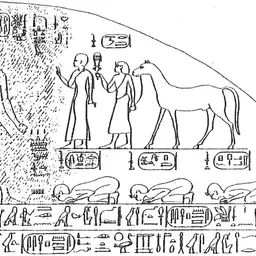
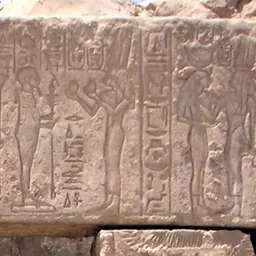
Stele commemorating the death of an Apis bull enthroned in "Year 26 of Taharqa". Found in the Serapeum of Saqqara, Saqqara. Louvre Museum. Stele of the Great Temple of Tanis, written in the "Year 6 of Taharqa" Taharqa has left monuments throughout Egypt and Nubia. In Memphis, Thebes, and Napata he rebuilt or restored the Temple of Amon.
Taharqa in Karnak Taharqa is known for various monuments in Karnak.
Shrine of Taharqa in Kawa
A small temple of Taharqa was once located at Kawa in Nubia (modern Sudan). It is located today in the Ashmolean Museum.
Taharqa in Jebel Barkal Taharqa is depicted in various reliefs in Jebel Barkal, particularly in the Temple of Mut.
Museum artifacts
Don’t just read it —
keep it.
Full-length biographies made to live with: read them, listen on the way to work, watch them tonight.
- E-book
- Audio
- Video
Instant download · yours to keep · every purchase keeps this site free
Important facts
People in Taharqa's life
Named in this biography and alive at the same time
Related people
Same field, nearest in time





Contemporaries
People whose lives overlapped Taharqa's

Frequently asked questions
Who was Taharqa?
Egyptian Pharaoh of the 25th dynasty
When was Taharqa born?
Taharqa was born in 720 BC.
When did Taharqa die?
Taharqa died in 664 BC.
What was Taharqa's occupation?
Taharqa was a statesperson.
What nationality was Taharqa?
Taharqa was Egyptian.
Sources & further reading
Cite this page
APA: Biography.guide. (2026). Taharqa. https://biography.guide/taharqa/
MLA: "Taharqa." Biography.guide, https://biography.guide/taharqa/.
Chicago: "Taharqa." Biography.guide. https://biography.guide/taharqa/.
Data last updated: 2026-09-27 · Spot an error? Report a correction.
Page generated 2026-09-27 05:17 UTC