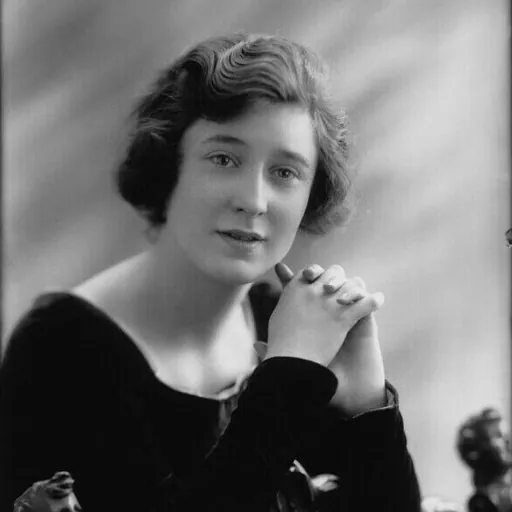
About Sylvia Cecil
Lived 1898 – 1983 (aged 84–85). Sylvia Cecil was an opera singer.
Sylvia Cecil (c. 1898 – c. 1983) was an English singer and actress. She began her career in the Gilbert and Sullivan operas with the D'Oyly Carte Opera Company, with whom she performed, off and on, from 1918 until 1937. She also performed in musical theatre, concerts, music hall and variety from 1921, and broadcast on radio. In the 1940s and 1950s she starred in several musicals by Ivor Novello and Noël Coward.
Biography Cecil was born in London. She was educated at St Clement Danes Grammar School, Holborn, and then studied for the stage with Clive Currie and at the Guildhall School of Music. During the following year she played Silvius in As You Like It and Helena in A Midsummer Night's Dream. In 1919 she added the principal soprano roles of Patience in Patience, the title role in Princess Ida (recreating that role for the company's first London revival of the opera in 1919), Yum-Yum in The Mikado, Elsie Maynard in The Yeomen of the Guard and Casilda in The Gondoliers. In 1920, she added to her repertory the role of Rose Maybud in Ruddigore, recreating the role when the opera was revived for the first time in Glasgow and then in London. but Neville Cardus in The Manchester Guardian thought her Yum-Yum, "not quite in the right key.... She sang rather finely but her song at the beginning of Act II does not ask for a full-blown concert method." Another critic of the same paper thought her voice "a little light" for Patience, but added that "she has gaiety and charm, and that is much."
Cecil left the D'Oyly Carte Opera Company in 1921 and began to perform in musical comedy. In 1922 she played Paula in Angel Face by Victor Herbert. In 1928, she played Flora Campbell in Blue Eyes at the then-new Piccadilly Theatre. She rejoined the D'Oyly Carte Opera Company for the first half of 1930, playing the roles of Josephine in H.M.S. Pinafore, Mabel in The Pirates of Penzance, Yum-Yum in The Mikado, Rose Maybud in Ruddigore and Gianetta in The Gondoliers.
Cecil performed with The Co-Optimists troupe in 1931. She also performed in music hall and variety in the early 1930s. In 1935, she starred in Shout for Joy at the Blackpool Opera House. She also began singing on the radio in the 1930s.
Cecil rejoined the D'Oyly Carte Opera Company again in 1936. During D'Oyly Carte's 36-week American tour, she played Josephine, Patience, Ida, Yum-Yum, Elsie and Gianetta. During that tour she and Derek Oldham were released by the company for one night to sing a programme of classical and popular favourites, including "Prithee, pretty maiden" from Patience, the evening before President Roosevelt's 2nd inauguration, at a party at the White House. She continued with the company until mid-1937, playing the same roles as she had played on the American tour. In 1941, she appeared in the film Inspector Hornleigh Goes To It (released in the US as Mail Train). In the same year she played Phyllis in a BBC broadcast of Iolanthe, with Bobbie Comber as the Lord Chancellor and Derek Oldham as Tolloller. Together with Martyn Green, she toured Variety Halls during the early years of World War II. They called their act Words with Music, featuring songs from Gilbert and Sullivan. On the Home Service she took part in a six-part series on Gilbert and Sullivan written by Leslie Baily, and a series featuring Ivor Novello's music, appearing alongside Olive Gilbert and Novello. She next starred as Rosa Cariatanza in Pacific 1860 by Noël Coward opposite Mary Martin in 1946. Theatre World wrote of her performance, "it stirs the audience to a semblance of life". In 1948–49 she toured in a long-running revival of Novello's Glamorous Night. In 1953 she appeared in Novello's King's Rhapsody. The Manchester Guardian said, "The production ... is worth seeing for the performance of Sylvia Cecil. While all the rest of the cast are straining every sinew to put their parts over (and showing it), Miss Cecil gives the impression of playing with no effort at all. She makes no attempt to take the limelight, but succeeds in being more convincing than all the rest put together. It is a brilliant performance." In 1955, Cecil sang in a revival of Novello's The Dancing Years staged on ice with a cast of 80 skaters.
Cecil appeared at the Savoy Theatre in 1975 with other former members of the D'Oyly Carte Opera Company in the chorus of Trial by Jury at the last night Centenary production of that opera. After the performance, she spoke before the curtain thanking the audience on behalf of the "old favourites" for their warm reception.
Notes, references and sources
Don’t just read it —
keep it.
Full-length biographies made to live with: read them, listen on the way to work, watch them tonight.
- E-book
- Audio
- Video
Instant download · yours to keep · every purchase keeps this site free
Important facts
People in Sylvia Cecil's life
Named in this biography and alive at the same time





Related people
Same field, nearest in time



Contemporaries
People whose lives overlapped Sylvia Cecil's



Frequently asked questions
Who was Sylvia Cecil?
singer and actress (1898–1983)
When was Sylvia Cecil born?
Sylvia Cecil was born in 1898.
When did Sylvia Cecil die?
Sylvia Cecil died on 11 September 1983.
What was Sylvia Cecil's occupation?
Sylvia Cecil was an opera singer.
Sources & further reading
Cite this page
APA: Biography.guide. (2026). Sylvia Cecil. https://biography.guide/sylvia-cecil/
MLA: "Sylvia Cecil." Biography.guide, https://biography.guide/sylvia-cecil/.
Chicago: "Sylvia Cecil." Biography.guide. https://biography.guide/sylvia-cecil/.
Data last updated: 2026-09-20 · Spot an error? Report a correction.
Portrait: Wikimedia Commons · author & licence
Page generated 2026-09-27 04:57 UTC