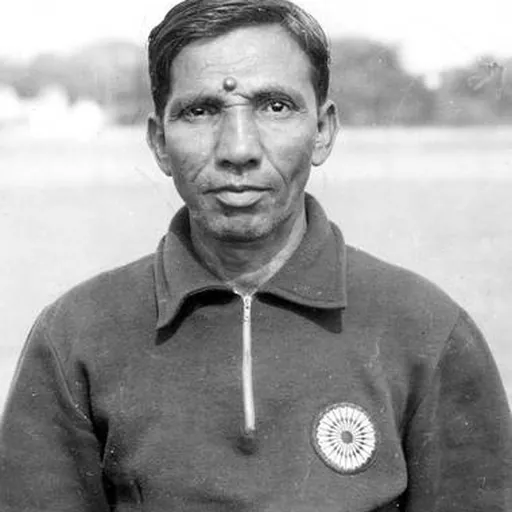
Syed Abdul Rahim
Manager of the India national football team, 1950 to 1963
About Syed Abdul Rahim
Lived 1909 – 1963 (aged 53). Syed Abdul Rahim was an Indian association football player and association football coach.
Syed Abdul Rahim (, 17 August 1909 – 11 June 1963), popularly known as Rahim Saab, was an Indian football coach and manager of the India national team from 1950 until his death in 1963, and a former player. He is regarded as the architect of modern Indian football. A teacher by profession, he was a strong motivator and his tenure as a coach is regarded as the "golden age" of football in India.
Under his stewardship, the India national team earned superiority in both technical qualities and tactical innovations, and got the nickname "Brazil of Asia". They went on to win gold medals in Asian Games of—(1951-Delhi and 1962-Jakarta), played semi-finals of the Summer Olympics—(1956-Melbourne) making India the first ever Asian country to achieve this place, win the titles of Asian Quadrangular Football Tournament for the years of—(1952-Colombo and 1954-Calcutta and came runners-up in Pestabola Merdeka—(1959 Kuala Lumpur).
Playing career Rahim was born on 17 August 1909 in Hyderabad, Hyderabad State, British India. In his early years, he worked as a school teacher. He also played for a team named "Eleven Hunters", consisting of then enrolled and former students of the college. Rahim also played for the Dutch Amateur League club HSV Hoek in the Netherlands, before going on to become a manager.
Football administration
When playing domestic football, Rahim along with Indian sports pioneer Syed Mohammad Hadi, became associated with activities related to football organization in Hyderabad State. In 1943, Rahim was elected secretary of HFA, while Ghulam Muhammad was elected as the first President in 1942. During the tenure of then AIFF vice-president Shiv Kumar Lal, both Andhra (incepted later) and Hyderabad Football Associations were merged to form Andhra Pradesh Football Association (APFA).
Managerial career Hyderabad City Police In 1950, Rahim joined Hyderabad City Police Club as coach. He succeeded Norbert Andrew Fruvall for the post. He managed the team from 1950 until his death in 1963. The Hyderabadi club won five consecutive Rovers Cups during his tenure from 1950 to 1955. He also took his team to five Durand Cup finals, winning three of them. At the 1958–59 edition, Hyderabad were on the verge of a hat-trick of Santosh Trophy titles in Madras, but went down 5–2 to Services in semi-finals. Rahim's first assignment as the coach of India was to train the team that toured Ceylon in 1949. became one of the best teams in Asia. In March 1951, at the inaugural 1951 Asian Games in New Delhi, Rahim helped India in winning the gold medal. They defeated Iran 1–0 in the gold medal match to gain their first trophy, as Sheoo Mewalal finished the tournament as top scorer. In 1954, noted British manager Bert Flatley became Rahim's assistant at the 1954 Asian Quadrangular Football Tournament.
During Rahim's tenure, the Indian football team enjoyed a great deal of success. India also reached the semi-finals of the 1956 Melbourne Olympics which is still considered India's greatest ever achievement in football. Under his coaching at that tournament, players like Neville D'Souza, Samar Banerjee, P. K. Banerjee, J. Krishnaswamy achieved fame worldwide. At the 1960 Summer Olympics in Rome, India lost to Hungary 2–1 in their first game, with Balaram scoring the consolation goal in the 79th minute. India almost upset 1958 FIFA World Cup semi-finalists France few days later, in which Balaram's goal gave the lead to India but a mistake from Ram Bahadur Thapa denied India a famous victory. He is also credited for bringing up and nurturing Indian talents during his tenure, including Peter Thangaraj, Nikhil Nandy, Kesto Pal, Chuni Goswami, Jarnail Singh, Tulsidas Balaram, Sheikh Abdul Latif, Mariappa Kempaiah, Dharmalingam Kannan, Hussain Ahmed, Mohammed Rahmatullah, Yousuf Khan, Arun Ghosh, Nikhil Nandy, and Amal Dutta. Rahim was succeeded by English coach Harry Wright in 1964, who led the side to the runners-up spot in the 1964 Asian Cup.
Tactics and style
Rahim is considered to be the greatest football coach India has ever produced. His tenure is considered as a "Golden age" of Indian football. Rahim was a teacher in his early career and coached Hyderabad City Police FC, which made him a strict disciplinarian and a good tactician. Utilizing the available resources, he made the best out of them by conducting non-dribbling and weaker leg (the players supposedly play with their weaker foot) tournaments to improve one-touch play.
Rahim introduced the classic 4–2–4 formation in Indian football team much before Brazil popularised it in the 1958 World Cup.
The 1962 Asian Games was Rahim's final major tournament, winning a 2–1 victory over South Korea.
Former Indian international Mohammed Zulfiqaruddin said about Rahim, as: He was a master at work. He made the Indian football team a formidable unit. He had the uncanny ability of spotting talent and turning them into solid players. But he was a strict disciplinarian. who represented India at the 1960 Summer Olympics. Hakim also worked as a FIFA official, a squadron leader in the Indian Air Force, and a referee. He later managed the national team like his father, and was a recipient of the Dhyan Chand Award.
Death Rahim died of lung cancer on 12 June 1963 after being bed-ridden for six months.
Legacy
A former Indian football player Fortunato Franco said about "Rahim Saab"; With him he took Indian Football to the grave.
In memory of Rahim, the I-League "Best Coach Award" is renamed as "Syed Abdul Rahim Award", given to the best coach in each season by the All India Football Federation (AIFF).
In popular culture A biopic on Rahim named Maidaan, directed by Amit Sharma, with Ajay Devgn as Rahim in lead role, was released theatrically on Eid al-Fitr 2024.
Honours Managerial Hyderabad City Police Durand Cup: 1950–51, 1954, 1957–58, 1961; runner-up: 1952, 1956–57 Rovers Cup: 1950, 1951, 1952, 1953, 1954, 1957, 1960, 1962 DCM Trophy: 1959
India Asian Games Gold Medal: 1951, 1962 Asian Quadrangular Football Tournament: 1952, 1954 Merdeka Cup runners-up: 1959
Hyderabad State Santosh Trophy: 1956–57, 1957–58
Don’t just read it —
keep it.
Full-length biographies made to live with: read them, listen on the way to work, watch them tonight.
- E-book
- Audio
- Video
Instant download · yours to keep · every purchase keeps this site free
Important facts
People in Syed Abdul Rahim's life
Named in this biography and alive at the same time







Related people
Same field, nearest in time


Contemporaries
People whose lives overlapped Syed Abdul Rahim's


Frequently asked questions
Who was Syed Abdul Rahim?
Manager of the India national football team, 1950 to 1963
When was Syed Abdul Rahim born?
Syed Abdul Rahim was born on 17 August 1909 in Hyderabad.
When did Syed Abdul Rahim die?
Syed Abdul Rahim died on 11 June 1963 in Hyderabad.
What was Syed Abdul Rahim's occupation?
Syed Abdul Rahim was an association football player and association football coach.
What nationality was Syed Abdul Rahim?
Syed Abdul Rahim was Indian.
Sources & further reading
Cite this page
APA: Biography.guide. (2026). Syed Abdul Rahim. https://biography.guide/syed-abdul-rahim/
MLA: "Syed Abdul Rahim." Biography.guide, https://biography.guide/syed-abdul-rahim/.
Chicago: "Syed Abdul Rahim." Biography.guide. https://biography.guide/syed-abdul-rahim/.
Data last updated: 2026-09-22 · Spot an error? Report a correction.
Portrait: Wikimedia Commons · author & licence
Page generated 2026-09-27 05:01 UTC