
About Sydney March
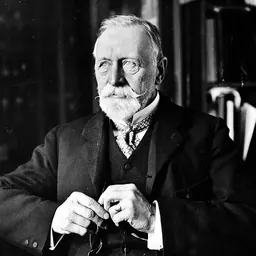
Lived 1876 – 1968 (aged 91–92). Sydney March was a British sculptor.
Sydney March (1876–1968) was an English sculptor. His primary focus was portrait busts and other sculptures of British royalty and contemporary figures, as well as war memorials. The second-born of eight artists in his family, he and his siblings completed the National War Memorial of Canada after the death of their brother Vernon March in 1930, who had created the winning design. It is the site in Ottawa of annual Remembrance Day ceremonies.
Among his many commissions, Sydney March also made a memorial to United Empire Loyalists, which was erected in 1929 in Hamilton, Ontario. Several of the siblings never married; they lived and worked together at "Goddendene", a 17-room house in Farnborough, Kent, England. They had three large studios and an iron foundry on the grounds.
Background
Sydney March, son of George Henry March and his wife Elizabeth Blenkin, was born in 1876 in Stoneferry, a suburb of Kingston upon Hull, in the East Riding of Yorkshire, England. He was the second of nine children, eight of whom became artists. At the time of the 1891 census, March was working as a monumental sculptor's apprentice. His father was a seed crusher foreman (oil miller).
By 1901, the family had moved to Battersea, London, where his father was employed as a builder's clerk. March studied at the Royal Academy Schools. Three of the March children became sculptors: Sydney, Elsie, and Vernon.
By 1911, all nine siblings, as yet unmarried, were living together in the 17-room house "Goddendene" in Farnborough, Kent, England. Only two of the March siblings married; between them, they had three children. Eva married Charles Francis Newman in 1916. They had a daughter, Heather. Frederick March married Agnes Annie Gow in 1926. They had two children, Elizabeth and Cecil.
Career
March and his siblings established studios at the family home of Goddendene in Locksbottom, Farnborough after 1901.
In 1900, the Royal Academy Schools awarded Sydney March first prize, a silver medal, for a model of a statue or group. One of March's first commissions was a bust of Edward VII. This prompted a visit by the British royal family to the family home of Goddendene. Bronze portrait bust of "Cecil John Rhodes" (1853–1902), South African imperialist and statesman, 1901, held in the National Portrait Gallery since 1960. Monument to Colonel Samuel Bourne Bevington, philanthropist, first mayor of Bermondsey, bronze statue in mayoral robes on stone base, erected 1910, on Tooley Street in London. Listed as a Grade II structure on the National Heritage List for England on 27 September 1972 and amended on 17 September 1998. Equestrian statue of Lord Kitchener, Commander in Chief of the Indian Army, 1914, installed in Calcutta. Bronze bust of Field Marshal Sir John French, 1st Earl of Ypres (1857–1925), commander of the British Expeditionary Force from August 1914 to December 1915, produced during WWI. Bromley Parish Church Memorial, to commemorate the parishioners who died in World War I, 1921, at Saint Peter and Saint Paul Church on Church Road in Bromley, Kent. Bromley War Memorial, square obelisk constructed of Portland stone with three bronze figures, which represent Liberty, Victory, and Peace. Victory in the center, winged and holding a laurel wreath. Flanked by Liberty, with a torch, and Peace, with flowers of remembrance. At Martin's Hill on Glassmill Lane in Bromley, Kent. Erected 1922. Listed as a Grade II structure on the National Heritage List for England on 14 December 1995. United Empire Loyalist Monument, unveiled on Empire Day 23 May 1929, at Prince's Square on Main Street East in Hamilton, Ontario. Gift to the city of Hamilton from Stanley Mills. The basis of a commemorative plate issued in 1932. Also the basis of a stamp issued on Dominion Day, 1 July 1934. Unveiled for the second time on 25 June 1958 by Governor General Vincent Massey. Depicts a family of Loyalists just after drawing their lot number from the surveyor. Described by Hugh Meller, author of London Cemeteries: An Illustrated Guide & Gazetteer, as "arguably the most dramatic sculpture in any of London's cemeteries." The title of the piece is "The Angel of Death".
National War Memorial of Canada
The March siblings often collaborated on their art pieces. The best known example of this is The Response, the National War Memorial of Canada in Ottawa, Ontario. Sydney's brother Vernon March, after a world-wide competition in 1925, was one of seven finalists of a field of 127 entrants. The seven finalists submitted scale models of their proposed designs. Vernon was awarded the commission in January 1926. Vernon March's design included bronze figures of Victory and Liberty on top of a granite arch. Below the arch, at the rear, is an unlimbered cannon. The monument includes 22 bronze figures under the arch, representing the branches of the Canadian forces during World War I.
Vernon March died of pneumonia in 1930, before the monument had been completed. It was initially positioned on High Street in Omagh, County Tyrone, where it was unveiled by the Duchess of Abercorn on 25 November 1904. Considered a traffic hazard as traffic increased greatly, it was relocated in 1964 to Drumragh Avenue in Omagh.
Other art pieces on which the March family collaborated include the Lewes War Memorial, located at School Hill on High Street in Lewes, East Sussex, England. Vernon March was the primary sculptor. The war memorial features a central obelisk of Portland stone, upon which an angel representing Victory is perched, her arms raised, one hand holding a laurel wreath. Other bronze angels sit at the base of the monument; adjacent shields list the names of the deceased soldiers of World War I. The monument includes a bronze figure of Victory standing on a globe, with serpents at her feet. In addition, bronze plaques listed the names of the deceased soldiers, as well as those from the gas company who served.
Death
Sydney March died at age 92 in the second quarter of 1968 in the county of Kent, England. Most of the members of the March family, including parents George and Elizabeth, are interred at Saint Giles the Abbot Churchyard in Farnborough, Kent. Sydney's ashes were buried in the family plot on 22 June 1968. In 1922, Sydney had sculpted the bronze angel that marks the family graves.
Legacy
The March artists were widely known in their time. A black-and-white, silent movie was filmed in 1924 that explored the March artists at work in their studios at Goddendene. It has been reproduced by British Pathé.
In April 2011, the Chelsfield Village Voice, the monthly newsletter for the village of Chelsfield in the London Borough of Bromley, reported a recent talk on the March family of artists by local historian and author Paul Rason at the area historical society. He accompanied his lecture with photographs, including one of Sydney's equestrian statue of Lord Kitchener during construction. He had photographs of the March family home of Goddendene, and images of the bronze figures of the National War Memorial of Canada.
In 2011, an exhibition was held at the Bromley Museum at The Priory on Church Hill in Orpington. Featuring the work of local artists, the exhibit included scale models made by artists of the March family.
The National War Memorial of Canada has been the location for Canada's annual National Remembrance Day celebration since 1939. The original model for the National War Memorial is displayed in the Royal Canadian Legion Hall of Honour in the Canadian War Museum in Ottawa (pictured).
Don’t just read it —
keep it.
Full-length biographies made to live with: read them, listen on the way to work, watch them tonight.
- E-book
- Audio
- Video
Instant download · yours to keep · every purchase keeps this site free
Important facts
People in Sydney March's life
Named in this biography and alive at the same time





Related people
Same field, nearest in time


Contemporaries
People whose lives overlapped Sydney March's
Frequently asked questions
Who was Sydney March?
British artist (1876–1968)
When was Sydney March born?
Sydney March was born in 1876 in Stoneferry.
When did Sydney March die?
Sydney March died in 1968 in Kent.
What was Sydney March's occupation?
Sydney March was a sculptor.
What nationality was Sydney March?
Sydney March was British.
Sources & further reading
Cite this page
APA: Biography.guide. (2026). Sydney March. https://biography.guide/sydney-march/
MLA: "Sydney March." Biography.guide, https://biography.guide/sydney-march/.
Chicago: "Sydney March." Biography.guide. https://biography.guide/sydney-march/.
Data last updated: 2026-09-20 · Spot an error? Report a correction.
Page generated 2026-09-27 05:20 UTC