
Svetozar Boroević
Austro-Hungarian field marshal
About Svetozar Boroević
Lived 1856 – 1920 (aged 63). Svetozar Boroević was an Austrian military personnel, university teacher and general field marshal.
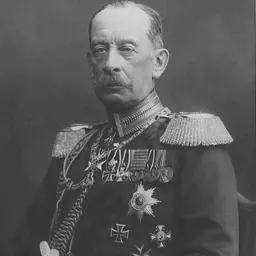
Svetozar Boroević von Bojna (or Borojević) (13 December 1856 – 23 May 1920) was an Austro-Hungarian field marshal who was described as one of the finest defensive strategists of the First World War. He commanded Austro-Hungarian forces in the Isonzo front, for which he was nicknamed the "Lion of Isonzo".
For his service during the First World War, Boroević rose to the rank of Feldmarschall before the end of the war in 1918, becoming the first and only Austro-Hungarian field marshal of South Slavic descent.
Life Early life Boroević was born to a Serbian Orthodox family on 13 December 1856 in the village of Umetić, Croatian Military Frontier. He was baptized in the Serbian Orthodox Church, most likely in the parish church in Mečenčani, where his father served. His father Adam Boroević was a Grenzer (border guard) officer, his mother was Stana (née Kovarbašić von Zborište). As an old man, Boroević's father had built a Serbian Orthodox church as his endowment in Mečenčani, which was consecrated in 1877. Boroević had a brother, Nikola, a colonel who also received Austrian noble status in 1917.
Some sources state that Boroević was an ethnic Serb or of Serb origin. Other sources regard him as an ethnic Croat or of Croat origin. Boroević himself stated that he was a Croat and that Croatia was his homeland.
Military career Early career He joined cadet school at the age of ten. After finishing grade school he moved to Kamenica and later Graz where he studied in military academies. After graduating from Military School he served as a Junior Officer in the army. He advanced quickly through the ranks. He was a corporal in 1872, and later on May 1, 1875, he became a lieutenant. He became the commander of the Sixth Corps of the I & R Army in April 1912 and on May 1, 1913, General of the Infantry. He would fight at the Battle of Komarów. He finished building defenses and managing the logistics of his army by the end of May. While there, Boroević's troops contained eleven Italian attacks and he was hailed as the Knight of Isonzo in Austria-Hungary, while his soldiers adored him and called him Naš Sveto! ("Our Sveto!"). For valor in combat, he was promoted to the rank of Generaloberst on 1 May 1916. On 23 August 1917 he rose to the position of commander of the Southwestern Front, which was later renamed Army Group Boroević. He would later fight at the Battle of Caporetto. The front was maintained until end of October 1918, when the Italian army launched the decisive offensive of Vittorio Veneto and non-Austrian troops left their positions following the secessions of their nations from the dual monarchy (Czechs on 28 October, South Slavs on 29 October, Slovaks on 30 October, Hungary on 31 October). After that Boroević fell back to Velden, where he sent a telegram to the Emperor offering to march on Vienna to fight the anti-Habsburg revolution in the imperial capital. It is not certain whether the Emperor was given this message (Boroević doubted it); the offer was refused on behalf of the Emperor. After the Imperial & Royal Army had been demobilized by the Emperor on 6 November, Boroević was retired, by the I & R War Ministry in liquidation, by 1 December 1918.
After the war
After the demise and disintegration of Austria-Hungary, Boroević decided to become a citizen of the newly created Kingdom of Serbs, Croats and Slovenes. He was not welcome despite offering his services to the National Council of Slovenes, Croats and Serbs. So he stayed in Carinthia, now Austria's southernmost state; his personal belongings, which were on transport in Slovenia, the former Austrian crownland of Carniola, were confiscated there. Boroević could not understand the mean treatment he had to experience, "the only field marshal the Southern Slavs had ever produced", as he wrote in his memoirs.
Boroević died in a hospital at Klagenfurt, the capital city of Carinthia. His body was transferred to Vienna where he was entombed at the Central Cemetery (Grave no. 62 in the New Arcades to the right of the Church of St. Charles Borromeo). The grave had been paid for by the former emperor Charles, who lived in Switzerland then. He could not take part in the funeral, since he had been banished from Austria for his lifetime by the Habsburg Law since 3 April 1919.
Honors Honorary degree In 1916, with the approval of the Emperor Franz Joseph I, on the proposal of the Faculty of Law and the Senate of the University of Zagreb, Svetozar Borojević and Archduke Eugen were awarded the university's highest honorary degree, Doctor Honoris Causa in the field of social sciences, for their victory over the enemy and especially for the protection of hereditary grudge, and rights and cultural progress of Croats ("Ob eximia in limitibus imperii strenue defendendis ac imprimis in Croatum paterno solo iuribus atque litterarum et artium progressu tuendis merita"). The award ceremonies were held on 30 January 1916 (for Archduke Eugen) and 1 February 1916 (for Svetozar Borojević) at the Fifth Army's military apartment, 305 Military Field Post on the Italian front. Delegation for the award was made of Josip Šilović; Milorad Stražnicki, dean of the Faculty of Law; Fran Barac, rector; Robert Frangeš-Mihanović, sculptor; and Andrija Kišur, clerk.
Honorary citizenship Croatia Honorary citizen of Karlovac, 1915. Honorary citizen of Sinj, November 1915; Sinj Municipality Council determined that the most beautiful street in the city would bear his name. Honorary citizen of Požega, Slavonski Brod and Varaždin, November 1915. Honorary citizen of Pazin, 5 May 1916. On 13 August 1919, during the occupation of Istria by the Kingdom of Italy, the City Assembly revoked his title. Honorary citizen of Janjina municipality, May 1917. Slovenia Honorary citizen of Ljubljana, August 1915; revoked in 1919, returned in 2009. Honorary citizen of Ajdovščina (1915), Renče and Goče (1916), Vitovlje (1916), Šempas, Sežana.
Don’t just read it —
keep it.
Full-length biographies made to live with: read them, listen on the way to work, watch them tonight.
- E-book
- Audio
- Video
Instant download · yours to keep · every purchase keeps this site free
Important facts
People in Svetozar Boroević's life
Named in this biography and alive at the same time
Related people
Same field, nearest in time



Contemporaries
People whose lives overlapped Svetozar Boroević's



Frequently asked questions
Who was Svetozar Boroević?
Austro-Hungarian field marshal
When was Svetozar Boroević born?
Svetozar Boroević was born on 13 December 1856 in Mečenčani.
When did Svetozar Boroević die?
Svetozar Boroević died on 23 May 1920 in Klagenfurt am Wörthersee.
What was Svetozar Boroević's occupation?
Svetozar Boroević was a military personnel, university teacher and general field marshal.
What nationality was Svetozar Boroević?
Svetozar Boroević was Austrian.
Sources & further reading
· Wikipedia: Svetozar Boroević
Cite this page
APA: Biography.guide. (2026). Svetozar Boroević. https://biography.guide/svetozar-boroevic/
MLA: "Svetozar Boroević." Biography.guide, https://biography.guide/svetozar-boroevic/.
Chicago: "Svetozar Boroević." Biography.guide. https://biography.guide/svetozar-boroevic/.
Data last updated: 2026-09-20 · Spot an error? Report a correction.
Page generated 2026-09-27 05:22 UTC