
About Susumu Kitagawa
Born 1951. Susumu Kitagawa is a Japanese chemist and university teacher.
is a Japanese Nobel Prize-winning chemist specializing in coordination chemistry, with a focus on organic–inorganic hybrid compounds and the chemical and physical properties of porous coordination polymers, particularly metal-organic frameworks. He is Distinguished Professor at Kyoto University's Institute for Integrated Cell-Material Sciences (iCeMS), which he co-founded. In 2025, he was awarded the Nobel Prize in Chemistry jointly with Richard Robson and Omar M. Yaghi.
Life
Kitagawa was born on 4 July 1951 in Kyoto.
He earned his PhD in hydrocarbon chemistry from Kyoto University in 1979, having completed his undergraduate studies at the same institution. That year, he was appointed assistant professor at Kindai University, where he was promoted to lecturer in 1983 and associate professor in 1988.
In 1992, he became professor of inorganic chemistry at Tokyo Metropolitan University. In 2024, he was appointed Executive Vice-President for Research Promotion at Kyoto University.
His overseas academic postings include a postdoctoral fellowship at Texas A&M University with F. Albert Cotton (1986–1987) and a guest professorship at the City University of New York (1996). He received an honorary doctorate from the Technical University of Munich in 2018.
Kitagawa served as a member and associate member of the Science Council of Japan from 2011 to 2023.
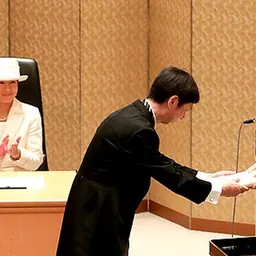
In 2025, Kitagawa, along with Richard Robson and Omar M. Yaghi, was awarded the Nobel Prize in Chemistry for their foundational work on molecular building blocks for metal-organic frameworks.
Research
Following the discoveries of Makoto Fujita (1994) and Omar M. Yaghi (1995), Kitagawa demonstrated in 1997 that coordination polymer structures possess gas adsorption properties, a key finding for the development of functional porous materials.
His most influential works include: A 1997 seminal report on a porous coordination polymer (MOF) for small molecule adsorption. A 2004 early review of functional porous coordination polymers. A 2009 review of "soft porous crystals," which feature large-scale structural transformability upon chemical or physical stimulation.
Awards
2003 – Chemical Society of Japan (CSJ) Prize for Creative Work 2010 – Thomson Reuters Citation Laureates 2011 – Medal with Purple Ribbon 2013 – De Gennes Prize 2016 – Japan Academy Prize 2016 – Fred Basolo Medal, Northwestern University 2017 – Chemistry for the Future Solvay Prize 2017 – Fujihara Award, The Fujihara Foundation of Science 2019 – Grand Prix de la Fondation de la Maison de la Chimie 2019 – Emanuel Merck Lectureship 2019 – Member of the Japan Academy 2023 – Fellow of the Royal Society 2025 – Nobel Prize in Chemistry 2025 – Order of Culture
Don’t just read it —
keep it.
Full-length biographies made to live with: read them, listen on the way to work, watch them tonight.
- E-book
- Audio
- Video
Instant download · yours to keep · every purchase keeps this site free
Important facts
People in Susumu Kitagawa's life
Named in this biography and alive at the same time



Related people
Same field, nearest in time



Contemporaries
People whose lives overlapped Susumu Kitagawa's


Frequently asked questions
Who is Susumu Kitagawa?
Japanese chemist
When was Susumu Kitagawa born?
Susumu Kitagawa was born on 4 July 1951 in Kyoto.
What is Susumu Kitagawa's occupation?
Susumu Kitagawa is a chemist and university teacher.
What nationality is Susumu Kitagawa?
Susumu Kitagawa is Japanese.
Sources & further reading
Cite this page
APA: Biography.guide. (2026). Susumu Kitagawa. https://biography.guide/susumu-kitagawa/
MLA: "Susumu Kitagawa." Biography.guide, https://biography.guide/susumu-kitagawa/.
Chicago: "Susumu Kitagawa." Biography.guide. https://biography.guide/susumu-kitagawa/.
Data last updated: 2026-09-27 · Spot an error? Report a correction.
Page generated 2026-09-27 05:17 UTC