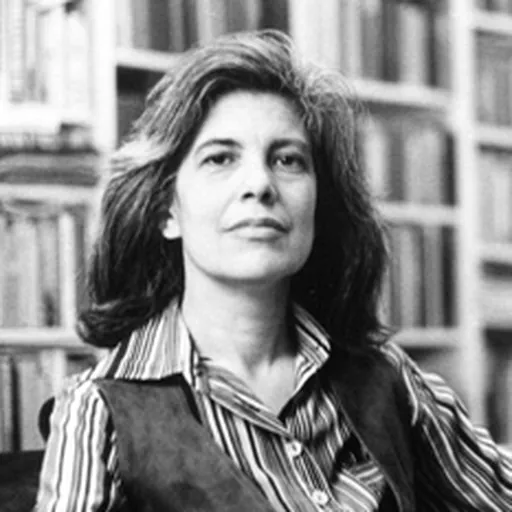
Susan Sontag
American writer and filmmaker, professor, and activist
About Susan Sontag
Lived 1933 – 2004 (aged 71). Susan Sontag was an American writer, film director, screenwriter, professor, essayist and novelist.
Early life and education Sontag was born Susan Rosenblatt in New York City, the daughter of Mildred (née Jacobson) and Jack Rosenblatt, both Jews of Lithuanian and Polish descent. Her father managed a fur trading business in Tianjin, China, where he died of tuberculosis in 1939, when Susan was five years old. Seven years later, Sontag's mother married U.S. Army Captain Nathan Sontag. Susan and her sister, Judith, took their stepfather's surname, although he did not adopt them formally.
Remembering an unhappy childhood, with a cold, alcoholic, distant mother who was "always away", Sontag lived on Long Island, New York, While at Chicago, she became close friends with fellow student Mike Nichols. In 1951, her work appeared in print for the first time in the winter issue of the Chicago Review.
At 17, Sontag married writer Philip Rieff, a sociology instructor at the University of Chicago, after a 10-day courtship; their marriage lasted eight years. While studying at Chicago, Sontag attended a summer school taught by the sociologist Hans Gerth, who became a friend and influenced her study of German thinkers. Upon completing her Chicago degree, Sontag taught freshman English at the University of Connecticut for the 1952–53 academic year. She attended Harvard University for graduate school, initially studying literature with Perry Miller and Harry Levin before moving into philosophy and theology under Paul Tillich, Jacob Taubes, Raphael Demos, and Morton White.
After completing her Master of Arts in philosophy, Sontag began doctoral research in metaphysics, ethics, Greek philosophy, Continental philosophy, and theology at Harvard. The philosopher Herbert Marcuse lived with Sontag and Rieff for a year while working on his 1955 book Eros and Civilization. Sontag researched for Rieff's 1959 study Freud: The Mind of the Moralist before their divorce in 1958, and contributed to the book to such an extent that she has been considered an unofficial co-author. The couple had a son, David Rieff, who went on to be his mother's editor at Farrar, Straus and Giroux, as well as a writer in his own right. According to Sontag's biographer Benjamin Moser, Sontag was the true author of the text on Freud, which she wrote after David's birth, and in the separation the latter was the subject of an exchange: she handed over the authorship of the book to Rieff, he gave her their son.
Sontag was awarded an American Association of University Women's fellowship for the 1957–58 academic year to St Anne's College, Oxford, where she traveled without her husband and son. There, she had classes with Iris Murdoch, Stuart Hampshire, A. J. Ayer, and H. L. A. Hart while also attending the B. Phil seminars of J. L. Austin and the lectures of Isaiah Berlin. But Oxford did not appeal to her, and she transferred after Michaelmas term of 1957 to the University of Paris (the Sorbonne). In Paris, Sontag socialized with expatriate artists and academics including Allan Bloom, Jean Wahl, Alfred Chester, Harriet Sohmers, and María Irene Fornés. She remarked that her time in Paris was perhaps the most important period of her life. She moved to New York in 1959 to live with Fornés for the next seven years, regaining custody of her son She wrote and directed four films and also wrote several plays, the most successful of which were Alice in Bed and Lady from the Sea.
Nonfiction High and low in mass culture
It was through her essays that Sontag gained early fame and notoriety. She frequently wrote about the intersection of high and low art and expanded the dichotomy concept of form and art in every medium. She elevated camp to the status of recognition with her widely read 1964 essay "Notes on 'Camp'", which accepted art as including common, absurd, and burlesque themes.
The concept of photography image In 1977, Sontag published the series of essays On Photography. These essays are an exploration of photographs as a collection of the world, mainly by travelers or tourists, and the way we experience it. In the essays, she outlined her theory of taking pictures as you travel: The method especially appeals to people handicapped by a ruthless work ethic—Germans, Japanese and Americans. Using a camera appeases the anxiety which the work driven feel about not working when they are on vacation and supposed to be having fun. They have something to do that is like a friendly imitation of work: they can take pictures. (p. 10)
Sontag writes that the convenience of modern photography has created an overabundance of visual material, and "just about everything has been photographed". This has altered our expectations of what we have the right to view, want to view, or should view.
Ethic and the problem of norms Ethical intentions are key points for Sontag. In her book On Photography Discussing photographs of Diane Arbus, Sontag writes on borders and landmarks of the photo program of beauty. Beauty is the ground of the photography program and at the same time one of the biggest conceptual questions of photography. The problem of identification of beauty and ugliness forms one more question—the idea of norm.
"In teaching us a new visual code, photographs alter and enlarge our notion of what is worth looking at and what we have the right to observe" and has changed our "viewing ethics".
According to journalist Mark M. Goldblatt, Sontag later made a "sarcastic retraction, saying the line slanders cancer patients". Patrick J. Buchanan said: "Rewrite that sentence with 'Jewish race' in place of 'white race' and the passage would fit nicely into Mein Kampf". According to Eliot Weinberger, "She came to regret that last phrase, and wrote a whole book against the use of illness as metaphor". But, he wrote, this did not lead to any "public curiosity about those who are not cancerously white", and "She may well have been the last unashamed Eurocentrist".
Allegations of plagiarism Ellen Lee accused Sontag of plagiarism after discovering at least 12 passages in In America that were similar to or copied from passages in four other books about Helena Modjeska without attribution. Sontag said of the passages, "All of us who deal with real characters in history transcribe and adopt original sources in the original domain. I've used these sources and I've completely transformed them. There's a larger argument to be made that all of literature is a series of references and allusions."
In a 2007 letter to the editor of the Times Literary Supplement, John Lavagnino identified an unattributed citation from Roland Barthes's 1970 essay "S/Z" in Sontag's 2004 speech "At the Same Time: The Novelist and Moral Reasoning", delivered as the Nadine Gordimer Lecture in March 2004. Further research led Lavagnino to identify several passages that appeared to have been taken without attribution from an essay on hypertext fiction by Laura Miller published in the New York Times Book Review six years earlier. Writing for the Observer, Michael Calderone interviewed Sontag's publisher, who said, "This was a speech, not a formal essay", and that "Susan herself never prepared it for publication".
On Communism At a New York pro-Solidarity rally in 1982, Sontag said that "people on the left", like herself, "have willingly or unwillingly told a lot of lies". She added that they:
Sontag's speech reportedly "drew boos and shouts from the audience". The Nation published her speech, excluding the passage contrasting the magazine with Reader's Digest. Responses to her statement were varied. Some said that Sontag's sentiments had been held by many on the left for years, while others accused her of betraying "radical ideas".
On the September 11 attacks Sontag was angrily criticized for what she wrote in the September 24, 2001, issue of The New Yorker about the immediate aftermath of 9/11. She called the attacks a "monstrous dose of reality" and criticized U.S. public officials and media commentators for trying to convince the American public that "everything is O.K." Specifically, she opposed the idea that the perpetrators were "cowards", a comment George W. Bush had made. Rather, she argued the country should see the terrorists' actions not as "a 'cowardly' attack on 'civilization' or 'liberty' or 'humanity' or 'the free world' but an attack on the world's self-proclaimed superpower, undertaken as a consequence of specific American alliances and actions."
Criticism from other writers In a 2000 article for Harper's Magazine'''s that was later included in his book Hooking Up, Tom Wolfe called Sontag "just another scribbler who spent her life signing up for protest meetings and lumbering to the podium encumbered by her prose style, which had a handicapped parking sticker valid at Partisan Review."
In "Sontag, Bloody Sontag", an essay in her 1994 book Vamps & Tramps, critic Camille Paglia describes her initial admiration of and subsequent disillusionment with Sontag. She makes several criticisms, including Harold Bloom's comment "Mere Sontagisme!" on Paglia's doctoral dissertation, and says that Sontag "had become synonymous with a shallow kind of hip posturing". Paglia also recounts a visit by Sontag to Bennington College, in which she arrived hours late and ignored the agreed-upon topic of the event.
Sontag's cool self-exile was a disaster for the American women's movement. Only a woman of her prestige could have performed the necessary critique and debunking of the first instant-canon feminist screeds, such as those by Kate Millett or Sandra Gilbert and Susan Gubar, whose middlebrow mediocrity crippled women's studies from the start ... No patriarchal villains held Sontag back; her failures are her own. — Camille Paglia
Activism Sontag became politically active in the 1960s, opposing the Vietnam War. In January 1968, she signed the "Writers and Editors War Tax Protest" pledge, vowing to refuse to pay a proposed 10% Vietnam War surtax. In May 1968, she visited Hanoi; afterward, she wrote favorably about North Vietnamese society in her essay Trip to Hanoi.
During 1989 Sontag was the President of PEN American Center, the main U.S. branch of the International PEN writers' organization. After Iranian leader Ayatollah Khomeini issued a fatwa death sentence against writer Salman Rushdie for blasphemy after the publication of his novel The Satanic Verses that year, Sontag's uncompromising support of Rushdie was crucial in rallying American writers to his cause.
A few years later, during the Siege of Sarajevo, Sontag gained attention for directing a production of Samuel Beckett's Waiting for Godot in a candlelit theater in the Bosnian capital, cut off from its electricity supply for three and a half years. The reaction of Sarajevo's besieged residents was noted:To the people of Sarajevo, Ms. Sontag has become a symbol, interviewed frequently by the local newspapers and television, invited to speak at gatherings everywhere, asked for autographs on the street. After the opening performance of the play, the city's Mayor, Muhamed Kreševljaković, came onstage to declare her an honorary citizen, the only foreigner other than the recently departed United Nations commander, Lieut. Gen. Phillippe Morillon, to be so named. "It is for your bravery, in coming here, living here, and working with us," he said.
Personal life Sontag's mother died of lung cancer in Hawaii in 1986. Her final illness has been chronicled by her son, David Rieff.
Sexuality and relationships
Sontag became aware of her bisexuality during her early teens. At 15, she wrote in her diary, "I feel I have lesbian tendencies (how reluctantly I write this)." At 16, she had a sexual encounter with a woman: "Perhaps I was drunk, after all, because it was so beautiful when H began making love to me... It had been 4:00 before we had gotten to bed... I became fully conscious that I desired her, she knew it, too."
Sontag lived with 'H', the writer and model Harriet Sohmers Zwerling, whom she first met at U. C. Berkeley from 1958 to 1959. Later, Sontag was the partner of María Irene Fornés, a Cuban-American avant garde playwright and director. Upon splitting with Fornés, she was involved with an Italian aristocrat, Carlotta Del Pezzo, and the German academic Eva Kollisch. Sontag was romantically involved with the American artists Jasper Johns and Paul Thek. During the early 1970s, she lived with Nicole Stéphane, a Rothschild banking heiress turned movie actress, and, later, the choreographer Lucinda Childs. Sontag also had a relationship with the writer Joseph Brodsky, who deepened her appreciation of the anti-communism of the writers persecuted by the Soviet regime, whom she had read and in some cases even known, without really understanding them.
With photographer Annie Leibovitz, Sontag maintained a close romantic relationship stretching from the later 1980s until her final years. Sontag and Leibovitz met in 1989, when both had already established notability in their careers. Leibovitz has suggested that Sontag mentored her and constructively criticized her work. During Sontag's lifetime, neither woman publicly disclosed whether the relationship was a friendship or romantic. Newsweek in 2006 made reference to Leibovitz's decade-plus relationship with Sontag: "The two first met in the late '80s, when Leibovitz photographed her for a book jacket. They never lived together, though they each had an apartment within view of the other's."
When interviewed for her 2006 book A Photographer's Life: 1990–2005, Leibovitz said the book told a number of stories, and that "with Susan, it was a love story." While The New York Times in 2009 referred to Sontag as Leibovitz's "companion", Leibovitz wrote in A Photographer's Life, "Words like 'companion' and 'partner' were not in our vocabulary. We were two people who helped each other through our lives. The closest word is still 'friend. The same year, Leibovitz said the descriptor "lover" was accurate. She later reiterated, "Call us 'lovers.' I like 'lovers.' You know, 'lovers' sounds romantic. I mean, I want to be perfectly clear. I love Susan."
In an interview in The Guardian in 2000, Sontag was open about bisexuality: 'Shall I tell you about getting older?', she says, and she is laughing. 'When you get older, 45 plus, men stop fancying you. Or put it another way, the men I fancy don't fancy me. I want a young man. I love beauty. So what's new?' She says she has been in love seven times in her life. 'No, hang on,' she says. 'Actually, it's nine. Five women, four men.' After Sontag's death, Newsweek published an article about Leibovitz that made clear references to her relationship with Sontag.
Legacy Following Sontag's death, Steve Wasserman of the Los Angeles Times called her "one of America's most influential intellectuals, internationally renowned for the passionate engagement and breadth of her critical intelligence and her ardent activism in the cause of human rights." Eric Homberger of The Guardian called Sontag "the 'Dark Lady' of American cultural life for over four decades."
Of Against Interpretation, Brandon Robshaw of The Independent later wrote that "Sontag was remarkably prescient; her project of analysing popular culture as well as high culture, the Doors as well as Dostoevsky, is now common practice throughout the educated world." In Critique and Postcritique (2017), Rita Felski and Elizabeth S. Anker argue that the title essay from the aforementioned collection played an important role in the field of postcritique, a movement within literary criticism and cultural studies that attempts to find new forms of reading and interpretation that go beyond the methods of critique, critical theory, and ideological criticism.
Reviewing Sontag's On Photography in 1998, Michael Starenko wrote that it "has become so deeply absorbed into this discourse that Sontag's claims about photography, as well as her mode of argument, have become part of the rhetorical 'tool kit' that photography theorists and critics carry around in their heads."
Awards and honors 1976: Arts and Letters Award in Literature 1977: National Book Critics Circle Award for On Photography 1979: Became member of the American Arts 1990: MacArthur Fellowship 1992: Malaparte Prize, Italy 1999: Commandeur des Arts et des Lettres, France 2001: Jerusalem Prize, awarded every two years to a writer whose work explores the freedom of the individual in society. 2003: Prince of Asturias Award on Literature. 2004: Two days after her death, Muhidin Hamamdzic, the mayor of Sarajevo announced the city would name a street after her, calling her an "author and a humanist who actively participated in the creation of the history of Sarajevo and Bosnia." Theatre Square outside the National Theatre was promptly proposed to be renamed Susan Sontag Theatre Square. It took five years, however, for that tribute to become official. On January 13, 2010, the city of Sarajevo posted a plate with a new street name for Theater Square: Theater Square of Susan Sontag.
Works Fiction The Benefactor (1963)
Plays
Nonfiction
Collections of essays Sontag published numerous essays and reviews in The New York Review of Books, Partisan Review, The New Yorker, Vanity Fair, Vogue, The New York Times, the Los Angeles Times, The Times Literary Supplement, The Nation, The New Republic, Art in America, Granta and the London Review of Books. Many of these were included in her collections.
Monographs (Authorship disputed) Her archive—and the efforts to make it publicly available while protecting it from bit rot—are the subject of the article On Excess: Susan Sontag's Born-Digital Archive, by Jeremy Schmidt and Jacquelyn Ardam.
Biographical play, documentary, and biopic film Sontag: Reborn is a play dramatizing Sontag's life as recorded in her early journals (which were later edited and published as the book Reborn). Described as "a spellbinding X-ray of a writer’s psyche", Sontag: Reborn traces Sontag's private life from age 14 to her emergence as a renowned author and activist. The young Sontag wrestles with her emerging sexuality and precocious intelligence. The refuge of her diary became integral to her development as a writer. The play was adapted from Sontag's journals by theatre artist Moe Angelos, who also plays Sontag in the production, directed by Marianne Weems, and produced by The Builders Association. Sontag: Reborn was first staged at the Under the Radar Festival in 2012, moved to off-Broadway at New York Theatre Workshop in 2013, and was staged into 2014.
A documentary about Sontag directed by Nancy Kates, Regarding Susan Sontag, was released in 2014. It received the Special Jury Mention for Best Documentary Feature at the 2014 Tribeca Festival.
In February 2023, Screen reported that Brouhaha Entertainment was producing a biographical film directed by Kirsten Johnson and featuring Kristen Stewart as Sontag. It is based on Benjamin Moser's biography Sontag: Her Life and Work.
Don’t just read it —
keep it.
Full-length biographies made to live with: read them, listen on the way to work, watch them tonight.
- E-book
- Audio
- Video
Instant download · yours to keep · every purchase keeps this site free
Important facts
Family & relationships
People in Susan Sontag's life
Named in this biography and alive at the same time




Related people
Same field, nearest in time

Contemporaries
People whose lives overlapped Susan Sontag's




Frequently asked questions
Who was Susan Sontag?
American writer and filmmaker, professor, and activist (1933–2004)
When was Susan Sontag born?
Susan Sontag was born on 16 January 1933 in New York City.
When did Susan Sontag die?
Susan Sontag died on 28 December 2004 in New York City.
What was Susan Sontag's occupation?
Susan Sontag was a writer, film director, screenwriter, professor, essayist and novelist.
What nationality was Susan Sontag?
Susan Sontag was American.
Sources & further reading
Cite this page
APA: Biography.guide. (2026). Susan Sontag. https://biography.guide/susan-sontag/
MLA: "Susan Sontag." Biography.guide, https://biography.guide/susan-sontag/.
Chicago: "Susan Sontag." Biography.guide. https://biography.guide/susan-sontag/.
Data last updated: 2026-09-23 · Spot an error? Report a correction.
Portrait: Wikimedia Commons · author & licence
Page generated 2026-09-27 05:05 UTC