
About Sumitro
Lived 1927 – 1998 (aged 71). Sumitro was an Indonesian photographer and military personnel.
Sumitro Sastrodihardjo (13 January 1927 – 10 May 1998) was a prominent Indonesian general in the early years of General Suharto's New Order before suddenly falling from grace in January 1974 after the Malari incident.
Early life Sumitro was born in Probolinggo, East Java on 13 January 1925. His father worked as a cashier for the Gending Sugar Factory and was also an activist with the Indonesian National Party whilst his mother was a housewife. As a child, Sumitro grew up at a Pesantren. During the Japanese occupation of the Dutch East Indies, Sumitro joined the Defenders of the Motherland Army (PETA), an auxiliary force set up by the Japanese Imperial Army which consisted of Indonesians with the intention of assisting them should the United States invade Java. Sumitro undertook basic training in Bogor and developed a reputation as a cadet who regularly broke the rules. By 1944, Sumitro had achieved enough to have been appointed a PETA platoon commander at his hometown of Probolinggo.
Military career After the Indonesian Declaration of Independence, Sumitro formed the People's Security Agency (BKR) militia in Probolinggo before becoming a platoon commander after the official formation of the Indonesian Military on 5 October 1945. By 1948, Sumitro was a Battalion Deputy Commander before being appointed military commander at the city of Malang. After Indonesia's independence had been recognized, Sumitro continued to be stationed in his home Province of East Java, which was now under the supervision of Military Territory (TT) V Brawijaya. Although he still did not have a lot of experience at this stage, Sumitro had already become quite successful. He had successfully applied a guerilla warfare strategy akin to what Orde Wingate did in Burma during the Indonesian National Revolution and he had also been successful in cleaning Sidoarjo, Mojokerto, and Pasuruan from wild militias. For his part, Sumitro stuck by Suharto and did not waver in his support.
By March 1966, the political situation had grown extremely tense. Sumitro recalled a meeting held by Suharto and attended by other Army Officers. During the meeting, Suharto told those who were present that there was a need to separate Sukarno from certain ministers in his cabinet such as Minister of Foreign Affairs Subandrio. Suharto decided to use a cabinet meeting on 11 March 1966 as the occasion in which the arrests could be made and delegated the task of making the arrests to the Army Paracommando Regiment (RPKAD).
For his part, Sumitro was given the task of putting the orders on paper and passing it down to the troops. On 11 March 1966 as the cabinet meeting was held and the RPKAD, masquerading as unidentified troops made their approach, Sumitro was at home. That morning, he received a call from Alamsyah Ratu Prawiranegara, a member of Suharto's personal staff. Alamsyah called on behalf of Suharto, who changed his mind about the arrests and was now ordering Sumitro to withdraw the troops. Sumitro responded that he cannot obey Suharto's orders because it was too late and the operation was already under way. A chain of events then went underway, culminating in Sukarno handing over de facto power to Suharto via Supersemar.
Suharto now sought to further weaken Sukarno's power and began appointing trusted allies as Regional Commanders. In mid-1966, Sumitro returned to East Java after being appointed as Commander of Kodam VIII/Brawijaya. In this position, Sumitro was responsible for the security of East Java. A task of considerable significance when taking into account the political situation at the time and the fact that East Java was Sukarno's home province. Nevertheless, Sumitro once again proved successful, eliminating pro-Sukarno sentiments within his command in late 1966.
After Suharto was appointed Acting President in 1967, Sumitro was transferred back to Jakarta. This time he became Operations Assistant to the Commander of the Army, a position that he held for two years. In 1969, Sumitro became Chief of Staff to the Minister of Defense and Security, a position which was then held by Suharto. A year later, he then became the Deputy Commander of Kopkamtib (Operational Command for the Restoration of Security and Order), the New Order's Secret Police organization.
Commandership of Kopkamtib and fall from grace
Sumitro reached what turned out to be the pinnacle of his military career in 1973 when he was appointed Commander of Kopkamtib and Deputy Commander of ABRI. As Commander of Kopkamtib, Sumitro gained enormous power and was already being dubbed as the "number two person" in charge of Indonesia after Suharto. Sumitro tried to further strengthen his position by trying to appoint a Deputy Kopkamtib Commander of his choosing. But Suharto saw through Sumitro's attention and appointed Admiral Sudomo, a close colleague, as Deputy Kopkamtib Commander.
As Suharto began his second term as president, he did not have the amount of popularity that he had when he took the office from Sukarno. As 1973 wore on, there was increasing displeasure, especially within universities with corruption, the amount of foreign investment in the Indonesian economy, and the power held by Suharto's personal assistants (Aspri). At the same time, a rivalry was developing within the political elite. On one side was Sumitro, who wanted to cut down military involvement in politics and reduce it to a purely professional role. On the other side was Ali Murtopo, who wanted the military to continue being involved with politics and one of the aforementioned Aspri.
Towards the end of 1973, Sumitro began to distance himself from the government. He did not take action against the criticism and dissent directed at the regime although it was well within his brief to do so. Sumitro began holding talks in university campuses and calling for a new leadership. For his part, Sumitro only continued to become more provocative in his actions. During the first days of January 1974, he visited Nasution and Sarwo Edhie Wibowo, two Generals who had helped Suharto gain power but has gotten disillusioned with the regime. As 1973 drew to a close, Suharto tried to mediate the two rivals through a series of meetings but he did not succeed.
Not long after the Malari Incident, Sumitro resigned the Commandership of Kopkamtib and followed it up two months later with his resignation as Deputy Commander of ABRI. Suharto tried to offer him the consolation of being Indonesian Ambassador to the United States, but Sumitro rejected it; preferring instead to retire from military life altogether. He died in Jakarta on 10 May 1998.
Miscellaneous Despite his rivalry with him, Sumitro had great respect for Ali, going as far as to claim that Ali would have been a good President.
Honour Foreign honour Knight-Grand Cross of the Order of Orange-Nassau with Swords of the Netherlands (1971) Honorary Commander of the Order of Loyalty to the Crown of Malaysia (P.S.M.) (1971)
Don’t just read it —
keep it.
Full-length biographies made to live with: read them, listen on the way to work, watch them tonight.
- E-book
- Audio
- Video
Instant download · yours to keep · every purchase keeps this site free
Important facts
People in Sumitro's life
Named in this biography and alive at the same time

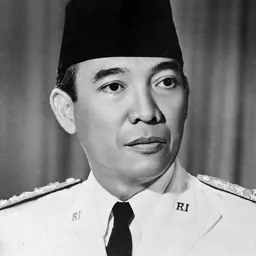

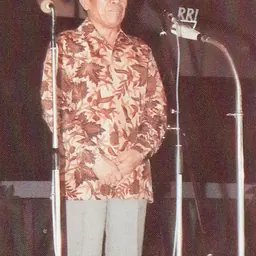
Related people
Same field, nearest in time






Contemporaries
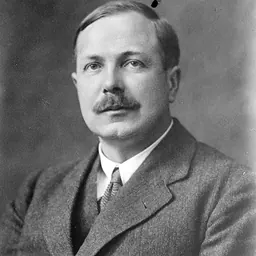
People whose lives overlapped Sumitro's

Frequently asked questions
Who was Sumitro?
Indonesian general (1927-1998)
When was Sumitro born?
Sumitro was born on 13 January 1927 in Probolinggo.
When did Sumitro die?
Sumitro died on 10 May 1998 in Jakarta.
What was Sumitro's occupation?
Sumitro was a photographer and military personnel.
What nationality was Sumitro?
Sumitro was Indonesian.
Sources & further reading
Cite this page
APA: Biography.guide. (2026). Sumitro. https://biography.guide/sumitro/
MLA: "Sumitro." Biography.guide, https://biography.guide/sumitro/.
Chicago: "Sumitro." Biography.guide. https://biography.guide/sumitro/.
Data last updated: 2026-09-26 · Spot an error? Report a correction.
Page generated 2026-09-27 05:13 UTC