
About Suh Se-ok
Lived 1929 – 2020 (aged 90–91). Suh Se-ok was a South Korean painter.
Suh Se-ok (; 1929 – 29 November 2020) artist known for his nonfigurative Oriental ink paintings. He is also known by the names Sanjeong (산정, 山丁) and Seo Se-ok.
He incorporated the use of spots and intense inkwash techniques to shape the field of contemporary Korean abstract ink paintings.서세옥 2014 기증작품 100, 5. In the 1960s, he formed an artist group ‘Ink Forest Group’ (Mungnimhoe, 묵림회, 墨林會, 1959–1964) with fellow Seoul National University (서울대학교) art school graduates including Park Se-won (박세원, 朴世元, 1922–1999), Chang Un-sang (장운상, 張雲祥, 1926–1982), and Chun Young-wha (전영화, 全榮華, 1929-), and led the reinvention of ink paintings through modern abstraction in South Korea. From the 1970s, he focused on his ‘People’ series, in which he depicted crowds of stick figures with simple brushstrokes and effectively expressed movement and creative use of composition. He is known for his usage of traditional Eastern materials, dynamic inkwash techniques, the utilisation of negative space, and simple yet effective brushstrokes.
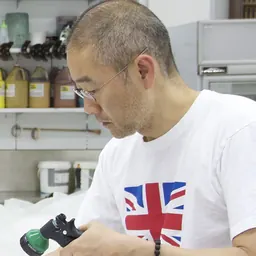
His eldest son, Do Ho Suh, is also a renowned contemporary Korean installation artist based in London. His younger son, Eul Ho Suh, is a well established architect, founder of SUH Architects.
Early life and education Suh Se-ok was born in 1929 in Daegu (대구, 大邱), Korea.
Growing up, Suh Seo-ok was told that he had a talent for literature and even prepared for his literary debut. However, he chose to pursue an education in art when he found that there is no freedom in literature as it is completely dependent on letters, which are mere signs of language.
Suh first learned to sketch still life of plaster sculptures from artist Gil Jin-seop (길진섭, 吉鎭燮, 1907–1975) and later enrolled to Seoul National University after the establishment of the College of Fine Arts in 1946.
Suh Se-ok graduated from Seoul National University Art School where he majored in Eastern Painting and trained to paint ‘new literati painting’ focused on simple, uncluttered use of space, and damchae (담채, thin applications of light colour ink) ink techniques under painter and art critic Geunwon Kim Yong-jun (근원 김용준, 近園 金瑢俊, 1904–1967).
While in university, he won first place in the first annual Korean-government-hosted art exhibition, Daehan Minguk Misul Jeollamhoe (대한민국미술전람회, 大韓民國美術展覽會, National Art Exhibition, also known as Gukjeon, 국전, 國展) in 1949 with his work Flower Seller (꽃장수, 1949). After graduating, he further trained in ink painting under Woljeon (월전, 月田) Jang U-seong (장우성, 張遇聖, 1912–2005). In addition to being a calligrapher, Suh was also a talented Hansi (한시, 漢詩, Chinese poetry) poet and an accomplished seal designer and engraver. His attempts to create a modern, distinctively Korean style of ink painting was a shared goal of many contemporary artists of the time- with fellow graduates of Seoul National University, Seo Se-ok formed Mukrimhoe in 1959, an artist group of Eastern-style painters who experimented with the traditional medium of ink and styles of avant-garde and abstraction. Although the group was exploring American and European post-war artistic movements such as Art Informel, Suh argued that the continued Korean appropriation of Western avant-gardes could lead to a loss of the understanding of Korean art and even art itself. Suh Se-ok went on to become an artist pursuing modernistic works using subdued, pale Indian ink, handmade mulberry paper or rice paper, lyrical brushstrokes, and negative space of Eastern ink-and-wash painting. He also participated in the regular general assembly of the IAA held in Tokyo, Japan in 1966 as the Korean representative and travelled throughout the arts circles of the North America and Europe.
His representative works include Seolhwayijang: People Handling the Sun (설화이장, 說話二章: 태양을 다투는 사람들, 1969), Long Life (장생, 1972), ‘행인’(1978), and Dancing People (춤추는 사람들, 1989). The figurative or abstract human forms in his paintings are made up of his characteristic brushstrokes of varying thickness, tones and lengths, painted in ink on mulberry paper. He was also a judge at Gukjeon from 1961 to 1982.
His famous 'People' series that developed from Suh's reformation of the pictographic Chinese character ‘in’ (인, 人, person) also hints inspiration from calligraphic painting. Yet he does not present a portrait of particular figures but hints to the universality of life, human beings, and human movement. In this sense, Suh Se-ok's ‘People’ series displays a compelling and immersive marriage between abstraction and figurative depiction, as 'intertwined formations oscillate between representation and sheer mark-making.”
Suh's exploration of form and void found expression in his free-flowing use of ink and white paper, a skilful play on presence and absence that not only evidenced his understanding of Eastern painting's quintessential nature, but also his technical skill in creating work that engaged with Korean painting's 'identity' - a concept that emerged following Japan's colonial rule of Suh's homeland from 1910–1945.
Awards
The Prime Minister Prize at the 1st National Art Exhibition, Korea (1949) Minister of Culture and Education Prize at the 3rd Gukjeon Exhibition (Daehan Minguk misul jeollamhoe, 1954) Director of the National Academy of Arts Prize, Best Artist Prize at the 19th Gukjeon Exhibition (1970) Ilmin Art Prize, Seoul, Korea (1994) The Artistic and Culture Prize of 13th Federation of Artistic and Culture, Korea (1999) The Artist of the Year, National Museum of Contemporary Art (2005) 52nd National Academy of Arts Award, Korea (2007)
Don’t just read it —
keep it.
Full-length biographies made to live with: read them, listen on the way to work, watch them tonight.
- E-book
- Audio
- Video
Instant download · yours to keep · every purchase keeps this site free
Important facts
People in Suh Se-ok's life
Named in this biography and alive at the same time


Related people
Same field, nearest in time


Contemporaries
People whose lives overlapped Suh Se-ok's
Frequently asked questions
Who was Suh Se-ok?
South Korean artist (1929–2020)
When was Suh Se-ok born?
Suh Se-ok was born in 1929.
When did Suh Se-ok die?
Suh Se-ok died on 29 November 2020.
What was Suh Se-ok's occupation?
Suh Se-ok was a painter.
What nationality was Suh Se-ok?
Suh Se-ok was South Korean.
Sources & further reading
Cite this page
APA: Biography.guide. (2026). Suh Se-ok. https://biography.guide/suh-se-ok/
MLA: "Suh Se-ok." Biography.guide, https://biography.guide/suh-se-ok/.
Chicago: "Suh Se-ok." Biography.guide. https://biography.guide/suh-se-ok/.
Data last updated: 2026-09-20 · Spot an error? Report a correction.
Page generated 2026-09-27 05:16 UTC