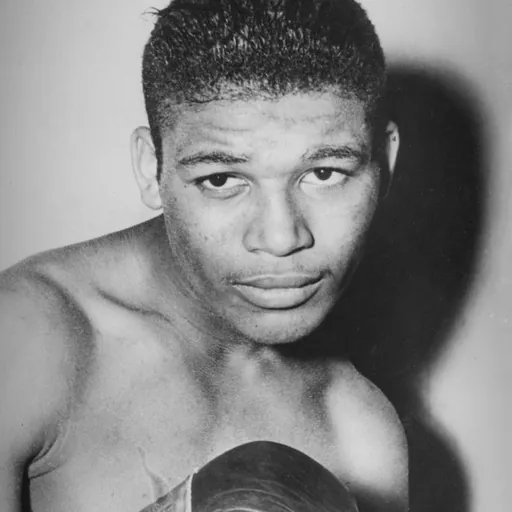
About Sugar Ray Robinson
Lived 1921 – 1989 (aged 67). Sugar Ray Robinson was an American boxer and film actor.
Walker Smith Jr. (May 3, 1921 – April 12, 1989), better known as Sugar Ray Robinson, was an American professional boxer who competed from 1940 to 1965. He was inducted into the International Boxing Hall of Fame in 1990. He is often regarded as the greatest boxer of all time, pound-for-pound , and is ranked as such by BoxRec as of May 2026.
Robinson was a dominant amateur, but his exact amateur record is not known. It is usually listed as 85–0 with 69 knockouts, 40 in the first round. However it has been reported he lost to Billy Graham and Patsy Pesca as a teenager under his given name, Walker Smith Jr. He turned professional in 1940 at the age of 19 and by 1951 had a professional record of 129–1–2 with 85 knockouts. From 1943 to 1951 Robinson went on a 91-fight unbeaten streak, the sixth-longest in professional boxing history. Robinson held the world welterweight title from 1946 to 1951, and won the world middleweight title in the latter year. He retired in 1952, only to come back two-and-a-half years later and regain the middleweight title in 1955.
He then became the first boxer in history to win a divisional world championship five times (a feat he accomplished by defeating Carmen Basilio in 1958 to regain the middleweight championship). Robinson was named "fighter of the year" twice: first for his performances in 1942, then nine years and over 90 fights later, for his efforts in 1951. Historian Bert Sugar ranked Robinson as the greatest fighter of all time and in 2002, Robinson was also ranked number one on The Ring magazine's list of "80 Best Fighters of the Last 80 Years". He was named the best boxer of all time, pound for pound, by the International Boxing Research Organization (IBRO) in both of its all-time ratings, in 2006 and 2019.
Renowned for his classy and flamboyant lifestyle outside the ring, Robinson is credited with being the originator of the modern sports "entourage". After his boxing career ended, Robinson attempted a career as an entertainer, but it was not successful. He struggled financially from the end of his boxing career in 1965 until his death in 1989. In 2006, he was featured on a commemorative stamp by the United States Postal Service.
Early life Robinson was born Walker Smith Jr. in Ailey, Georgia, to Walker Smith Sr. and Leila Hurst. Robinson was the youngest of three children; his eldest sister Marie was born in 1917, and his other sister Evelyn in 1919. His father was a cotton, peanut, and corn farmer in Georgia, who moved the family to Detroit where he initially found work in construction.
His parents separated, and he moved with his mother to Harlem at the age of 12. Robinson originally aspired to be a doctor, but after dropping out of DeWitt Clinton High School (in the Bronx) in ninth grade, he switched his goal to boxing.
When he was 14, he attempted to enter his first boxing tournament, but was told he first needed an AAU membership card—which he could not legally procure until he was 16. He circumvented the AAU's age requirement by using an ID card from a youth named Ray Robinson, who had quit boxing. So, Walker began his amateur fighting career under that name—and it stuck. Later, when a lady in the audience at a fight in Watertown, New York, said he was "sweet as sugar," the name "Sugar Ray Robinson" was born. He won the New York Golden Gloves featherweight championship in 1939 (defeating Louis Valentine on points in 3 rounds), and the New York Golden Gloves lightweight championship in 1940 (defeating Andy Nonella by KO in 2). Robinson won the first five rounds, according to Joseph C. Nichols of The New York Times, before Zivic came back to land several punches to Robinson's head in the sixth and seventh. Robinson then won four consecutive bouts by knockout, before defeating Servo in a controversial split decision in their May rematch. After winning three more fights, Robinson faced Jake LaMotta, who would become one of his more prominent rivals, for the first time in October. He defeated LaMotta by a unanimous decision, although he failed to get Jake down. Robinson weighed compared to 157.5 for LaMotta, but he was able to control the fight from the outside for the entire bout, and actually landed the harder punches during the fight. Robinson then won four more fights, including two against Izzy Jannazzo, from October 19 to December 14. For his performances, Robinson was named "Fighter of the Year". He finished 1942 with a total of 14 wins and no losses.
Robinson built a record of 40–0 before losing for the first time to LaMotta in a 10-round re-match. LaMotta, who had a weight advantage over Robinson, knocked Robinson out of the ring in the eighth round, and won the fight by decision. The fight took place in Robinson's former home town of Detroit, and attracted a record crowd. Robinson had a 15-month military career. Robinson served with Joe Louis, and the pair went on tours with the Special Services division where they performed exhibition bouts in front of U.S. Army troops. Robinson got into trouble several times while in the military. He argued with superiors who he felt were discriminatory against him, and refused to fight exhibitions when he was told African American soldiers were not allowed to watch them. In late March 1944 Robinson was stationed at Fort Hamilton in Brooklyn, waiting to ship out to Europe, where he was scheduled to perform more exhibition matches. But on March 29, Robinson disappeared from his barracks. When he woke up on April 5 in Fort Jay Hospital on Governor's Island, he had missed his sailing for Europe and was under suspicion of deserting. He himself reported falling down the stairs in his barracks on the 29th, but said that he had complete amnesia, and he could not remember any events from that moment until the 5th. According to his file, a stranger had found him in the street on April 1 and helped him to a hospital. In his examination report, a doctor at Fort Jay concluded that Robinson's version of events was sincere. He was examined by military authorities, who claimed he suffered from a mental deficiency. Robinson was granted an honorable discharge on June 3, 1944. He later wrote that unfair press coverage of the incident had "branded" him as a "deserter". Robinson maintained his close friendship with Louis from their time in military service, and the two went into business together after the war. They planned to start a liquor distribution business in New York City, but were denied a license due to their race.
Besides the loss in the LaMotta rematch, the only other mark on Robinson's record during this period was a 10-round draw against José Basora in 1945.
Welterweight champion By 1946, Robinson had fought 75 fights to a 73–1–1 record, and beaten every top contender in the welterweight division. However, he refused to cooperate with the Mafia, which controlled much of boxing at the time, and was denied a chance to fight for the welterweight championship. Robinson was finally given a chance to win a title against Tommy Bell on December 20, 1946. Robinson had already beaten Bell once by decision in 1945. The two fought for the title vacated by Servo, who had himself lost twice to Robinson in non-title bouts. In the fight, Robinson, who only a month before had been involved in a 10-round brawl with Artie Levine, was knocked down by Bell. The fight was called a "war", but Robinson was able to pull out a close 15-round decision, winning the vacant World Welterweight title.
In 1948 Robinson fought five times, but only one bout was a title defense. Among the fighters he defeated in those non-title bouts was future world champion Kid Gavilán in a close, controversial 10-round fight. Gavilán hurt Robinson several times in the fight, but Robinson controlled the final rounds with a series of jabs and left hooks. In 1949, he boxed 16 times, but again only defended his title once. In that title fight, a rematch with Gavilán, Robinson again won by decision. The first half of the bout was very close, but Robinson took control in the second half. Gavilán would have to wait two more years to begin his own historic reign as welterweight champion. The only boxer to match Robinson that year was Henry Brimm, who fought him to a 10-round draw in Buffalo.
Robinson fought 19 times in 1950. He successfully defended his welterweight title for the last time against Charley Fusari. Robinson won a lopsided 15-round decision, knocking Fusari down once. Robinson donated all but $1 of his purse for the Fusari fight to cancer research. In 1950 Robinson fought George Costner, who had also taken to calling himself "Sugar" and stated in the weeks leading up to the fight that he was the rightful possessor of the name. "We better touch gloves, because this is the only round", Robinson said as the fighters were introduced at the center of the ring. "Your name ain't Sugar, mine is." Robinson then knocked Costner out in 2 minutes and 49 seconds.
Jimmy Doyle incident Jimmy Doyle (bottom) being helped up from the canvas by three unidentified men following his match against Sugar Ray Robinson. Doyle died hours later in a Cleveland hospital. In June 1947, after four non-title bouts, Robinson was scheduled to defend his title for the first time in a bout against Jimmy Doyle. Robinson initially backed out of the fight because he had a dream that he was going to kill Doyle. A priest and a minister convinced him to fight. His dream ended up becoming a reality. On June 25, 1947, Robinson dominated Doyle and scored a decisive knockout in the eighth round that knocked Doyle unconscious and resulted in Doyle's death later that night.
After Doyle's death, criminal charges were threatened against Robinson in Cleveland, up to and including murder, though none actually materialized. After learning of Doyle's intentions of using the bout's money to buy his mother a house, Robinson gave Doyle's mother the money from his next four bouts so she could purchase herself a home, fulfilling her son's intention.
Middleweight champion
It is stated in his autobiography that one of the main considerations for his move up to middleweight was the increasing difficulty he was having in making the welterweight weight limit. However, the move up would also prove beneficial financially, as the division then contained some of the biggest names in boxing. Vying for the Pennsylvania state middleweight title in 1950, Robinson defeated Robert Villemain. Later that year, in defense of that crown, he defeated Jose Basora, with whom he had previously drawn. Robinson's 50-second, first-round knockout of Basora set a record that would stand for 38 years. In October 1950, Robinson knocked out Bobo Olson a future middleweight title holder.
On February 14, 1951, Robinson and LaMotta met for the sixth time. The fight would become known as The St. Valentine's Day Massacre. Robinson won the undisputed World Middleweight title with a 13th round technical knockout. Robinson outboxed LaMotta for the first 10 rounds, then unleashed a series of savage combinations on LaMotta for three rounds, LaMotta had lost by knockout to Billy Fox earlier in his career. However, that fight was later ruled to have been fixed and LaMotta was sanctioned for letting Fox win. That bout, and some of the other bouts in the six-fight Robinson-LaMotta rivalry, was depicted in the Martin Scorsese film Raging Bull. "I fought Sugar Ray so often, I almost got diabetes", LaMotta later said. and an entourage of 13 people, some included "just for laughs". He was a hero in France due to his recent defeat of LaMotta—the French hated LaMotta for defeating Marcel Cerdan in 1949 and taking his championship belt (Cerdan died in a plane crash en route to a rematch with LaMotta). During his fight in Berlin against Gerhard Hecht, Robinson was disqualified when he knocked his opponent out with a punch to the kidney: a punch legal in the US, but not Europe. Three months later in a rematch in front of 60,000 fans at the Polo Grounds, Following Robinson's victory, residents of Harlem danced in the streets. In 1951, Robinson was named Ring Magazine's "Fighter of the Year" for the second time.
In 1952 he fought a rematch with Olson, winning by a decision. He next defeated former champion Rocky Graziano by a third-round knockout, then challenged World Light heavyweight champion Joey Maxim. In the Yankee Stadium bout with Maxim, Robinson built a lead on all three judges' scorecards, but the temperature in the ring took its toll. He won five fights in 1955, before losing a decision to Ralph 'Tiger' Jones. He bounced back, however, and defeated Rocky Castellani by a split decision, then challenged Bobo Olson for the world middleweight title. He won the middleweight championship for the third time with a second-round knockout—his third victory over Olson. After his comeback performance in 1955, Robinson expected to be named fighter of the year. However, the title went to welterweight Carmen Basilio. Basilio's handlers had lobbied heavily for it on the basis that he had never won the award, and Robinson later described this as the biggest disappointment of his professional career. "I haven't forgotten it to this day, and I never will", Robinson wrote in his autobiography. Robinson and Olson fought for the last time in 1956, and Robinson closed the four-fight series with a fourth-round knockout.
In 1957 Robinson lost his title to Gene Fullmer. Fullmer used his aggressive, forward moving style to control Robinson, and knocked him down in the fight. Robinson, however, noticed that Fullmer was vulnerable to the left hook. Fullmer headed into their May rematch as a 3–1 favorite. Boxing critics have referred to the left-hook which knocked out Fullmer as "the perfect punch". It marked the first time in 44 career fights that Fullmer had been knocked out, and when someone asked Robinson after the fight how far the left hook had traveled, Robinson replied: "I can't say. But he got the message." but regained it for a record fifth time when he beat Basilio in the rematch. Robinson struggled to make weight, and had to go without food for nearly 20 hours leading up to the bout. He badly damaged Basilio's eye early in the fight, and by the seventh round it was swollen shut. The two judges gave the fight to Robinson by wide margins: 72–64 and 71–64. The referee scored the fight for Basilio 69–64, and was booed loudly by the crowd of 19,000 when his decision was announced. The day before the fight Pender commented that he planned to start slowly, before coming on late. He did just that and outlasted the aging Robinson, who, despite opening a cut over Pender's eye in the eighth round, was largely ineffective in the later rounds. In their rematch four months later, Moyer defeated Robinson on points, as he pressed the action and made Robinson back up throughout the fight. Moyer won 7–3 on all three judges scorecards. Robinson lost twice more in 1962, before winning six consecutive fights against mostly lesser opposition. In February 1963 Robinson lost by a unanimous decision to former world champion and fellow Hall of Famer Joey Giardello. Giardello knocked Robinson down in the fourth round, and the 43-year-old took until the count of nine to rise to his feet. Robinson was also nearly knocked down in the sixth round, but was saved by the bell. He rallied in the seventh and eight rounds, before struggling in the final two. Famed sports author Pete Hamill mentioned that one of the saddest experiences of his life was watching Robinson lose to Archer. He was even knocked down and Hamill pointed out that Archer had no knockout punch at all; Archer admitted afterward that it was only the second time he had knocked an opponent down in his career. The crowd of 9,023 at the Civic Arena in Pittsburgh gave Robinson several standing ovations, even while he was being thoroughly outperformed by Archer. Robinson retired from boxing with a record of 174–19–6 (2 no contests) with 109 knockouts in 201 professional bouts, ranking him among the all-time leaders in knockouts.
Later life
In his autobiography, Robinson states that by 1965 he was broke, having spent all of the $4 million in earnings he made inside and out of the ring during his career. A month after his last fight, Robinson was honored with a Sugar Ray Robinson Night on December 10, 1965, in New York's Madison Square Garden. During the ceremony, he was honored with a massive trophy. However, there was not a piece of furniture in his small Manhattan apartment with legs strong enough to support it. Robinson was elected to the Ring Magazine boxing Hall of Fame in 1967, two years after he retired and the International Boxing Hall of Fame in 1990. In the late 1960s he acted in some television shows, like Mission: Impossible. An episode of Land of the Giants called "Giants and All That Jazz" had Sugar as a washed up boxer opening a nightclub. He also appeared in a few films including the Frank Sinatra cop movie The Detective (1968), the cult classic Candy (1968), and the thriller The Todd Killings (1971) as a police officer. In 1969, he founded the Sugar Ray Robinson Youth Foundation for the inner-city Los Angeles area. The foundation does not sponsor a boxing program.
Death In Robinson's last years he was diagnosed with Alzheimer's disease and diabetes mellitus that was treated with insulin. He died in Los Angeles from heart disease on April 12, 1989, at the age of 67. Robinson is buried at Inglewood Park Cemetery, Inglewood, California.
Personal life
Robinson married Marjorie Joseph in 1938; the marriage was annulled the same year. Their son, Ronnie Smith, was born on September 25, 1938. Robinson met his second wife Edna Mae Holly, a noted dancer who performed at the Cotton Club and toured Europe with Duke Ellington and Cab Calloway. According to Robinson, he met her at a local pool he frequented after his boxing workouts. In an attempt to get her attention he pushed her into the pool one day, and said it was an accident. After this attempt was met with disdain, he appeared at the nightclub she danced at and introduced himself. Soon the couple were dating and they married in 1944. They had one son, Ray Robinson Jr. (born 1949) before their acrimonious divorce in 1962.
In April 1959, Robinson's eldest sister, Marie, died of cancer at the age of 41.
In December 1959, Barbara Johnson (aka Barbara Trevigne) of South Ozone Park, a singer and dancer, brought a paternity suit in New York against the former champ, claiming Sugar Ray Robinson was the father of her son Paul born in 1953. On May 18, 1963, Jet reported that the court had ruled in Robinson's favor. Robinson is quoted exulting at the win saying "Justice triumphed."
In 1965, Robinson married Millie Wiggins Bruce and the couple settled in Los Angeles. When Robinson was sick with his various ailments, his son accused the elder Robinson's wife of keeping him under the influence of medication to manipulate him. According to Ray Robinson Jr., when Robinson Sr.'s mother died, he could not attend his mother's funeral because Millie was drugging and controlling him. However, Robinson had been hospitalized the day before his mother's death due to agitation which caused his blood pressure to rise. Robinson Jr., and Edna Mae likewise said that Millie kept them away from Robinson during his last years.
Boxing style
Robinson was the modern definition of a boxer puncher. He was able to fight almost any style: he could come out one round brawling, the next counterpunching, and the next fighting on the outside flicking his jab. Robinson would use his formless style to exploit his opponents' weaknesses. He also possessed great speed and precision. He fought in a very conventional way with a firm jab, but threw hooks and uppercuts in flurries in an unconventional way.
He possessed tremendous versatility—according to boxing analyst Bert Sugar, "Robinson could deliver a knockout blow going backward." Robinson was efficient with both hands, and he displayed a variety of effective punches—according to a Time article in 1951, "Robinson's repertoire, thrown with equal speed and power by either hand, includes every standard punch from a bolo to a hook—and a few he makes up on the spur of the moment." His defense relied on footwork, lateral movement and head movement to evade punches. Robinson used the shoulder roll, bob and weave, and slipped punches.
Legacy
Robinson has been ranked as the greatest boxer of all time by sportswriters, fellow boxers, and trainers. The phrase "pound for pound" was created by sportswriters for him during his career as a way to compare boxers irrespective of weight. The Sporting News recognized Robinson as the Fighter of the Decade for the 1950s. In 1997, The Ring ranked him as the best pound-for-pound fighter in history, In 2007 ESPN.com featured the piece "50 Greatest Boxers of All Time", in which it named Robinson the top boxer in history. In 2003, The Ring ranked him number 11 in the list of all-time greatest punchers. Robinson was also ranked as the number 1 welterweight and the number 1 pound-for-pound boxer of all time by the International Boxing Research Organization. He was inducted into the Madison Square Garden Walk of Fame at its inception in 1992.
Robinson was one of the first African Americans to establish himself as a star outside sports. He was an integral part of the New York social scene in the 1940s and 1950s. Robinson was known as a flamboyant personality outside the ring. He combined striking good looks with charisma and a flair for the dramatic. He drove a flamingo-pink Cadillac and was an accomplished singer and dancer, who once pursued a career in the entertainment industry.
According to ESPN's Ron Flatter: "He was the pioneer of boxing's bigger-than-life entourages, including a secretary, barber, masseur, voice coach, a coterie of trainers, beautiful women, a dwarf mascot and lifelong manager George Gainford." In 1962, in an effort to persuade Robinson to return to Paris—where he was still a national hero—the French promised to bring over his masseur, his hairdresser, a man who would whistle while he trained, and his trademark Cadillac. This larger-than-life persona made him the idol of millions of African American youths in the 1950s. Robinson inspired several other fighters who took the nickname "Sugar" in homage to him: Sugar Ray Leonard, Sugar Shane Mosley, and MMA fighter "Suga" Rashad Evans. Sugar Ray Leonard said, "Someone once said there was a comparison between Sugar Ray Leonard and Sugar Ray Robinson. Believe me, there's no comparison. Sugar Ray Robinson was the greatest." Laurence Holder wrote a play about him entitled Sugar Ray in 2016.
Professional boxing record
Titles in boxing Major world titles NYSAC welterweight champion (147 lbs) NBA (WBA) welterweight champion (147 lbs) NYSAC middleweight champion (160 lbs) (5×) NBA (WBA) middleweight champion (160 lbs) (5×)
The Ring magazine titles The Ring welterweight champion (147 lbs) The Ring middleweight champion (160 lbs) (5×)
Regional/International titles Pennsylvania State middleweight champion (160 lbs)
Lineal titles Lineal welterweight champion (147 lbs) Lineal middleweight champion (160 lbs) (5×)
Undisputed titles Undisputed welterweight champion (147 lbs) Undisputed middleweight champion (160 lbs) (5×)
Awards and honors
The Ring magazine Fighter of the Year 2x: in 1942 and 1951. Edward J. Neil Trophy (now known as the Sugar Ray Robinson Award in his honor) winner in 1950. Inducted into the International Boxing Hall of Fame's inaugural class of 1990. Inducted into the Michigan Sports Hall of Fame in 1991. Inducted into the Madison Square Garden Walk of Fame in 1992. The United States Postal Service honored Robinson with a stamp in 2006. Inducted into the Martial Arts History Museum Hall of Fame in 2023.
Don’t just read it —
keep it.
Full-length biographies made to live with: read them, listen on the way to work, watch them tonight.
- E-book
- Audio
- Video
Instant download · yours to keep · every purchase keeps this site free
Important facts
People in Sugar Ray Robinson's life
Named in this biography and alive at the same time






Related people
Same field, nearest in time



Contemporaries
People whose lives overlapped Sugar Ray Robinson's





Frequently asked questions
Who was Sugar Ray Robinson?
American boxer (1921–1989)
When was Sugar Ray Robinson born?
Sugar Ray Robinson was born on 3 May 1921 in Ailey.
When did Sugar Ray Robinson die?
Sugar Ray Robinson died on 12 April 1989 in Culver City.
What was Sugar Ray Robinson's occupation?
Sugar Ray Robinson was a boxer and film actor.
What nationality was Sugar Ray Robinson?
Sugar Ray Robinson was American.
Sources & further reading
· Wikipedia: Sugar Ray Robinson
Cite this page
APA: Biography.guide. (2026). Sugar Ray Robinson. https://biography.guide/sugar-ray-robinson/
MLA: "Sugar Ray Robinson." Biography.guide, https://biography.guide/sugar-ray-robinson/.
Chicago: "Sugar Ray Robinson." Biography.guide. https://biography.guide/sugar-ray-robinson/.
Data last updated: 2026-09-21 · Spot an error? Report a correction.
Portrait: Wikimedia Commons · author & licence
Page generated 2026-09-27 04:59 UTC