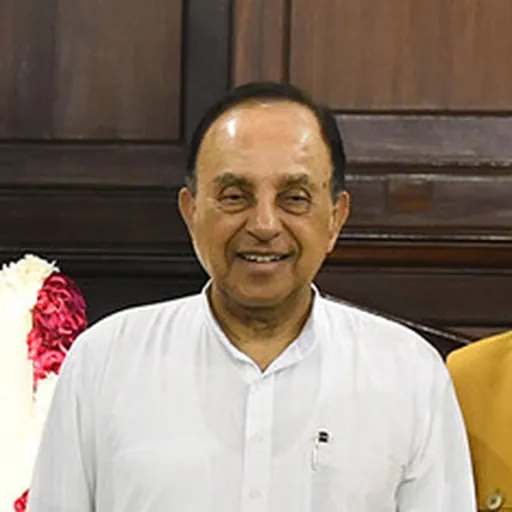
About Subramanian Swamy
Born 1939. Subramanian Swamy is an Indian economist, politician, author and statistician.
Subramanian Swamy (born 15 September 1939) is an Indian politician, economist and statistician. Before joining politics, he was a professor of Mathematical Economics at the Indian Institute of Technology, Delhi. He is known for his Hindu nationalist views. Swamy was a member of the Planning Commission of India and was a Cabinet Minister in the Chandra Shekhar government. Between 1994 and 1996, Swamy was Chairman of the Commission on Labour Standards and International Trade under former Prime Minister P. V. Narasimha Rao. Swamy was a long-time member of the Janata Party, serving as its president until 2013 when he joined the Bharatiya Janata Party (BJP). He has written on foreign affairs of India dealing largely with China, Pakistan and Israel. He was nominated to Rajya Sabha on 25 April 2016 for a six-year term, ending on 24 April 2022.
Family and education Subramanian Swamy was born on 15 September 1939, in Mylapore, Chennai, Tamil Nadu, India, to a family which hailed originally from Mullipallam, Sholavandan, Madurai in Tamil Nadu in a Vadadesa Vadama Tamil Brahmin family. His father, Sitaraman Subramanian, was a bureaucrat and his mother, Padmavathi, was a homemaker. He has one younger brother, Ram Subramanian, as well as two younger sisters.
Sitaraman Subramanian was an officer in the Indian Statistical Service who served as the director of the Central Statistical Institute in Delhi, and was a statistical adviser to the Government of India.
Education He attended Hindu College, University of Delhi, from where he earned his bachelor's degree in Mathematics. He then took his master's degree in Statistics from the Indian Statistical Institute, Kolkata. He was later recommended by Hendrik S. Houthakker His thesis adviser was Nobel laureate Simon Kuznets. While he was a doctoral student at Harvard, he attended Massachusetts Institute of Technology as a cross-registered student and later worked at the United Nations Secretariat in New York City as an Assistant Economics Affairs Officer in 1963. He subsequently worked as a resident tutor at Lowell House at Harvard University.
Family and personal life Swamy met Roxna Swamy , whose father was member of Indian Civil Service (British India), an Indian lady of Parsi ethnicity who was studying PhD in mathematics at Harvard University. They were married in June 1966. Journalist Coomi Kapoor is his sister-in-law. Swamy has two daughters. The elder daughter, Gitanjali Swamy, is an entrepreneur and private equity professional. She is married to Sanjay Sarma, a professor at MIT, who is the son of E.A.S Sarma, a retired IAS officer and former secretary of Economic Affairs to the government of India. The younger daughter, Suhasini Haidar, is a print and television journalist married to Nadeem Haidar, the son of former Indian Foreign Secretary Salman Haidar.
Academic career In July 1965, immediately after obtaining his PhD in economics from Harvard, Swamy joined the Department of Economics at the Harvard Faculty of Arts and Sciences as an assistant professor. As an associate professor, he was invited by Amartya Sen to occupy the chair on Chinese studies at the Delhi School of Economics. He was removed from the position by its board of governors in the early 1970s because of his disapproval of Indira Gandhi's poor economic policies but was legally reinstated in the late 1990s by the Supreme Court of India. He continued in the position until 1991 when he resigned to become a cabinet minister. He served on the Board of Governors of the IIT, Delhi (1977–80) and on the Council of IITs (1980–82). He also taught economics courses at Harvard Summer School until 2011, when the Harvard faculty voted to eliminate Swamy's courses as a result of his "offensive" statements about Muslims.
Swamy currently serves as Chairman of the Board of Governors of the SCMS Group of Institutions, which includes the SCMS Cochin School of Business in Kochi.
Political career
Early politics Swamy's career started with his involvement in the Sarvodaya movement, which was an apolitical movement but which formed the foundation of the creation of Janata Party later. The real turn in his political career came after his sacking from IIT. Liberal economic policies put forward by him did not go well with the then Prime Minister Indira Gandhi who sneered at his plans as 'Santa Claus with unrealistic ideas'. He was later expelled from the Indian Institute of Technology Delhi. This marked the beginning of his active political career. As a staunch opponent of Indira Gandhi, the opposition part, Bharatiya Jana Sangh sent him to Rajya Sabha – the upper house of Indian Parliament.
In Janata Party In 1981, he along with Harish Rawat and 13 others led first pilgrimage to Kailash–Manasarovar after 1962 Sino-Indian War. In 1984, Swamy stated his opinion that Janata Party should focus on organisational levels of the party. In February 1984, he filed his nomination for Janata Party President against Chandra Shekhar, but lost. In the same year, 1984, Swamy was expelled from Janata Party after he levelled allegations against Chandra Shekhar that Shekhar had manipulated the Janata Party presidency election. Subsequently, he joined Lok Dal, party of former Prime Minister Charan Singh. He fought 1984 Lok Sabha election from Mumbai North East Lok Sabha constituency on Lok Dal ticket, but lost.
In May 1988, Lok Dal (A) was merged with Janata Party with Ajit Singh as its president and Swamy became general secretary of Janata Party. Later in October 1988, Janata Dal was formed by merging major opposition parties with Janata Party one of its constituent. But Swamy along with Indubhai Patel, H. D. Deve Gowda, Syed Shahabuddin, Sarojini Mahishi refused to accept the merger of Janata Party into Janata Dal and remained in Janata Party. In December 1990, he was elected as president of Janata Party by Central Parliamentary Board.
Electoral history 1974–1976Member of Rajya Sabha from Uttar Pradesh, elected on a Jan Sangh party ticket 1977–1980Member of Lok Sabha from Mumbai North-East, elected on a Janata Party ticket 1980–1984Member of Lok Sabha from Mumbai North-East, elected on a Janata Party ticket 1988–1994Member of Rajya Sabha from Uttar Pradesh, elected on a Janata Party ticket 1998–1999Member of Lok Sabha from Madurai, elected on a Janata Party ticket 2016–2022Member of Rajya Sabha, Nominated Category
Minister of Commerce and Law of India (1990–1991) During 1990 and 1991, Swamy served as a member of the Planning Commission of India and as Cabinet Minister of Commerce and Law. On 27 December 1990, Financial Times published an interview of Swamy by David Housego in which he claimed that the decision to raise import duties by his government is a "panic reaction". In Parliament Prime Minister Chandra Shekhar claimed that Swamy had denied what had been attributed to him in the article, but David Housego who wrote the story stood firmly by it.
Swamy along with Commerce Secretary Montek Singh Ahluwalia decided to build Trade Policy 1991-92 which would get rid of import licencing for a wide range of import and allow these items to be imported freely against licences earned by exporters. This policy was to be announced in April 1991 but Chandra Shekhar government was pulled down.
Later years
Between 1994 and 1996, Swamy was chairman of the Commission on Labour Standards and International Trade (equivalent in rank to a cabinet minister) under Prime Minister P. V. Narasimha Rao. But in 1998, Delhi High Court dismissed his petition under technical grounds.
During 1998 general election, Swamy formed an alliance with J. Jayalalithaa's AIADMK and won from Madurai constituency. One year later, on 29 March 1999, Swamy organised a tea party to bring various opposition leaders together. This meeting was attended by various leaders like Chandra Shekhar, P. V. Narasimha Rao, H. D. Deve Gowda, J. Jayalalithaa, Manmohan Singh, Sonia Gandhi etc. This led to AIADMK's withdrawal from NDA coalition government and the government lost the majority in the Lok Sabha.
On 15 May 2004, Swamy wrote a letter to President A. P. J. Abdul Kalam raising doubt whether Sonia Gandhi can become Prime Minister of India citing Section 5 of Citizenship Act, 1955.
He continued to be president of the Janata Party till 2013. On 11 August 2013, Swamy officially joined the BJP when its president was Rajnath Singh. His admission to the party would mark the merger of the Janata Party with the Bharatiya Janata Party.
On 8 April 2015, Swamy formed Virat Hindustan Sangam, a right-wing cultural organisation to push issues like building Ram Mandir, scrapping Article 370 and bringing Uniform Civil Code. He was nominated by president to Rajya Sabha in 2016.
Elections contested Lok Sabha Year Constituency Party Votes % Opponent Votes % Result Margin 1977Mumbai North East 260,699 61.34 Kulkarni Rajaram Alias Raja Gopal 137,577 32.37 1980 199,472 40.00 D. N. Chaulkar 160,566 32.20 1984 13,924 2.17 Gurudas Kamat 273,847 42.62 1996Madurai 144,249 20.06A. G. S. Ram Babu 334.055 46.45 1998 266,202 40.48 245,305 37.30 1999 20,489 2.74P. Mohan 328,204 43.85 2004 12,009 1.62 414,433 56.03
Rajya Sabha
Court petitions and allegations
Complaint against Jayalalithaa In 1996, Swamy had filed a criminal complaint against Jayalalithaa which led to her prosecution, conviction and sentencing to four years imprisonment by the trial court in 2014. Later, on 11 May 2015, a special Bench of the Karnataka High Court set aside the trial court order convicting former Tamil Nadu Chief Minister Jayalalitha, who was acquitted of all charges in the disproportionate assets case. An Appeal against the High court verdict was filed in Supreme Court. The final verdict of Supreme Court came in February 2017 that indicted Jayalalitha posthumously and upheld the trial court judgement in toto.
Phone tapping allegation
Swamy released a letter alleging that former intelligence chief had asked DoT to tap the phone of many politicians and businessmen in Karnataka when Ramakrishna Hegde, the then Chief Minister, resigned in 1988. Hegde then filed a case against him in 1989 and 1990.
Hashimpura massacre
In 1987, when Muslim youths were killed under police custody, Swamy spoke against it and sat on a fast for more than a week in Jantar Mantar demanding the institution of an inquiry. After 25 years he started pursuing the case once again in court.
Rebecca John, a counsel for the Hashimpura complainants, told Additional Sessions Judge Rakesh Siddhartha who is conducting the trial in the case, that "there is no other motive than politics behind Swamy's plea for further investigation and it would only further delay the trial".
Role in exposing 2G spectrum case
In November 2008, Swamy amongst others wrote the first of five letters to Prime Minister Manmohan Singh seeking permission to prosecute A. Raja in regard to 2G spectrum case. After not receiving any response, Swamy decided to file a case on his own in the Supreme Court of India regarding the matter, which then asked the Central Bureau of Investigation to produce a detailed report on it. He further called on the Indian government to re-auction the 2G spectrum without the involvement of Communications Minister Kapil Sibal.
On 15 April 2011, he filed a 206-page petition with PM Singh seeking permission to prosecute Sonia Gandhi on charges of corruption. He also raised doubts regarding her acquisition of Indian citizenship. Swamy filed documents in the court to prosecute Minister of Home Affairs P. Chidambaram by including a 15 January 2008 letter written by Chidambaram to Prime Minister Manmohan Singh. Swamy also placed on record the certified copy of the minutes of a meeting between Chidambaram, Raja and the prime minister during the tenure of Raja as the MOC&IT. Since criminal charges were filed against the accused, but no evidence was given by Swamy or the CBI, all the respondents have got bail as of July 2012.
Sanction to prosecute telecom minister A. Raja On 31 January 2012, the Supreme Court of India accepted Swamy's petition against the Prime Minister's Office in the 2G case, saying that all public authorities should give a sanction within three months against any public official if a request is made for prosecution.
The Supreme Court said that Swamy had the locus standi to seek sanction from the Prime Minister for the prosecution of A. Raja in the 2G case. Sanction by a competent authority for the prosecution of a public servant has to be granted within a time frame, the apex court said. Justice AK Ganguly said that the sanction would be deemed to be granted if competent authority failed to take a decision within four months.
Swamy's arguments were that he wrote to the PMO on 29 November 2008, but it was only on 19 March 2010 the PMO replied that the plea made by Swamy was "premature" as investigation was being carried out by the Central Bureau of Investigation (CBI).Raja was arrested by the CBI in the case and got bail on 15 May 2012 after spending nearly 15 months in the Tihar Central Jail.
On 21 December 2017, the special CBI Court Judge acquitted the accused including A. Raja.
Petition to strike down "single directive provision" In 1997, Swamy filed a petition in the Supreme Court of India to strike down a provision which barred CBI from investigating corruption charges against officers of the rank of joint secretary and above without prior permission of the Government of India called as "Dr. Subramanian Swamy Versus Director, Central Bureau of Investigation & Anr." on 6 May 2014, a five-judge constitution bench held the single directive provision as invalid and unconstitutional. The court said that "Protection of prior approval for probing graft charges against officers at level of joint secretary and above has propensity of shielding corruption." Incumbent CBI Director Ranjit Sinha welcomed the judgement and said, "now a very heavy responsibility has been cast upon us to ensure that no innocent civil-servant is harassed."
Investigation on EVM
Swamy demanded that an independent committee should be formed to check the security and safety of the Electronic Voting Machines (EVM) to avoid any rigging or tampering. He demanded that a printed receipt should be given to every voter after casting the vote. His PIL to investigate the working of EVM was dismissed by the Delhi High Court on 17 January 2012. The court refused to give any direction to the Election Commission to bring back paper-ballot system or use of printed receipts. The Commission argued that the use of paper is not feasible due to the huge size of Indian electorate. The court further asked the Election Commission to "immediately begin a process of wider consultations" and the Parliament "to go into this question in depth and decide".
On 22 January 2013 the Election Commission informed the Supreme Court that it would include Voter Verifiable Paper Audit Trail (VVPAT) system which is in the testing phase after the court agreed with some points raised by Swamy who was the contender, in the machines so that every voter will come to know who he/she is voting by getting a printed slip after pressing the EVM button. The voter paper audit trail has then been in use from 4 September 2013.
On 8 October 2013 the Supreme Court directed the Election Commission to implement audit trail system in 2014 general election in phases.
National Herald case
On 1 November 2012 Swamy alleged that both Sonia and Rahul Gandhi have committed fraud and land grabbing to a tune of by acquiring a public ltd company called Associated Journals Private Ltd (AJPL) through their owned private company, Young Indian which was formed on 23 November 2010. Through this they had got publication rights of National Herald and Qaumi Awaz newspapers, with real estate properties in Delhi and Uttar Pradesh. The acquired place was intended only for newspaper purposes but were used for running a passport office, amounting to crores of rupees, it alleges. Swamy further added that Rahul Gandhi hid the facts in his affidavit while filing nomination for the 2009 Lok Sabha elections.
It further alleges that on 26 February 2011 AJPL approved the transfer of unsecured loan of from the All India Congress Committee at zero interest. Swamy argued that it is illegal for any political party to lend the loan as per violation of Section 269T of Income Tax Act 1961. on 2 November, the party responded that the loan was given only for reviving the National Herald newspaper with no commercial interest. Swamy decided to approach the Supreme Court for de-recognising the Congress party, while the Election Commission ordered the probe on 17 November 2012.
The hearing of the case had been taken up thereafter on different occasions with the court observing prima facie evidence against all the accused. on 28 August the metropolitan court fixed 9 December for the next hearing of the case, while on 12 January 2015 the judge of the Delhi High Court recused himself from hearing the case stating that schedule of cases has been changed and directed that the petitions be directed before an appropriate bench. on 27 January 2015, the Supreme Court asked Swamy to make out a case for the speedy trial in the Delhi High Court since the petition cannot be heard directly.
On 18 September 2015 it was reported that the Enforcement Directorate had reopened the investigation. Following it, on 19 December 2015 Patiala House Court granted unconditional bail immediately on the hearing to all the five accused but one. on 12 July 2016 the Delhi High Court set aside the trial court order of 11 January and 11 March based on plea by Swamy to examine balance sheets of Congress party, AJL and Young Indian from 2010 to 2013, and fixed the date of next hearing on 20 August. Currently, the case proceedings are on-going in Delhi High Court.
Temple cases Nataraja temple case
Swamy had filed a petition in the Supreme Court with priests of the Dikshitar sect challenging the decision of the Madras High Court on transferring the administration of the Nataraja temple to the then Tamil Nadu government in 2009.
Swamy on referring to the provisions of Tamil Nadu Hindu Religious and Charitable Endowments Act, contended that Podu Dikshitars have right to administer the temple and argued on handing over the administration on mismanagement grounds of temple's wealth is violation under Article 26 of the Constitution of India. on 6 January 2014 the Supreme Court ruled that the administration is to be handed over back to the priests of the temple from the state government.
State control of Hindu temples Subramanian Swamy filed a petition to remove Kerala State government's control over Hindu temples by abolishing Devaswom. In 2018, the Supreme Court agreed to examine the petition moved by him and TG Mohan Das to abolish Devaswom Board. The Supreme Court issued notice to the Kerala government and Devaswom Board of Travanacore and Cochin and sought their response in six weeks. In 2019, the Kerala government opposed Subramanian Swamy's plea.
Ayodhya temple case
On 22 February 2016, Swamy filed a petition in the Supreme Court allowing construction of Rama temple at the disputed site where Babri Masjid was demolished in 1992, and expediting the adjudication related to order of the Allahabad High Court on 30 September 2010, petition was accepted on 26 February to be later heard by the court.
Uttarakhand Char Dham Devasthanam Management Act, 2019 In February 2020, Subramanian Swamy filed a public interest litigation in Uttarakhand High Court against newly framed law to govern Char Dham and 51 other temples of the state. Swamy in his PIL, requested the court to declare the Uttarakhand Char Dham Devasthanam Management Act, 2019 'unconstitutional' which was passed in the legislative assembly of Uttarakhand in December 2019. However, the Court read down Section 22 of the Act, which was about the acquisition of land for the Char Dham.
Personal allegations against Narendra Modi
Swamy has been making allegations related with personal conduct against Indian Prime Minister Narendra Modi. He has also made repeated public comments against Modi in the light of the Epstein case, which has often led to public controversy. Lately, Modi's biographer Madhu Kishwar also joined the fray, making similar allegations. The BJP has strongly refuted these allegations, with a BJP member filing complaint case in Varanasi Court against such allegations.
Political positions
Foreign policy China Swamy has worked towards normalising relations between China and India. According to Swamy, the re-opening of the Kailash Mansarovar pilgrimage route was announced at a meeting convened by the People's Republic of China paramount leader Deng Xiaoping in April 1981, in which Swamy was in attendance.
Israel In various speeches and articles, Swamy has expressed his admiration for, and solidarity with, the State of Israel and has credited its retaliatory capacity for its ability to survive as a nation in a hostile Arab environment. Swamy made pioneering efforts towards India's establishment of diplomatic relations with Israel.
Sri Lanka and LTTE Swamy, on several occasions, has voiced support for the state of Sri Lanka in its role during Sri Lanka's protracted civil war with the LTTE, for which he was criticised as "pro Lanka" by his political opponents domestically. in an interview given to The Sunday Leader newspaper, Swamy stated that the Indian government should attend the CHOGM meeting held in Colombo despite stiff opposition from Indian politicians in Tamil Nadu concerned for the welfare and human rights of Tamils in Sri Lanka, placing the onus on the LTTE for human rights violations during the Sri Lankan civil war, he had favoured Mahinda Rajapaksa also during Sri Lanka 2015 election.
United States Swamy is a strong supporter of former U.S. President Donald Trump, endorsing Trump's presidential candidacy in 2016 and comparing Trump to himself.
After the Charlottesville riots in August 2017, he posted a tweet urging Indians residing in the United States to "stand with Trump at this hour of his being hunted by cockeyed liberals & Left wing loonies on racism" and praised Trump for "having showed the hypocrites their place by telling it like it is."
Following criticism of Pakistan by Trump, Swamy called for closer relations between India and the United States.
Domestic policy
Kodava Council in Kodagu Since at least 2017, Subramanian Swamy has supported CNC's demand for a Codava Autonomous Region (CAR) and a Codava Development Council for the Kodava tribe in the Kodagu district of Karnataka. Swamy discussed the idea of an autonomous development council for the Kodavas with H N Ananth Kumar in 2018 in the presence of Amit Shah and Rajnath Singh and wrote a letter to Karnataka's CM B S Yediyurappa seeking implementation of the demand in 2019. In 2023, his PIL filed on behalf of CNC caused the High Court to order issue of notice to the State and Central Governments to set up a commission to examine the demand for geo-political autonomy for the Kodava tribe.
Cow In March 2017, he brought a private member's bill to punish cow slaughter in India with capital punishment.
LGBT rights In 2018, when the Indian Supreme Court decriminalized gay sexual acts, Swamy criticised the ruling, saying "It could give rise to an increase in the number of HIV cases."
Kashmir In September 2008, Swamy stridently retorted against the contentions of some Indian columnists who voiced their opinions in favor of "peacefully" surrendering Kashmir to Pakistan(source?). He said,
"I would say that the silent suffering majority of India wants none of this. The 'Kashmir issue,' in fact, can no more be solved by dialogue either with the Pakistanis or the Hurriyat, leave alone the constitutional impossibility of allowing it to secede. [...]Kashmir, in fact, is now our defining identity. It is a touchstone for our resolve to preserve our national integrity. The population of that State may be majority Muslim but the land and its history is predominantly Hindu. for our commitment to the survival of the ancient civilisation of India and the composite culture that secularists talk of, we have not only to win that coming inevitable war but also resolve never to part with Kashmir. [...]
Pakistanis often cite the United Nations resolutions on Kashmir to argue for a plebiscite. This obfuscates the fact of accession of the State to India. The legality of the Instrument of Accession signed in favour of India by the then Maharaja of J&K, Hari Singh, on 26 October 1947 has to prevail anyway.
Tamil Nadu politics Swamy is well known for his critical views against the "Aryan versus Dravidian" politics of Periyar E. V. Ramasamy, calling it as the theory forwarded by the British. He has been a staunch opponent of the armed rebel group Liberation Tigers of Tamil Eelam. He also urged the Indian government not to support the US led resolution condemning war crimes in the Sri Lankan Civil War, citing it as one-sided and not in the interest of India. Swamy moved the court and got the order restoring quota for Sri Lankan Tamil refugees in colleges in the state.
Swamy obtained Supreme Court Stay against the implementation of Sethusamudram Shipping Canal Project (SSCP). He believes that it would hurt the sentiments of people who believe that this shallow land connecting between Tamil Nadu and Sri Lanka was built by Lord Rama. He strongly opposes the implementation of SSCP citing that implementing this scheme will be a criminal offence under section 295 Indian Penal Code. He wrote letters to Prime Minister of India in June 2009 asking him to stop the project and had informed the Supreme Court on 14 October 2015 that the government may not continue with the Sethusamudram Project.
Hindu nationalism Swamy has made several statements in the past that reflect on his Hindu nationalist position. He has called for the creation of an "enlightened secular democracy which redresses all historical wrongs done to Hindus." He has claimed that India is the world's most ancient civilization that consists of "an organic cultural core which is Hindu in character." He has also claimed that the Hindu foundation of India is what makes India distinctive in the world. he called for the removal of 300 mosques built at sites of Hindu temples. and for the disenfranchisement of Muslims unless they "acknowledge that their ancestors were Hindus". After the Faculty of Arts and Sciences at Harvard voted to have his classes removed for "demonising" Muslims, his regular Harvard summer teaching sessions were cancelled because of this article. He later claimed that this had been misinterpreted in a tweet stating, "One fake quote is that I had declared Muslims are not equal to Hindus under Art. 14."
Punjab Politics Swamy had been sent to the Golden Temple to settle with Jarnail Singh Bhindranwale in 1984, he was greeted and had good relations with him. Swamy stated that Bhindranwale had wanted to come to a non-violent solution to the issues that Punjab had, and Bhindranwale condemned the terrorism and violent incidents that happened prior to the operation. Swamy also condemned the needless military action and use of the Indian Army in a political battle between the Congress and the Akali protests- he believed, since Bhindranwale was staunchly anti-Communist, the Soviet Union pushed for the operation. Harvinder Singh Phoolka, Pushpindar Singh and Subramanian Swamy at The Sikh Forum, 33rd Anniversary of Operation Blue Star.
Conspiracy theory
In September 2020, Swamy said that India's Central Bureau of Investigation (CBI), Enforcement Directorate (ED), and Narcotics Control Bureau (NCB) had "unearthed huge evidence" to prove in court that Bollywood actor Sushant Singh Rajput's death was "murder by conspiracy." Swamy also said there had been "systematic destruction" of evidence in the case. In October 2020, after a medical board from the All India Institute of Medical Sciences (AIIMS) ruled out murder, stating that the actor died by suicide, a team of scientists associated with Microsoft Research, India released an independent report, "Anatomy of a Rumour: Social media and the suicide of Sushant Singh Rajput." They wrote, "Perhaps the most interesting case is that of sitting parliamentarian Subramanian Swamy, once a central player in the policy circles, now wilfully [ sic] mongering deceit, and also the most popular Twitter handle in wordclouds [ sic] of trolls." In December 2020, after more than four months of investigation, the CBI sent Swamy a 3-page letter stating it was looking into all aspects of the case "in a thorough and professional manner using latest scientific techniques," and that "no aspect has been ruled out," but making no mention of Swamy's conspiracy theories.
Honours and awards Year Name Awarding organisation Ref. 2012 Distinguished Alumni Award. Hindu College, University of Delhi. 2016 Tamil Ratna America Tamil Sangam
Books, research papers and journals Swamy is the author of several books, research papers and journals. A complete list of papers, books and journals authored by him is given below. He has also co-authored with Paul Samuelson, a paper on the Theory of Index Numbers (American Economic Review, 1974) and another in the Royal Economic Society's Economic Journal (1984). Himalayan Challenge: India, China and the Quest for Peace (Publisher: Rupa Publications India; ) The Hindu Manifesto for India's Democracy (Publisher: Har Anand Publications; )
Articles "Can India make it? India's path to sustained growth" (Publisher: Harvard Asia Pacific Review, Volumes 6–8 by Harvard University. Dept. of East Asian Languages and Civilizations, 2002) "The response to economic challenge: a comparative economic history of China and India", 1870–1952 (Publisher: The Quarterly Journal of Economics, Volume 93 by Harvard University by the MIT Press, 1979)
Research papers "Economic growth and income distribution in a developing nation" (Publisher: Harvard University, 1965) "Nuclear policy for India" (Publisher: Bharatiya Jana Sangh Publication, 1968) "Plan for full employment" (Publisher: Bharatiya Jana Sangh, 1970) "Theoretical aspects of index numbers" (Publisher: Harvard Institute of Economic Research, 1985) "Land reforms: an economist's approach" (Publisher: Deendayal Research Institute)
Don’t just read it —
keep it.
Full-length biographies made to live with: read them, listen on the way to work, watch them tonight.
- E-book
- Audio
- Video
Instant download · yours to keep · every purchase keeps this site free
Important facts
People in Subramanian Swamy's life
Named in this biography and alive at the same time

Related people
Same field, nearest in time



Contemporaries
People whose lives overlapped Subramanian Swamy's




Frequently asked questions
Who is Subramanian Swamy?
Indian politician
When was Subramanian Swamy born?
Subramanian Swamy was born on 15 September 1939 in Mylapore.
What is Subramanian Swamy's occupation?
Subramanian Swamy is an economist, politician, author and statistician.
What nationality is Subramanian Swamy?
Subramanian Swamy is Indian.
Sources & further reading
· Wikipedia: Subramanian Swamy
Cite this page
APA: Biography.guide. (2026). Subramanian Swamy. https://biography.guide/subramanian-swamy/
MLA: "Subramanian Swamy." Biography.guide, https://biography.guide/subramanian-swamy/.
Chicago: "Subramanian Swamy." Biography.guide. https://biography.guide/subramanian-swamy/.
Data last updated: 2026-09-22 · Spot an error? Report a correction.
Portrait: Wikimedia Commons · author & licence
Page generated 2026-09-27 05:01 UTC