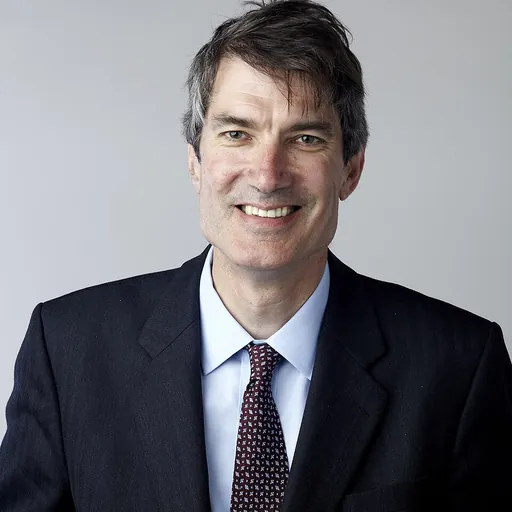
About Steven Cowley
Born 1951. Steven Cowley is a British physicist, known for Fusion power.
Sir Steven Charles Cowley (born 1959) is a British theoretical physicist and international authority on nuclear fusion and astrophysical plasmas. He has served as director of the United States Department of Energy (DOE) Princeton Plasma Physics Laboratory (PPPL) since 1 July 2018. Cowley is also a member of the Commission on the Scaling of Fusion Energy, a 12-month effort to create a shared vision for government, academia, and industry on fusion. In May 2024, he was appointed the chair of the board of trustees for the Faraday Institution. Previously he served as president of Corpus Christi College, Oxford, since October 2016. He was also the head of the European Atomic Energy Community (EURATOM) / Culham Centre for Fusion Energy (CCFE) and chief executive officer of the United Kingdom Atomic Energy Authority (UKAEA).
Career and research Following his PhD, Cowley completed postdoctoral research at the Culham Centre for Fusion Energy (CCFE). He returned to Princeton in 1987 and joined the faculty at University of California, Los Angeles (UCLA) in 1993, becoming full professor in 2000. At Imperial College, London, Cowley led the plasma physics group from 2001 to 2003, while also serving as a part-time professor. He was appointed as the head of the EURATOM / CCFE Fusion Association in September 2008 and as CEO of UKAEA in November 2009.
On 18 March 2015, he was elected the 31st President of Corpus Christi College, Oxford, his alma mater: he took up the post on 1 October 2016. He is the first scientist to hold the post.
On 1 July 2018, he was appointed director of the Princeton Plasma Physics Laboratory (PPPL).
Cowley's research interests are in plasmas and nuclear fusion, in astrophysical plasmas and the laboratory, such as the Joint European Torus (JET) and the International Thermonuclear Experimental Reactor (ITER). His research has been funded by Science and Technology Facilities Council (STFC) and the Engineering and Physical Sciences Research Council (EPSRC). Cowley co-chaired the National Academy of Sciences assessment of plasma science in the United States.
Inspiring Growth at PPPL Cowley has been central to PPPL's new and expanded mission into research areas beyond traditional fusion work. This effort is culminating in the construction of a new building at PPPL: the Princeton Plasma Innovation Center (PPIC). PPIC is designed to support PPPL's expanded mission into microelectronics, quantum sensors and devices, and sustainability sciences while housing theoretical and computational scientists. Cowley spoke of PPPL's quest to diversify the Lab at the May 2024 PPIC groundbreaking. "The Lab had one mission until now, and that was delivering fusion energy", Cowley said. "Now, that mission has broadened really because we need to serve the nation, and we have the skills to do that".
At the same time, Cowley has continued to express the Lab's strong commitment to basic science research, including astrophysics. At the unveiling of the Facility for Laboratory Reconnection Experiments (FLARE) in June 2025, Cowley said the experiment – which is designed to study magnetic reconnection — represents the next generation of research into fundamental plasma physics and will serve as a collaborative research platform for scientists worldwide.
"We have fulfilled our promise to design and build this device and offer it to the scientific community. I expect FLARE to produce important insights for plasma science in the coming years, and I just can't wait". are needed to design the ideal fusion system. "We’ve got to stop guessing how to get to fusion and start calculating how to get to fusion".
In his 2025 Robert Hofstadter Memorial Lecture at Stanford University, Cowley noted StellFoundry as one such project at PPPL that is using AI to try to find the ideal configuration for stellarators.
In an opinion piece in The Washington Post, however, Cowley pointed out that "a digital solution is not enough", calling for "investments in the tens of billions of dollars" to build a fusion pilot plant. He also noted that developing a highly skilled workforce and international collaboration are key. "I am now firmly convinced it isn't if, but when fusion will be deployed at scale. Undoubtedly, by the end of this century, clean, safe, sustainable fusion reactors will power cities, towns, data centers, and factories. ... I won't live to see it happen, but I take comfort in knowing that babies born today might well witness the world transformed.
Awards and honours Cowley was elected a Fellow of the Royal Society (FRS) in 2014. His biography reads:
His certificate of election reads:
Cowley was also elected a Fellow of the American Physical Society (APS) in 1998, the Institute of Physics (FInstP) in 2004 and the Royal Academy of Engineering (FREng) in 2014. He was awarded an honorary fellowship of the Institute of Engineering and Technology in 2015. In 2011, he was appointed to the UK Government's Council for Science and Technology.
In the 2018 Birthday Honours, Cowley was appointed a Knight Bachelor for services to science and to the development of nuclear fusion. In July 2019, Cowley was awarded the honorary degree of Doctor of Science (honoris causa) by the University of Lancaster for his standing as the international authority on fusion energy.
Family Steven Cowley is the grandson of John Duncan Cowley, who was the director of the School of Librarianship of the University of London. He is also the great-great-nephew of Sir Arthur Ernest Cowley.
Cowley met his future wife, Margaret Koval, during his graduate studies at Princeton University when she arrived as a new graduate student. Koval worked as an Emmy Award-winning television writer, producer, and director for ABC and PBS. She is now a painter. They married in 1985, shortly before Cowley defended his doctoral thesis. The couple has two sons.
Don’t just read it —
keep it.
Full-length biographies made to live with: read them, listen on the way to work, watch them tonight.
- E-book
- Audio
- Video
Instant download · yours to keep · every purchase keeps this site free
Important facts
People in Steven Cowley's life
Named in this biography and alive at the same time




Related people
Same field, nearest in time


Contemporaries
People whose lives overlapped Steven Cowley's


Frequently asked questions
Who is Steven Cowley?
British theoretical physicist
When was Steven Cowley born?
Steven Cowley was born in 1951 in Cambridge.
What is Steven Cowley's occupation?
Steven Cowley is a physicist.
What is Steven Cowley known for?
Steven Cowley is known for Fusion power.
What nationality is Steven Cowley?
Steven Cowley is British.
Sources & further reading
Cite this page
APA: Biography.guide. (2026). Steven Cowley. https://biography.guide/steven-cowley/
MLA: "Steven Cowley." Biography.guide, https://biography.guide/steven-cowley/.
Chicago: "Steven Cowley." Biography.guide. https://biography.guide/steven-cowley/.
Data last updated: 2026-09-21 · Spot an error? Report a correction.
Portrait: Wikimedia Commons · author & licence
Page generated 2026-09-27 05:00 UTC