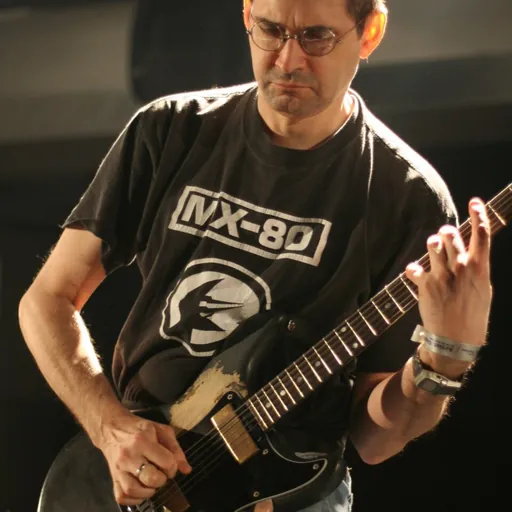
About Steve Albini
Lived 1962 – 2024 (aged 61). Steve Albini was an American record producer, singer, audio engineer, guitarist, music journalist and musician.
Steven Frank Albini ( ; July 22, 1962 – May 7, 2024) was an American musician and audio engineer. He founded and fronted the influential post-hardcore and noise rock bands Big Black (1981–1987), Rapeman (1987–1989), and Shellac (1992–2024), and engineered acclaimed albums such as the Pixies' Surfer Rosa, PJ Harvey's Rid of Me, Nirvana's In Utero (both 1993), and Manic Street Preachers' Journal for Plague Lovers (2009).
Albini was born in Pasadena, California, and raised in Missoula, Montana. After discovering the Ramones as a teenager, he immersed himself in punk rock and underground culture. He earned a degree in journalism at Northwestern University, Illinois, and wrote for local zines in Chicago. He formed Big Black in 1981 and recruited Santiago Durango and Dave Riley. Big Black attracted a following, releasing two albums and four EPs. In 1987 he formed Rapeman with David Wm. Sims and Rey Washam, releasing one album and one EP in 1988. He formed Shellac with Bob Weston and Todd Trainer in 1992, with whom he released several albums, including At Action Park (1994) and 1000 Hurts (2000); To All Trains was released ten days after his death.
After Big Black's dissolution, Albini became a sought-after recording engineer, rejecting the term "record producer". He recorded several thousand records, collaborating with acts such as Nirvana, the Breeders, the Jesus Lizard, Page and Plant, Godspeed You! Black Emperor, Joanna Newsom, Cheap Trick and Slint. He refused royalties on albums he worked on, operating fee-only. He founded the Chicago recording studio Electrical Audio in 1997, dedicated to recording a live sound at a cheap price.
Noted for his outspoken and blunt opinions, Albini was critical of local punk scenes and the music industry, which he viewed as exploitative of artists. He was a strict adherent of analog recording, and praised the independence in music created by the Internet. He was also infamous for authoring transgressive art as a reaction to artistic compromise, which he expressed some regret for in his final years. He died of a heart attack in 2024.
Early life
was born in Pasadena, California, to Gina (née Martinelli) and Frank Addison Albini. His father was a wildfire researcher. He had two siblings. In his youth, Albini's family moved often as a result of their father's profession, Albini was Italian American, and some of his family are from the Piedmont region of Northern Italy. He said, "I was baffled and thrilled by music like the Ramones, the Sex Pistols, Pere Ubu, Devo, and all those contemporaneous, inspirational punk bands without wanting to try to mimic them."
At 17, Albini was struck by a car while riding his motorcycle, which resulted in a serious leg injury. During his recovery, he taught himself to play his first instrument, the bass guitar. As a teenager, Albini played in bands including the Montana punk band Just Ducky, the Chicago band Small Irregular Pieces of Aluminum, and another band that the record label Touch and Go Records said Albini was "paying us not to mention".
After graduating from Hellgate High School, He said that he studied painting in college with Ed Paschke, who he called a brilliant educator and "one of the only people in college who actually taught me anything".
In the Chicago area, Albini covered the nascent punk rock scene in zines including Matter and later Boston's Forced Exposure, and gained a reputation for the iconoclastic nature of his articles. About the same time, he began recording musicians and engineered his first album in 1981. He co-managed Ruthless Records with John Kezdy of the Effigies and Jon Babbin of Criminal IQ Records. According to Albini, he maintained a "straight job" for five years until 1987, working in a photography studio as a photograph retouch artist. He played all of the instruments on Lungs except the saxophone, played by his friend John Bohnen. The Bulldozer (1983) EP followed on Ruthless and Fever Records. and live drummer Pat Byrne joined shortly after, and the band—along with a Roland TR-606 drum machine — released the 1984 EP Racer-X after touring and signing a contract with the Homestead Records business. Pezzati was replaced on bass by Dave Riley, with whom the group recorded their debut full-length album Atomizer (1986). The band also released The Hammer Party while signed to Homestead, which was a compilation of the Lungs and Bulldozer EPs. In 1987, Big Black released their second and final full-length album Songs About Fucking and the single "He's a Whore / The Model", both on Touch and Go. Also, it caught the attention of Robert Plant, who later chose Albini to produce Walking Into Clarksdale, his album with Jimmy Page. with Bob Weston (formerly of Volcano Suns) and Todd Trainer (of Rifle Sport, Breaking Circus and Brick Layer Cake). They released six studio albums in his lifetime: At Action Park (1994), The Futurist (1997), Terraform (1998), 1000 Hurts (2000), Excellent Italian Greyhound (2007) and Dude Incredible (2014). Albini died ten days before the release of their seventh studio album To All Trains (2024).
Influences Albini said that "anybody can play notes. There's no trick. What is a trick and a good one is to make a guitar do things that don't sound like a guitar at all. The point here is stretching the boundaries." He praised guitarists including Andy Gill of Gang of Four, Rowland S. Howard of the Birthday Party, John McKay of Siouxsie and the Banshees, Keith Levene of Public Image Ltd, Steve Diggle and Pete Shelley of Buzzcocks, Ron Asheton of the Stooges, Paul Fox of the Ruts, Greg Ginn of Black Flag, Lyle Preslar of Minor Threat, John McGeoch of Magazine and the Banshees, and Tom Verlaine of Television. According to the Rolling Stone journalist Rob Sheffield, Albini gave the album a "raw room-tone live crunch, especially the heavy drums and slashing guitars".
Albini did not see himself as a record producer, which he defined as someone completely responsible for a recording session. Instead, he described himself as an audio engineer. He left creative decisions to the artist and saw it as his job to satisfy them. Albini felt that putting producers in charge often destroyed records and that the role of the recording engineer was to solve technical problems, not to threaten the artist's creative control, He felt that his involvement in recording was unimportant and sometimes created public relations problems for acts, or could distract from the record. He would occasionally work unpaid if an act ran out of money, preferring not to leave work unfinished. He worked with artists including Nirvana, the Breeders, Godspeed You! Black Emperor, Mogwai, the Jesus Lizard, Don Caballero, PJ Harvey, the Wedding Present, Joanna Newsom, Superchunk, Low, Dirty Three, Jawbreaker, Neurosis, Chevelle, Page and Plant, Helmet, Fred Schneider, the Stooges, Nina Nastasia, Cheap Trick, Motorpsycho, Slint, mclusky, Labradford, Veruca Salt, and the Auteurs.
Methods
Albini's recording style was influenced by the English producer and engineer John Loder, who recorded numerous early punk records "cheaply and quickly in a small studio".
Albini advocated analog recording, believing it was irresponsible to give clients digital files as masters as he feared emerging digital formats would become unusable in later formats. In "The Problem with Music", he wrote that Digital Audio Tape "sounds like shit" and that "using [it] for final masters is almost fraudulently irresponsible" due to how quickly he had seen it deteriorate. In 2005, he said he disliked recording with computers, finding that software was unreliable and overcomplex.
Sound According to The Guardian, Albini was "especially good at capturing the raw sound of a band, as though they were playing right in front of you"; bands would hire him in an attempt to sound "realer". Pitchfork wrote that Albini "captured the quiet and the loud all at once". Steve Von Till of Neurosis, who recorded several albums with Albini, said in 2013: "He is the best damn engineer in the world, I believe. He's very traditional, there's no tricks, there's no fix it later. There's only an extremely high-fidelity approach towards capturing a natural performance in a room."
Albini disputed the idea that his records had a specific sound and dismissed his reputation for working with "hard-hitting grunge bands", pointing out that he had recorded hundreds of acoustic albums and that he did not impose his own taste on his clients. Following this arrangement, Albini created recording space in the house he shared with his partner, but this eventually took over almost all the rooms, with the exception of the bedroom.
During his first years at Electrical Audio, Albini's unpopularity with major labels in the wake of engineering Nirvana's In Utero (1993) made it difficult to secure consistent work. Although he produced Bush's chart-topping 1996 album Razorblade Suitcase, Albini's refusal to take royalties meant that he saw little passive income from producing music. He charged a flat fee, with higher rates for major label artists and more affordable prices for smaller bands. He preferred not to be credited and would seemingly work with any artist who reached out to him. Albini was also very critical of Sonic Youth's decision to sign with Geffen Records, stating that they "chose to join the mainstream culture and become a foot soldier for that culture's encroachment into my neck of the woods by acting as scouts", and that they induced many bands from the American underground to make "very stupid career moves." He still considered them friends and felt that their music managed to keep its own integrity, but stressed that they should be embarrassed about their behavior.
In 2018, Albini said the reduction in the power of record labels over the preceding 25 years had reduced the prevalence of producers who are there only to exert artistic control over the recording. In contrast, he felt that digital recording created more freedom for people to do productive work as engineers. He wrote in each issue a chronicle called "Tired of Ugly Fat?", and contributed articles such as "Husker Du? Only Their Hairdresser Knows For Sure". While in Australia in November 2014, Albini spoke with national radio station Double J and stated that, while the music industry was healthy in his view, music journalism was in crisis. He cited the media attention he received after criticizing Amanda Palmer for not paying her musicians after receiving over $1 million on Kickstarter to release her 2012 album Theatre Is Evil, saying: "I don't think I was wrong but I also don't think that it was that big of a deal." He described the music media as "superficial" and composed of "copy-paste bullshit".
Albini frequently expressed a dislike for pop music, which he said was "for children and idiots". When the electronic music producer Powell wrote to him asking permission to sample a Big Black record, Albini replied explaining his dislike for electronic dance music: "I've always detested mechanised dance music, its stupid simplicity, the clubs where it was played, the people who went to those clubs, the drugs they took, the shit they liked to talk about, the clothes they wore, the battles they fought amongst each other … basically all of it, 100 per cent hated every scrap ... I detest club culture as deeply as I detest anything on Earth." However, he allowed Powell to use the sample and to use his reply in a billboard advertising the record, writing: "Don't care. Enjoy yourself." During performances of the Atomizer track "Jordan, Minnesota", about a child sex ring scandal, Albini would sometimes pretend to be a child being raped. After Big Black's disbandment, Albini played as part of the short-lived band Run Nigger Run (with Nash Kato of Urge Overkill), the name taken from the tagline of a 1970s blaxploitation film. The band performed a song called "Pray I Don't Kill You Faggot". In the letter, Albini described Phair as "a fucking chore to listen to", the Smashing Pumpkins as "ultimately insignificant" and Urge Overkill as "weiners in suits playing frat party rock". Of Poster Children he wrote "they had a really fruity drummer for a while, but I think he died of the syph". saying "a lot of things I said and did from an ignorant position of comfort and privilege are clearly awful and I regret them". Albini maintained a food blog, documenting meals he had cooked for Whinna. The Los Angeles Times described him as a "good food writer" with a "laconic, dry wit".
Albini was an avid poker player, particularly in mixed games. He won two World Series of Poker bracelets: in 2018, Albini finished first in a $1,500 stud event for $105,629; and won a $1,500 H.O.R.S.E. event in 2022 for $196,089. He described his relationship to the game in a 2022 PokerNews article: "Poker is one part of my life. So when I'm playing poker, I try to commit to it. I try to take it seriously. I try to make sure I devote the attention to it that it deserves as an occupation. But it's only part of my year. I only play tournaments at the World Series of Poker. I play cash games informally in Chicago. It's a part of my livelihood, but it's not my profession."
Death and legacy Albini died from a heart attack at his home in Chicago, on May 7, 2024, at the age of 61. Dave Grohl dedicated a performance of the Foo Fighters song "My Hero" in his memory, and Joanna Newsom did the same with a performance of her song "Cosmia". On June 30, the stretch of Belmont Avenue where Electrical Audio is located was given the honorary title "Steve Albini Way".
Discography
Selected publications "Husker Du? Only Their Hairdresser Knows for Sure" Article for Matter on Hüsker Dü, published September 1983. "I would like to be paid like a plumber" Letter written by Steve Albini to Nirvana in 1992, outlining his working philosophy "The Problem with Music" Essay written by Steve Albini for The Baffler in 1993. "Ask a music scene micro celebrity" Steve Albini answers questions about bands and music on a poker forum, The 2+2 Forums, July 7, 2007. Archived from the original on April 17, 2010. "I am Steve Albini, ask me anything" reddit IAmA, May 8, 2012; accessed June 21, 2015. "Steve Albini talks to LISTEN: "I try to be an ally in feminism"" Interview in LISTEN, May 2, 2016; accessed August 16, 2016.
Don’t just read it —
keep it.
Full-length biographies made to live with: read them, listen on the way to work, watch them tonight.
- E-book
- Audio
- Video
Instant download · yours to keep · every purchase keeps this site free
Important facts
People in Steve Albini's life
Named in this biography and alive at the same time





Related people
Same field, nearest in time




Contemporaries
People whose lives overlapped Steve Albini's





Frequently asked questions
Who was Steve Albini?
American musician and audio engineer (1962–2024)
When was Steve Albini born?
Steve Albini was born on 22 July 1962 in Pasadena.
When did Steve Albini die?
Steve Albini died on 7 May 2024 in Chicago.
What was Steve Albini's occupation?
Steve Albini was a record producer, singer, audio engineer, guitarist, music journalist and musician.
What nationality was Steve Albini?
Steve Albini was American.
Sources & further reading
Cite this page
APA: Biography.guide. (2026). Steve Albini. https://biography.guide/steve-albini/
MLA: "Steve Albini." Biography.guide, https://biography.guide/steve-albini/.
Chicago: "Steve Albini." Biography.guide. https://biography.guide/steve-albini/.
Data last updated: 2026-09-22 · Spot an error? Report a correction.
Portrait: Wikimedia Commons · author & licence
Page generated 2026-09-27 05:03 UTC