
Stephen College
English activist
About Stephen College
Lived 1635 – 1681 (aged 45–46).
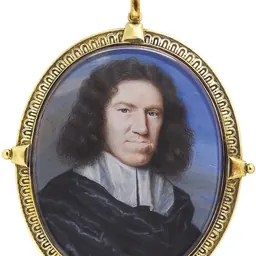
Stephen College (also Colledge) was baptised as Stephen Golledge in Hertfordshire (1637–1681) was an English joiner, activist Protestant, and supporter of the perjury underlying the fabricated Popish Plot. He was tried and executed for high treason, on somewhat dubious evidence, in 1681.
Life He was born in 1637, and worked in the trade of carpentry, hence his nickname "the Protestant joiner". College was a skilled joiner: evidence of his work still survives to this day, in the form of the wooden panelling that he made for the Stationers Hall in 1674. He became known as an anti-Catholic political speaker. He had been a Presbyterian until the Restoration of 1660 when he conformed to the Church of England. He made himself notorious by his declamations against the papists, by writing and singing political ballads, and by inventing a weapon for self-defence at close quarters, which he called 'the Protestant flail'.
He knew many persons of rank. He met his future wife Ann Enock of Swalcliffe Oxfordshire who was employed as a hand maiden by the Ann Countess of Rochester at Adderbury, Stephen was employed by her son John Wilmot, the Earl of Rochester, at his house in Ditchley Oxfordshire. They married and had a daughter, Edith. The Lord William Russell and Lady Berkeley showed him kindness, which inspired him with a desire to rise in the world. He was one of the bitterest opponents of Lord Stafford, and exulted over his condemnation and death.
Among the writings attributed to him are coarse attacks on Catholics including James, Duke of York, the Duchess of Portsmouth, and lawyers including Lord Chief Justice Scroggs, whom he hated for acquitting the royal physician, Sir George Wakeman, of the fabricated charge of attempting to assassinate the King by poison. Among these are 'Truth brought to Light, or Murder will out;' 'Justice in Masquerade, or Scroggs upon Scroggs;' another beginning' Since Justice Scroggs Pepys and Dean did bail;' 'The Pope's Advice and Benediction to his Judge and Jury in Eutopia;' 'The Wolf Justice ' (against Scroggs); 'A Caution,' and 'A Satyr'.
Trial and execution When Parliament moved to Oxford, in March 1681, College went there on horseback, ostentatiously displaying weapons and wearing defensive armour, speaking threateningly against King Charles II, and advocating resistance. In June 1681, after the condemnation of Edward Fitzharris, College was arrested, carried before Secretary of State Leoline Jenkins on 29 June, and committed to the Tower. He was indicted at the Old Bailey on 8 July for seditious words and actions, but saved by the influence of Slingsby Bethel and Henry Cornish, sheriffs of whig sympathies. They packed a grand jury who returned a verdict of ignoramus, or “we do not know" (i.e., "we know of no reason why he should stand trial"). (Oates falsely claimed to be a Doctor of Divinity, and endured much ridicule from Jeffreys as a result).
At nearly two o'clock in the morning the jury retired, and in half an hour gave their verdict of guilty. The court then adjourned until ten o'clock, when sentence of death was pronounced against him. He was visited in prison by two of the university divines, Dr. Marshall and Dr. Hall, who declared him to be penitent. His family was admitted to see him, and attempts were made to obtain a remission of the sentence, but the sole concession granted was that his quarters should be delivered to his friends. On 31 August he was taken in a cart to the place of execution, and made a long speech, chiefly to clear himself from the charge of being a papist. He was then hanged, drawn and quartered by Jack Ketch. His remains were buried the next evening at St. Gregory's Church, by St. Paul's.
Don’t just read it —
keep it.
Full-length biographies made to live with: read them, listen on the way to work, watch them tonight.
- E-book
- Audio
- Video
Instant download · yours to keep · every purchase keeps this site free
Important facts
People in Stephen College's life
Named in this biography and alive at the same time




Contemporaries
People whose lives overlapped Stephen College's






Frequently asked questions
Who was Stephen College?
English activist
When was Stephen College born?
Stephen College was born in 1635.
When did Stephen College die?
Stephen College died in 1681.
Sources & further reading
Cite this page
APA: Biography.guide. (2026). Stephen College. https://biography.guide/stephen-college/
MLA: "Stephen College." Biography.guide, https://biography.guide/stephen-college/.
Chicago: "Stephen College." Biography.guide. https://biography.guide/stephen-college/.
Data last updated: 2026-09-20 · Spot an error? Report a correction.
Page generated 2026-09-27 05:31 UTC