
Stephen Cole Kleene
American mathematician and theoretical computer scientist
About Stephen Cole Kleene
Lived 1909 – 1994 (aged 85). Stephen Cole Kleene was an American mathematician, computer scientist, philosopher, university teacher and logician, known for Intuitionism, Kleene star and Kleene's algorithm.
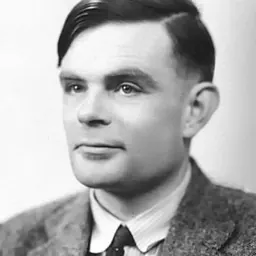
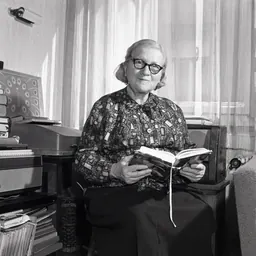
Stephen Cole Kleene ( ; January 5, 1909 – January 25, 1994) was an American mathematician and logician. One of the students of Alonzo Church, Kleene, along with Rózsa Péter, Alan Turing, Emil Post, and others, is best known as a founder of the branch of mathematical logic known as recursion theory, which subsequently helped to provide the foundations of theoretical computer science. Kleene's work grounds the study of computable functions. A number of mathematical concepts are named after him: Kleene hierarchy, Kleene algebra, the Kleene star (Kleene closure), Kleene's recursion theorem and the Kleene fixed-point theorem.
Biography Kleene was born to Alice Lena Cole, a published poet, and Gustav Adolph Kleene, a professor of economics at Trinity College, in Hartford, Connecticut. Gustav's parents were immigrants from Germany.
Kleene was awarded a bachelor's degree from Amherst College in 1930. He was awarded a Ph.D. in mathematics from Princeton University in 1934, where his thesis, entitled A Theory of Positive Integers in Formal Logic, was supervised by Alonzo Church. In the 1930s, he did important work on Church's lambda calculus. In 1935, he joined the mathematics department at the University of Wisconsin–Madison, where he spent nearly all of his career. After two years as an instructor, he was appointed assistant professor in 1937.
He was a visiting scholar at the Institute for Advanced Study in Princeton in 1939–1940. In 1941, he returned to Amherst College, where he spent one year as an associate professor of mathematics. In 1942, he married Nancy Elliott. In the same year he enlisted in the United States Navy Reserve as a lieutenant, attaining the rank of lieutenant commander by his discharge in 1946.
In 1946, Kleene returned to the University of Wisconsin-Madison, becoming a full professor in 1948 and the Cyrus C. MacDuffee professor of mathematics in 1964. He served two terms as the Chair of the Department of Mathematics and one term as the Chair of the Department of Numerical Analysis (later renamed the Department of Computer Science). He also served as Dean of the College of Letters and Science in 1969–1974. During his years at the University of Wisconsin he was thesis advisor to 13 Ph.D. students. He retired from the University of Wisconsin in 1979. In 1999 the mathematics library at the University of Wisconsin was renamed in his honor.
Kleene's teaching at Wisconsin resulted in three texts in mathematical logic, Kleene (1952), (1967), and Kleene and Vesley (1965). The first two are often cited and still in print. Kleene (1952) wrote alternative proofs to the Gödel's incompleteness theorems that enhanced their canonical status and made them easier to teach and understand. Kleene and Vesley (1965) is the classic American introduction to intuitionistic logic and mathematical intuitionism.
Kleene served as president of the Association for Symbolic Logic, 1956–1958, and of the International Union of History and Philosophy of Science, 1961. The importance of Kleene's work led to Daniel Dennett coining the saying, published in 1978, that "Kleeneness is next to Gödelness." In 1990, he was awarded the National Medal of Science.
Kleene and his wife Nancy Elliott had four children. He had a lifelong devotion to the family farm in Maine.
Selected publications
Don’t just read it —
keep it.
Full-length biographies made to live with: read them, listen on the way to work, watch them tonight.
- E-book
- Audio
- Video
Instant download · yours to keep · every purchase keeps this site free
Important facts
more
Realizability, Regular expressions, Smn theoremPeople in Stephen Cole Kleene's life
Named in this biography and alive at the same time




Related people
Same field, nearest in time
Contemporaries
People whose lives overlapped Stephen Cole Kleene's



Frequently asked questions
Who was Stephen Cole Kleene?
American mathematician and theoretical computer scientist (1909–1994)
When was Stephen Cole Kleene born?
Stephen Cole Kleene was born on 5 January 1909 in Hartford.
When did Stephen Cole Kleene die?
Stephen Cole Kleene died on 25 January 1994 in Madison.
What was Stephen Cole Kleene's occupation?
Stephen Cole Kleene was a mathematician, computer scientist, philosopher, university teacher and logician.
What was Stephen Cole Kleene known for?
Stephen Cole Kleene was known for Intuitionism, Kleene star, Kleene's algorithm, Kleene's theorem, Kleene–Mostowski hierarchy and Kleene–Rosser paradox.
What nationality was Stephen Cole Kleene?
Stephen Cole Kleene was American.
Sources & further reading
· Wikipedia: Stephen Cole Kleene
· DBpedia: Stephen Cole Kleene
Cite this page
APA: Biography.guide. (2026). Stephen Cole Kleene. https://biography.guide/stephen-cole-kleene/
MLA: "Stephen Cole Kleene." Biography.guide, https://biography.guide/stephen-cole-kleene/.
Chicago: "Stephen Cole Kleene." Biography.guide. https://biography.guide/stephen-cole-kleene/.
Data last updated: 2026-09-25 · Spot an error? Report a correction.
Page generated 2026-09-27 05:13 UTC