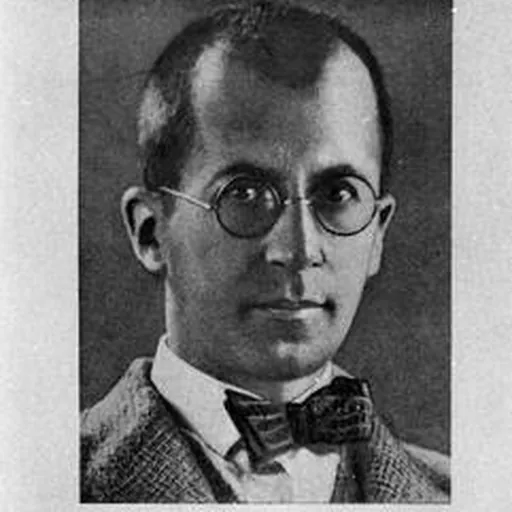
About Stephan Cohn-Vossen
Lived 1902 – 1936 (aged 34). Stephan Cohn-Vossen was a German and Russian mathematician, known for Cohn-Vossen's inequality.
Stefan Cohn-Vossen (28 May 1902 – 25 June 1936) was a mathematician, specializing in differential geometry. He is best known for his collaboration with David Hilbert on the 1932 book Anschauliche Geometrie, translated into English as Geometry and the Imagination. Both Cohn-Vossen's inequality and the Cohn-Vossen transformation are named after him. He also proved the first version of the splitting theorem.
Biography Stefan Cohn-Vossen was born 28 May, 1902 to Emanuel Cohn, a lawyer, and Hedwig (née Vossen) in Breslau (then a city in the Kingdom of Prussia; now Wrocław in Poland). He attended Göttingen in 1920; his notes from Hilbert's lectures on geometry at that time would form the basis for Anschauliche Geometrie. He wrote a 1924 doctoral dissertation at the University of Breslau (now the University of Wrocław) under the supervision of Adolf Kneser. In 1929 he completed his habilitation at Göttingen with his thesis Non-rigid closed surfaces under Richard Courant.
Cohn-Vossen became a professor at the University of Cologne in 1930. In 1931, Cohn-Vossen married Dr. Margot Maria Elfriede Ranft. Anschauliche Geometrie was published in 1932; the book was well reviewed and by association with Hilbert, Cohn-Vossen became well known. He was barred from lecturing in 1933 under Nazi racial legislation, because he was Jewish.
Unable to work in Germany, Cohn-Vossen moved to Switzerland in 1934, first to Locarno and then to Zurich, where he taught gymnasium. His son, , was born in Zurich in September 1934. Both Courant and Karl Löwner recommended Cohn-Vossen for positions abroad, at Istanbul and Dartmouth respectively; ultimately he emigrated to the USSR, with support from Herman Müntz, Fritz Houtermans, Pavel Alexandrov, and Heinz Hopf, where he was appointed to the Academy of Sciences and worked at Leningrad State University and the Steklov Institute.
Cohn-Vossen died in Moscow from pneumonia in 1936. Despite his short time in the USSR, Cohn-Vossen had a significant impact on the development of differential geometry "in the large" in Soviet mathematics.
Following Cohn-Vossen's death, his widow, Dr. Elfriede Cohn-Vossen, remarried Alfred Kurella, returned to Germany in 1954, and died in 1957. His son, Richard, became a filmmaker. In 1946, unaware of his death, the University of Cologne offered Cohn-Vossen his professorship back.
Publications
Books
Articles
Don’t just read it —
keep it.
Full-length biographies made to live with: read them, listen on the way to work, watch them tonight.
- E-book
- Audio
- Video
Instant download · yours to keep · every purchase keeps this site free
Important facts
People in Stephan Cohn-Vossen's life
Named in this biography and alive at the same time



Related people
Same field, nearest in time
Contemporaries
People whose lives overlapped Stephan Cohn-Vossen's



Frequently asked questions
Who was Stephan Cohn-Vossen?
Russian mathematician (1902–1936)
When was Stephan Cohn-Vossen born?
Stephan Cohn-Vossen was born on 28 May 1902 in Wrocław.
When did Stephan Cohn-Vossen die?
Stephan Cohn-Vossen died on 25 June 1936 in Moscow.
What was Stephan Cohn-Vossen's occupation?
Stephan Cohn-Vossen was a mathematician.
What was Stephan Cohn-Vossen known for?
Stephan Cohn-Vossen was known for Cohn-Vossen's inequality.
What nationality was Stephan Cohn-Vossen?
Stephan Cohn-Vossen was German and Russian.
Sources & further reading
· Wikipedia: Stephan Cohn-Vossen
Cite this page
APA: Biography.guide. (2026). Stephan Cohn-Vossen. https://biography.guide/stephan-cohn-vossen/
MLA: "Stephan Cohn-Vossen." Biography.guide, https://biography.guide/stephan-cohn-vossen/.
Chicago: "Stephan Cohn-Vossen." Biography.guide. https://biography.guide/stephan-cohn-vossen/.
Data last updated: 2026-09-20 · Spot an error? Report a correction.
Portrait: Wikimedia Commons · author & licence
Page generated 2026-09-27 04:58 UTC