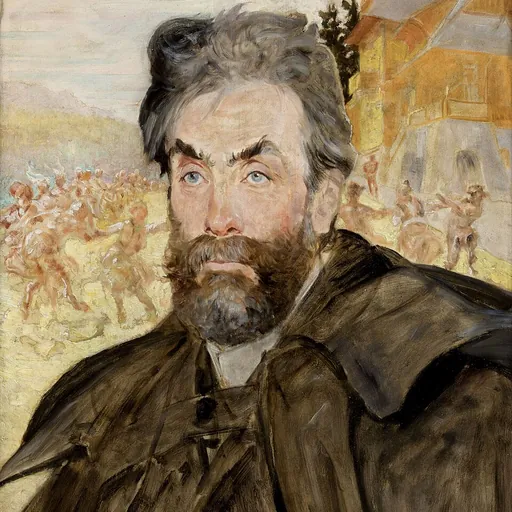
About Stanisław Witkiewicz
Lived 1851 – 1915 (aged 64). Stanisław Witkiewicz was a Russian painter, architect, writer and art critic.
Stanisław Witkiewicz (; 8 May 1851 – 5 September 1915 painter, art theoretician, and amateur architect, known for his creation of "Zakopane Style".
Life Witkiewicz was born in the Samogitian village of Pašiaušė , present-day Lithuania, ruled at the time by the Russian Empire. His parents were Ignacy and Elwira Witkiewicz. Elwira came from a wealthy Szemiot family and grew up in a palace in Diktariškiai.
Ignacy Witkiewicz at the age of 17 was a participant in the November Uprising, and after it ended he settled on the family estate and took up agriculture. The legend of his brother Jan Prosper, sentenced to long-term military service for his patriotic activities at school age, was alive in the family. In the Russian army, he made a career as a researcher of Central Asia and a diplomat, and in the family tradition was considered a “Polish Wallenrod,” seeking to provoke a Russian-British conflict. Elwira's brother was Franciszek Szemiot, a commander in the November Uprising, then traveling the world looking for opportunities to fight for a free Poland, he was friends with Adam Mickiewicz and Juliusz Słowacki, the latter dedicated a poem to him. The memory of heroic family members influenced the patriotic atmosphere of the household.
Ignacy and Elwira had twelve children, the first daughter Elwira was born in 1840, followed by Angelika, Wiktor, Anna, Barbara, Jan, Ignacy, Stanisław, Maria, Aniela and Eugenia, born in 1856. Three daughters, Angelika, Anna and Justyna died in childhood.
The Witkiewicz family, especially Elwira, sought to raise the consciousness of the people, adhering to democratic views similar to those preached by Szymon Konarski's Association of the Polish People. Elwira founded a hospital for peasants in Pašiaušė and a school for their children, where her eldest daughter taught them in Polish and Lithuanian. Lithuanian was also taught to all the Witkiewicz children.
As an adolescent, he spent several years in Siberian Tomsk, where his parents and two older siblings were exiled for their support of the January Uprising.
Villa Konstantynówka in Zakopane. Joseph Conrad stayed there in 1914
In 1886, he visited Zakopane for the first time. He developed a fascination with the Tatra Mountains, the Podhale highlanders and their vernacular traditions. His ambition became to create a Polish national style based on the highlanders' art, which he considered quintessentially Polish.
He formulated the Zakopane Style (styl zakopiański) (also known as Witkiewicz Style (styl witkiewiczowski)) in architecture, in which he designed homes and interiors for well-off, artistically-minded Poles including Bronisława Kondratowicz. Chrześcijaństwo i katechizm. O nauce religii w szkołach galicyjskich (Christianity and the Catechism. About the Teaching of Religion in Galician Schools) (1904), Wallenrodyzm czy znikczemnienie (Wallenrodism or Becoming Ignoble) (published in Kultura Polski 1917, a fragment of the work Studium o duszy polskiej po 1863 roku (A Study of the Polish Soul after 1863), Przełom (Turning Point), Życie, etyka i rewolucja (Life, Ethics and Revolution), Na przełęczy. Wrażenia i obrazy z Tatr (On the Mountain Pass. Impressions and images from the Tatras) (1891, first published in Tygodnik Illustrowany 1889–1890), Po latach (Years Later) (1905), Z Tatr (From the Tatras) (1907), Monographs: Juliusz Kossak (1900), Aleksander Gierymski (1903), Matejko (1908).
Selected paintings
Don’t just read it —
keep it.
Full-length biographies made to live with: read them, listen on the way to work, watch them tonight.
- E-book
- Audio
- Video
Instant download · yours to keep · every purchase keeps this site free
Important facts
People in Stanisław Witkiewicz's life
Named in this biography and alive at the same time



Related people
Same field, nearest in time
Contemporaries
People whose lives overlapped Stanisław Witkiewicz's


Frequently asked questions
Who was Stanisław Witkiewicz?
Polish artist, writer and architect (1851-1915)
When was Stanisław Witkiewicz born?
Stanisław Witkiewicz was born on 21 May 1851 in Pašiaušė.
When did Stanisław Witkiewicz die?
Stanisław Witkiewicz died on 5 November 1915 in Lovran.
What was Stanisław Witkiewicz's occupation?
Stanisław Witkiewicz was a painter, architect, writer and art critic.
What nationality was Stanisław Witkiewicz?
Stanisław Witkiewicz was Russian.
Sources & further reading
· Wikipedia: Stanisław Witkiewicz
· DBpedia: Stanisław Witkiewicz
Cite this page
APA: Biography.guide. (2026). Stanisław Witkiewicz. https://biography.guide/stanislaw-witkiewicz/
MLA: "Stanisław Witkiewicz." Biography.guide, https://biography.guide/stanislaw-witkiewicz/.
Chicago: "Stanisław Witkiewicz." Biography.guide. https://biography.guide/stanislaw-witkiewicz/.
Data last updated: 2026-09-23 · Spot an error? Report a correction.
Portrait: Wikimedia Commons · author & licence
Page generated 2026-09-27 05:06 UTC