
Stamatis Voulgaris
Greek painter and urban planner
About Stamatis Voulgaris
Lived 1774 – 1842 (aged 67–68). Stamatis Voulgaris was an architect, architecture, military officer and urbanism, known for Greece, Morea expedition and Patras.
Stamatis Voulgaris or Stamati Bulgari , was a Greek painter, architect and the first urban planner of modern Greece. He was born in Lefkimmi in the island of Corfu, Venetian Ionian Islands in 1774, and died in 1842. He was also an officer in the French army and had been also granted French nationality.
Life
Youth Stamatis Voulgaris was born in Lefkimmi, on the island of Corfu in the Ionian Islands (then a Venetian possession), in 1774. His parents were Alexandros Voulgaris of Aloysios and Loukia Pandis. From the age of seven, he attended school at St. Justine's monastery in Garitsa, where he learned his first letters. There, he was a classmate of Ioannis Kapodistrias, the future governor of Greece. An interesting incident led him to his decision to become an urban planner. During the Russian-Turkish siege of 1798–1799, while in the vicinity of the San Giacomo theater in Corfu, a cannon ball fired from a Russian vessel fell beside young Voulgaris without immediately exploding. He immediately grabbed the fuse and then neutralized it, thus saving the theater and a whole French military detachment which passed nearby with heavy weapons and ammunition. French General Louis François Jean Chabot, a friend of Napoleon, to honor his bravery, enlisted him in the French army. When the French left, the young man followed them to Paris, where he studied urban planning in a military academy.
In 1808, he was appointed lieutenant of the Engineers. At the same time, he studied at the Collège des Quatre-Nations (which now houses the headquarters of the Institut de France). He became an engineer geographer and an extraordinary designer in the service of the ministry's Dépôt de la Guerre (a depository of maps and archives). He participated in several military missions, notably between 1810 and 1814, as an employee at the General Staff of the governor of the Ionian Islands (now again under French rule), General François-Xavier Donzelot. After the French surrendered the Islands in 1814, he was arrested by the English and imprisoned in Malta. When he was released, he undertook a new special mission in Epirus and Albania, then was recalled to France to fight at the Battle of Waterloo on 18 June 1815. After Napoleon's defeat, he was removed from the army by the Bourbon Restoration, then was reinstated and raised to the rank of captain of the General Staff. On 30 January 1817, he was officially naturalized as a French citizen by order of King Louis XVIII.
Barbizon School
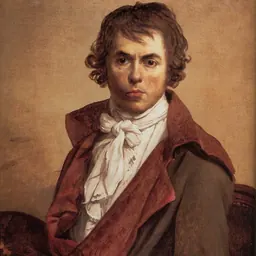
Voulgaris followed several painting courses in parallel with his studies, in particular in the atelier of the renown painter Jacques-Louis David. This colony of landscape artists (called the "open airists"), grouping painters such as Charles-François Daubigny, Théodore Rousseau, Jean-François Millet or Gustave Courbet, were coming together a few kilometers from Paris to work in the forest of Fontainebleau which was for them a source of inspiration.
Voulgaris and Corot thus lived together in the village of Chailly-en-Bière from July 1821. Corot drew several portraits of Voulgaris, "in his bed" or "sitting in front of his easel" (he wrote at the bottom of the latter with a graphite stylus: "Stamati Bulgari in rage with reason"). Voulgaris also painted in 1821, in his Souvenirs (published in 1835), a literary painting of this forest of Fontainebleau which used to inspire him with a "meditative and religious feeling". This description is considered to be the very first known of this colony of artists.
Spain expedition and travel to the Antilles In 1823 he fought in the 3rd Corps of the Pyrenees Army during the Spanish military expedition led by France against the Spanish liberals to restore King Ferdinand VII to his throne. On the occasion of this campaign, he wrote two chapters in his Souvenirs from the Alhambra Palace in Granada.
Morea expedition and urban planning in Greece
Since 1821, the Greek War of Independence was raging in Greece, which had not left Voulgaris indifferent: in 1825 he wrote in his Souvenirs: "Grecs, aux armes! aux armes!", They were all four attached to the general staff of General Maison, commander-in-chief of the Morea military expedition, whose mission was to liberate the Peloponnese from the Turkish-Egyptian occupation troops of Ibrahim Pasha. The artillery captain Pauzié founded the Artillery School (Σχoλή Πυρoβoλικoύ) and then the Central Military Academy of the Evelpides (Κεντρική Στρατιωτική Σχολή Ευελπίδων) in 1828 on the model of the French École Polytechnique. Captain Peytier drew the first modern map of the Peloponnese.
Kapodistrias appreciated the expertise of Voulgaris. The two men met first in Italy in Ancona, and then embarked together aboard the frigate HMS Warspite for Nafplio in Greece, where they arrived on 7 January 1828. Kapodistrias asked Voulgaris to conduct a study on the search for a suitable location in the city to build a colony for war refugees. Allocation of other urban plans followed, such as the urban planning of the cities of Nafplio (historic center and suburb of Prónoia), Tripoli, Pylos and Argos, in collaboration with Captain Garnot.
Yet, the most important urban planning mission of Voulgaris was the planning of the city of Patras in 1829, on Kapodistrias' order. He also planned to build nine symmetrical public squares, quays, vast and long boulevards or avenues bordered by trees and perfectly ventilated, fountains, arcades, green areas round the Patras Castle and three main doors which would open on the roads to Gastouni, Kalavryta and Corinth.
Decorations
Publications Stamatis Voulgaris, Examen moral des principaux tableaux de la galerie du Luxembourg en 1818, et considérations sur l'état actuel de la peinture en France, par M. Stamati Bulgari, (Gallica – BnF), Paris, 1827. Stamatis Voulgaris, Notice sur le comte Jean Capodistrias, Président de la Grèce, suivie d'un extrait de sa correspondance ; par Stamati Bulgari, Chef de bataillon au Corps Royal d’État-major, Delaunay, Paris, 1832. Stamatis Voulgaris, Souvenirs de Stamati Bulgari, Chef de bataillon au Corps Royal d'État-major, en retraite, (Gallica – BnF), A. Pihan de La Forest, Paris, 1835.
Don’t just read it —
keep it.
Full-length biographies made to live with: read them, listen on the way to work, watch them tonight.
- E-book
- Audio
- Video
Instant download · yours to keep · every purchase keeps this site free
Important facts
People in Stamatis Voulgaris's life
Named in this biography and alive at the same time




Related people
Same field, nearest in time

Contemporaries
People whose lives overlapped Stamatis Voulgaris's




Frequently asked questions
Who was Stamatis Voulgaris?
Greek painter and urban planner
When was Stamatis Voulgaris born?
Stamatis Voulgaris was born in 1774 in Lefkimmi.
When did Stamatis Voulgaris die?
Stamatis Voulgaris died in 1842 in Lefkimmi.
What was Stamatis Voulgaris's occupation?
Stamatis Voulgaris was an architect, architecture, military officer and urbanism.
What was Stamatis Voulgaris known for?
Stamatis Voulgaris was known for Greece, Morea expedition and Patras.
Sources & further reading
· Wikipedia: Stamatis Voulgaris
Cite this page
APA: Biography.guide. (2026). Stamatis Voulgaris. https://biography.guide/stamatis-voulgaris/
MLA: "Stamatis Voulgaris." Biography.guide, https://biography.guide/stamatis-voulgaris/.
Chicago: "Stamatis Voulgaris." Biography.guide. https://biography.guide/stamatis-voulgaris/.
Data last updated: 2026-09-22 · Spot an error? Report a correction.
Page generated 2026-09-27 05:27 UTC