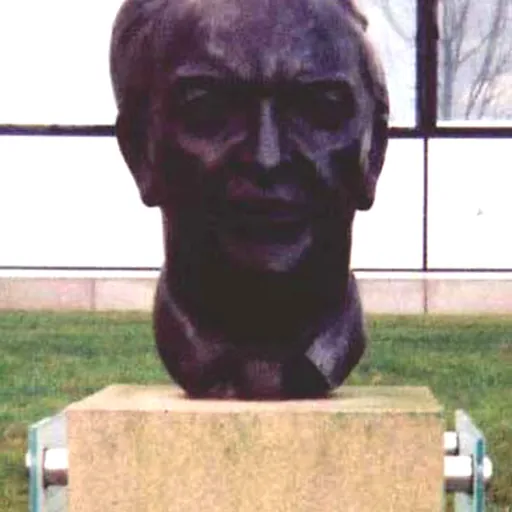
About Sorley MacLean
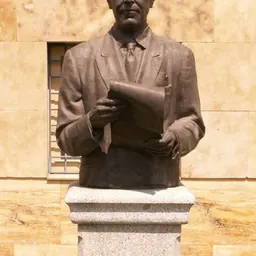
Lived 1911 – 1996 (aged 85). Sorley MacLean was a British poet, translator, writer, school teacher, education in Scotland and head teacher.
Sorley MacLean (; 26 October 1911 – 24 November 1996) was a Scottish Gaelic poet, described by the Scottish Poetry Library as "one of the major Scottish poets of the modern era" because of his "mastery of his chosen medium and his engagement with the European poetic tradition and European politics". Nobel Prize Laureate Seamus Heaney credited MacLean with saving Scottish Gaelic poetry. Nicolson had been involved in the ILP and imprisoned as a conscientious objector in WWI and was also a noted historian and Gaelic scholar. Of especial note was MacLean's paternal grandmother, Mary Matheson, whose family had been evicted from Lochalsh in the 18th century. Until her death in 1923, she lived with the family and taught MacLean many traditional songs from Kintail and Lochalsh, as well as Skye. Calvinism taught that God would save a small portion of humanity, the elect, while the vast majority were doomed by the sinfulness inherent in human nature. Only 5% of the congregation took communion; the remainder were considered mere "adherents" who were probably destined for eternal torment in hell. Free Presbyterians believed that the Free Church was too lenient, let alone the Church of Scotland. They prohibited any form of amusement on the Sabbath, but had a rich tradition of unaccompanied psalm singing.
MacLean later said that he had abandoned religion for socialism at the age of twelve, as he refused to accept that a majority of human beings were consigned to eternal damnation. In 1941, he wrote that "perhaps my obsession with the cause of the unhappy, the unsuccessful, the oppressed comes from this." The pessimism of the Calvinist tradition had a strong impact on his world-view, and he also retained "a puritanical contempt for mere worldly riches and power". MacLean defended the Free Presbyterian Church against opponents who had little familiarity with it, once describing Free Presbyterian Church elders as "saintly, just saintly men". Sometimes he altered his poetry to avoid offending the religious members of his family. He also admired the linguistic and literary sophistication and creativity of Protestant sermons in Gaelic. The wide vocabulary, high register, and passion of these sermons had a significant impact on his poetic style.
1930s He was educated at Raasay Primary School and Portree Secondary School. He was involved in founding the institution and also served on its board. of the other poems, the most significant was the long narrative poem An Cuilthionn. He received seven honorary degrees. Twice, he was the honorary head of the Gaelic Society of Inverness, in 1970 and 1982; he was made honorary president of the Saltire Society in 1985. Douglas Young wrote that "the best poetry written in our generation in the British Isles has been in Scottish Gaelic, by Sorley MacLean." John MacInnes called him a "magisterial writer" who "[pushed] Gaelic to its limits". He said that it is "truly astonishing" that Gaelic, so long minoritized, could have produced a writer like MacLean, who could not express what he had to say in any other language: "Somhairle MacGill-Eain needed Gaelic, and Gaelic needed Somhairle MacGill-Eain". According to Iain Crichton Smith, translator of MacLean's poetry, Dàin do Eimhir was "the greatest Gaelic book of this century", an assessment with which Christopher Whyte agreed. According to Maoilios Caimbeul, MacLean was the best Scottish Gaelic poet of all time. Smith compared the calibre of MacLean's love poetry to that of Catallus and William Butler Yeats. Nobel Prize Laureate Seamus Heaney said that MacLean had "saved Gaelic poetry... for all time". to set some of MacLean's poems to music.
In the Gaelic-speaking world, MacLean's influence has been pervasive and persistent. Poet Aonghas MacNeacail started writing in English, because "My education gave me to believe that Gaelic literature was dead"; he credited MacLean with convincing him otherwise and inspiring him to write in Gaelic. The Gaelic rock band Runrig once invited MacLean to come onstage for a poetry reading. However, MacLean had less impact on rural Gaelic-speaking communities. Novelist Angus Peter Campbell wrote that he preferred the work of local Uist bards to MacLean, and he believed that other Uist people felt the same. Australian poet Les Murray acknowledged MacLean's influence on his work.
A film, Hallaig, was made in 1984 by Timothy Neat, including a discussion by MacLean of the dominant influences on his poetry, with commentary by Smith and Heaney, and substantial passages from the poem and other work, along with extracts of Gaelic song. The poem also forms part of the lyrics of Peter Maxwell Davies' opera The Jacobite Rising; and MacLean's own reading of it in English and in Gaelic was sampled by Martyn Bennett in his album Bothy Culture for a track of the same name.
A controversy erupted in 2000, when John MacLeod, chief of Clan MacLeod, put the Black Cuillin mountain range of Skye on the market in order to finance the repair of Dunvegan Castle. His real estate agency, Savills, used excerpts from An Cuilthionn to advertise the property. Many people found this to be an inappropriate use of MacLean's work. Savills apologized unreservedly, which was accepted by Renee MacLean.
Selected works Poetry collections
Literary criticism
Don’t just read it —
keep it.
Full-length biographies made to live with: read them, listen on the way to work, watch them tonight.
- E-book
- Audio
- Video
Instant download · yours to keep · every purchase keeps this site free
Important facts
People in Sorley MacLean's life
Named in this biography and alive at the same time




Related people
Same field, nearest in time

Contemporaries
People whose lives overlapped Sorley MacLean's






Frequently asked questions
Who was Sorley MacLean?
Scottish poet (1911–1996)
When was Sorley MacLean born?
Sorley MacLean was born on 21 October 1911 in Isle of Raasay.
When did Sorley MacLean die?
Sorley MacLean died on 24 November 1996 in Inner Hebrides.
What was Sorley MacLean's occupation?
Sorley MacLean was a poet, translator, writer, school teacher, education in Scotland and head teacher.
What nationality was Sorley MacLean?
Sorley MacLean was British.
Sources & further reading
Cite this page
APA: Biography.guide. (2026). Sorley MacLean. https://biography.guide/sorley-maclean/
MLA: "Sorley MacLean." Biography.guide, https://biography.guide/sorley-maclean/.
Chicago: "Sorley MacLean." Biography.guide. https://biography.guide/sorley-maclean/.
Data last updated: 2026-09-22 · Spot an error? Report a correction.
Portrait: Wikimedia Commons · author & licence
Page generated 2026-09-27 05:03 UTC