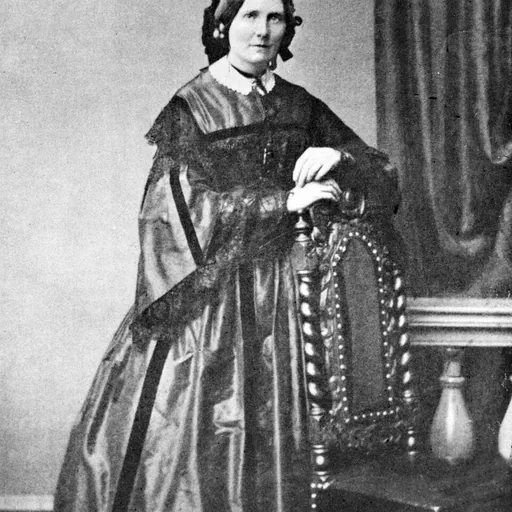
About Sophie Dedekam
Lived 1820 – 1894 (aged 74). Sophie Dedekam was a Norwegian composer and diarist.
Sophie Dedekam (1 April 18201 June 1894) was a Norwegian composer and diarist, one of the most significant Norwegian women composers of the 19th century, and principally remembered today for a hymn included in the Church of Norway Hymn Book and for her published recollections of a visit to Paris.
Dedekam was born in the Norwegian coastal town of Arendal, the daughter of the town's mayor. She became active in the social and cultural life of the city at an early age, where she sang and played the piano. She traveled to Paris when she was 25 for a visit of several weeks, recording her experiences in letters and in a diary that were published after she died. Dedekam did some public concertizing as a singer and collaborative pianist early in her life, but most of her performing was limited to amateur venues in the Arendal area or at home with her family and friends.
Dedekam also composed songs from an early age, again mostly for local consumption. Many of her pieces were eventually published by Wilhelm Hansen Music Publishers (known today as Edition Wilhelm Hansen) in Copenhagen. A number of her songs became quite well known in Norway as a result, but Sophie rarely received recognition as their composer, nor did she seek it. Two of her songs were also published by Theodora Cormontan, another Norwegian woman composer from Arendal.
As an unmarried woman in 19th century Norway, Sophie Dedekam's economic vitality diminished after her father's death. She spent the remainder of her life staying with various friends and relatives, by all accounts a happy person who brought joy to those around her. She died at the farm of her sister and her sister's husband in 1894.
Early life Sophie Hedvig Dedekam was born in a southern Norwegian coastal town whose strong sea-related industries inspired a cosmopolitan environment, with organizations like the Dramatic Society and the Musical Society to help cultivate her talents. Her father, Morten Smith Dedekam (1793–1861), attended a private school in Copenhagen and studied business in England before returning to Arendal to work as a merchant. He entered local politics in 1823 and became the town's first mayor in 1837, a position he held until his death. Interested in history, Dedekam helped found the Arendal Museum in 1831 and served as its first director. Also passionate for the theater, as an amateur actor he appeared in over 160 roles.
In 1819 Morton Dedekam married his 17-year-old cousin, Margrethe Sophie Ebbel (1802–1854). The couple had five daughters and one son who lived to adulthood. An accomplished amateur pianist, Margrethe offered music lessons to her daughter, constituting the extent of Sophie's musical training. Sophie's autobiographic almanacs record the early manifestation of this training through singing and playing the piano at various society events to which she had access through her parents’ social and economic position. Her almanacs also note early efforts at composition, where Sophie described melodies coming to her intact, ready to be immediately written down. School records describe Sophie as an intelligent, lively, and engaged student. One of her teachers wrote "Sophie’s diligence, attention, and thoughtfulness always please me."
Writing from Paris At the age of 25, Sophie Dedekam traveled to Paris for a month's visit. She faithfully recorded in letters and in her diary her impressions of the music, theater, and art she encountered there. After hearing Meyerbeer’s "Robert le diable" she wrote "I could feel the blood rush from my cheeks . . . My God and Father, it was delightful! Yes, everything was glorious beyond measure; there are no words to describe one’s feelings when hearing such music." Upon visiting the Louvre, she penned "No one can blame an Arendal girl for getting carried away." Emma Ree also recalled "Ah, I remember the evenings when she would gather everyone, young and old, family members and guests, around the piano. We loved to hear her sing, and her repertoire was great, ranging from Norwegian folk songs to lieder by Schubert to Danish vaudeville songs to the music of Halfdan Kjerulf and the Gunnar Wennerberg 'Psalms of David,' as well as her own songs. Each of us had a personal favorite. On the whole, she inspired us to appreciate great literature, great art, and everything that is pure and good."
In the early 1880s Dedekam would turn to another woman composer from Arendal by the name of Theodora Cormontan, the first woman professional music publisher in Norway. The Cormontan Music Publishing Company released two Dedekam songs in 1885 with the apparent intent of publishing more than 40 of them, but Arendal's severe economic depression of 1886 resulted in the dissolution of Cormontan's business.
Dedekam's most enduring set of songs is her "6 Sange: udsatte for to syngestemmer og pianoforte" ("6 Songs for two voices and piano"), originally published by Wilhelm Hansen and reissued by Recital Publications in 2009. The collection includes "Sang af ‘Arne’" (text by Bjørnstjerne Bjørnson), "Naar Solen ganger til Hvile" (text by Valdemar Adolph Thisted), "De to Drosler" (text by Christian Winther), "Taaren" (text by Hans Christian Andersen), "Ungbirken" (text by Jørgen Moe), and "Hvad jeg elsker" (text again by Andersen). The works are representative of Dedekam's compositional style: engaging melodies, a literate sensitivity to the texts, and straightforward accompaniments. Their popularity during Sophie's lifetime and the lack of recognition she received for them are documented by Emma Ree as she notes how her aunt was amused "when she traveled along the coast [of Norway] and heard girls on the steamer and various groups wherever she went singing her songs 'Naar Solen ganger til Hvile,' 'Taaren,' 'De to Drosler,' etc. and nobody knew she was the composer. Her songs had all become folk songs."
Hymns
The melody for which Sophie Dedekam is best remembered is "Naar Solen ganger til Hvile," originally composed with a text by Valdemar Adolph Thisted (1815–1887). Today it is better known in Norway as the tune associated with "Nå lukker solen sitt øye" by Christian Richardt (1831–1892). The sweet, simple melody and childhood-oriented poem that begins "Now the sun closes its eyes and I close mine" result in a beloved evening prayer song that appears in the current Church of Norway Hymn Book. It can also be found in the current Swedish hymn book with the title "Hur ljuvligt det är att möta," a setting of a Kirsten D. Hansen text translated by Jakob Bystrom in 1903. As hymn number 301, it is one of 325 ecumenical hymns common to almost all Christian denominations in Sweden.
This hymn tune, often referred to as "Dedekam," was utilized in a number of Norwegian-American Lutheran hymnals of the late 19th and early 20th centuries. These include Concordia Norsk (Augsburg Publishing, 1916), Fredsbasumen (Skoog and DeLander, 1899), and Sangbogen (edited by Reimstad and Gjertsen, 1912). Texts set to the Dedekam tune in these hymnals include "Hvor deilig det er at mode" by Kirsten D. Hansen (1850–1902), "Der er en underfud kilde" by Herman Richard Steffensen (1853–1907), "Et barn I dag er os givet" by Betty Ehrenborg (1818-1880), and "Her vandrer en pilegrimsskare" (uncredited author). The Dedekam hymn tune continues to appear in hymnals later in the 20th and into the 21st centuries, including The Psalter Hymnal (blue) published by the United Reformed Churches in North America and The Book of Psalms for Singing published by the Reformed Presbyterian Church of North America. Other tunes by Dedekam appeared in early Norwegian-American hymnals, notably "Taaren," with a text by H. C. Andersen.
List of Works
The following 42 song titles (from the never-completed Cormontan Music Publishing Company's series "Romance og sange med piano af Sophie Dedekam") are listed on the front covers of Nos. 1 & 2, the only two Dedekam songs actually published by Theodora Cormontan. The poets are noted in parentheses.
"1. En Aften ved Alsteren. (Johan Sebastian Welhaven) "2. Sympathier. (Welhaven) "3. Sangens Væld. (Welhaven) "4. Troubaduren. (Welhaven) "5. Af "Kongedatterens Brudefart." (Andreas Munch) "6. Svundne Dage. Efter det Engelske. (Munch) "7. Aftensang. (Johann Wolfgang von Goethe) "8. Lifvet och dödeb. (Vitalis) "9. Dansemusik. (Palludan-Müller) "10. Ved du hvorfor? (Christian Molbech) "11. Barnets Sång. "12. Svalen. (Missionær Borchgrevinck.) "13. Vaar Bebudelse. (Christian Richardt) "14. Den gamle Mester. (Jörgen Moe) "15. Forvandling. (Richardt) "16. Det gamle Arnested. (Oversat fra "Quechy.") "17. Hvar är de christnas fosterland? "18. Vill du gå med? "19. Træet. (Bjørnstjerne Bjørnson) "20. Vaakjending. (Rördam) "21. Naar Solen skinner. "22. Höstsang. (Welhaven) "23. Nattetanker. (Welhaven) "24. Et Liv. (Hans Christian Andersen) "25. Sabbat-Stilhed. (Munch) "26. Hvor mange Gange skal Gud takkes. (Henrik Wergeland) "27. J en sövnlös Nat. "28. En liten tid. "29. Gjensyn. (Palludan-Müller) "30. Liden Fugl. (Andreas Hansen) "31. Solnedgang. (Molbech) "32. Sang af "Arne." (Bjørnson) "33. Hjemmets Magt. (Welhaven) "34. Jeg har ingen Hansker, jeg har ingen Hat. "35. Sommerfuglen. (After Lamartine) "36. De to Engle. (Bernhard Severin Ingemann) "37. Naar Solen ganger til Hvile. (Valdemar Adolph Thisted) "38. Hvad jeg elsker. (Andersen) "39. Ungbirken. (Moe) "40. De to Drossler. (Christian Winther) "41. Taaren. (Andersen) "42. Draaben. (Schaldemose)
Don’t just read it —
keep it.
Full-length biographies made to live with: read them, listen on the way to work, watch them tonight.
- E-book
- Audio
- Video
Instant download · yours to keep · every purchase keeps this site free
Important facts
People in Sophie Dedekam's life
Named in this biography and alive at the same time



Related people
Same field, nearest in time

Contemporaries
People whose lives overlapped Sophie Dedekam's




Frequently asked questions
Who was Sophie Dedekam?
Norwegian composer
When was Sophie Dedekam born?
Sophie Dedekam was born on 1 April 1820 in Arendal Municipality.
When did Sophie Dedekam die?
Sophie Dedekam died on 1 June 1894 in Ottestad.
What was Sophie Dedekam's occupation?
Sophie Dedekam was a composer and diarist.
What nationality was Sophie Dedekam?
Sophie Dedekam was Norwegian.
Sources & further reading
Cite this page
APA: Biography.guide. (2026). Sophie Dedekam. https://biography.guide/sophie-dedekam/
MLA: "Sophie Dedekam." Biography.guide, https://biography.guide/sophie-dedekam/.
Chicago: "Sophie Dedekam." Biography.guide. https://biography.guide/sophie-dedekam/.
Data last updated: 2026-09-22 · Spot an error? Report a correction.
Portrait: Wikimedia Commons · author & licence
Page generated 2026-09-27 05:01 UTC