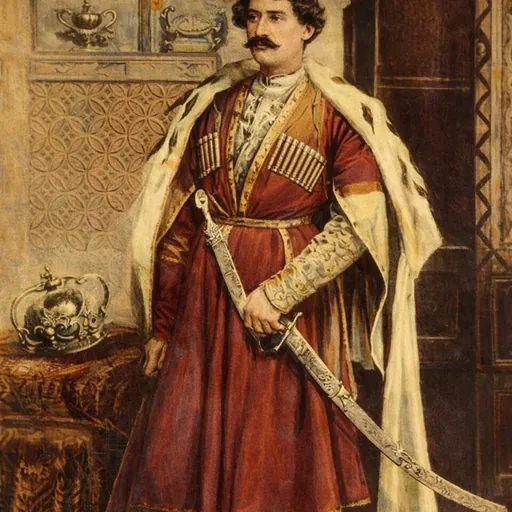
About Solomon II of Imereti
Lived 1772 – 1815 (aged 42–43). Solomon II of Imereti was a monarch, public figure and royalty.
Solomon II (born as David) (; 1772 – 7 February 1815) was a Georgian monarch of the Bagrationi dynasty, who reigned as the last king (mepe) of Imereti in western Georgia from 1789 to 1790 and from 1792 until his deposition by the Imperial Russian government in 1810.
Biography Early years He was born as David, to Prince Archil of Imereti, brother of King Solomon I of Imereti, by his wife Helen, daughter of King Heraclius II of Georgia. Solomon I, who died in 1784 without a male heir, named his nephew David as his successor. However, Solomon's uncle David II prevented him, and another rival prince, George, from being crowned as king and occupied the throne, leading to a civil war. Heraclius II interfered on behalf of his grandson and sent in an army, defeating David II at the Battle of Matkhoji on June 11, 1789. David, son of Archil, was crowned as King of Imereti under the name of Solomon II, but David II continued his efforts to resume the throne until his final defeat in 1792. He ruled under the protection of his maternal grandfather, Heraclius II, and continued Solomon I's policy of restricting the powers of feudal aristocracy. In 1795, he and Heraclius fought with a small Imeretian force at the Battle of Krtsanisi against the Persians, only to be completely defeated by the latter.
Later years After Russia quelled the uprising, Solomon fled to the Ottoman possessions in Trebizond where he died in 1815 and was buried at the Saint Gregory of Nyssa Church. The body of Solomon II, the last reigning Georgian king, was moved from Trebizond to Gelati Monastery, Georgia, in 1990.
Family Solomon was married to Princess Mariam Dadiani (1783–1841), daughter of Katsia Dadiani, Prince of Mingrelia, with no children.
Solomon II's attitude towards the church The spiritual teacher of Solomon II was Hilarion (secular name Iesse Kanchaveli). Their close relationship and shared vision for the state led to many beneficial changes in the kingdom. In order to develop and strengthen religious and state thinking, the king reinforced the Church and promoted worthy individuals. King Solomon II rewarded the faithful princes of the country with estates, granted lands and tax privileges to the Church of Jerusalem in Imereti, and reissued the royal charter of the Bichvinta Cathedral. On July 27, 2005, the Georgian Orthodox Church canonized Solomon II as a saint in recognition of his religious merits and devotion to the homeland.
Don’t just read it —
keep it.
Full-length biographies made to live with: read them, listen on the way to work, watch them tonight.
- E-book
- Audio
- Video
Instant download · yours to keep · every purchase keeps this site free
Important facts
Family & relationships
People in Solomon II of Imereti's life
Named in this biography and alive at the same time
Related people
Same field, nearest in time

Contemporaries
People whose lives overlapped Solomon II of Imereti's


Frequently asked questions
Who was Solomon II of Imereti?
King of Imereti (western Georgia)
When was Solomon II of Imereti born?
Solomon II of Imereti was born in 1772 in Kutaisi.
When did Solomon II of Imereti die?
Solomon II of Imereti died on 7 February 1815 in Trabzon.
What was Solomon II of Imereti's occupation?
Solomon II of Imereti was a monarch, public figure and royalty.
What nationality was Solomon II of Imereti?
Solomon II of Imereti's recorded nationality: Kingdom of Imereti.
Sources & further reading
· Wikipedia: Solomon II of Imereti
· DBpedia: Solomon II of Imereti
Cite this page
APA: Biography.guide. (2026). Solomon II of Imereti. https://biography.guide/solomon-ii-of-imereti/
MLA: "Solomon II of Imereti." Biography.guide, https://biography.guide/solomon-ii-of-imereti/.
Chicago: "Solomon II of Imereti." Biography.guide. https://biography.guide/solomon-ii-of-imereti/.
Data last updated: 2026-09-25 · Spot an error? Report a correction.
Portrait: Wikimedia Commons · author & licence
Page generated 2026-10-04 09:37 UTC