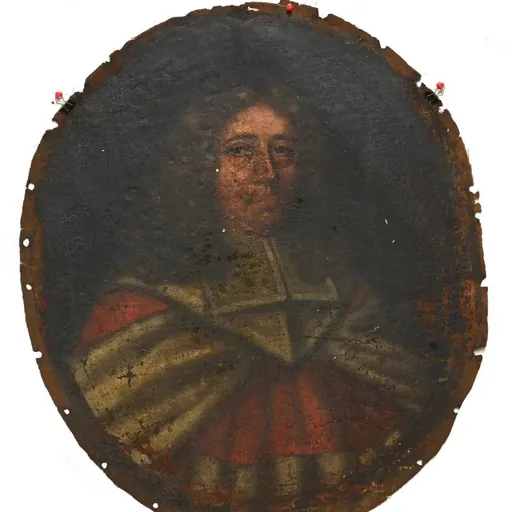
About Sir Richard Reynell, 1st Baronet
Lived 1626 – 1699 (aged 72–73). Sir Richard Reynell, 1st Baronet was a judge and politician.
Sir Richard Reynell, 1st Baronet (1626 – 18 October 1699), was an English-born judge who had a distinguished career in Ireland and held office as Lord Chief Justice of the King's Bench in Ireland. He was the first of the Reynell baronets of Laleham.
Background and early career He was born in Devonshire, second son of Sir Richard Reynell (1583-1648) of East Ogwell and his wife (and cousin) Mary Reynell, daughter of Richard Reynell of Creedy Widger, near Crediton, and Mary Peryam. The Reynells were an ancient West Country family, who were descended from Sir Richard Reynell, a prominent Crown servant who lived in Somerset in the time of Richard I. The judge was the great-grandson of Richard Reynell, High Sheriff of Devon 1584-5, and the younger brother of the politician Sir Thomas Reynell (1625-1698). On the return of James Butler, 1st Duke of Ormonde to the Lord Lieutenancy in 1677, Essex before departing for England recommended Reynell to him as one of the few Irish judges who was a man of learning and was neither too old nor too frail to perform his duties effectively. having demonstrated his loyalty to the new administration, he received his overdue promotion as Lord Chief Justice of Ireland, but he had a somewhat troubled tenure in that office. While his legal ability was not in dispute, he had made numerous enemies. In politics, he was generally seen as a Tory at a time when the Whigs were the dominant party, and in 1693 he was openly accused of being a Jacobite. In 1692 an anonymous memorandum addressed to the King dealing with the alleged misgovernment of Ireland named Reynell as one of four senior judges who were guilty of numerous acts of injustice, and in particular, were guilty of favouring Irish interests over English. The King did not take this accusation seriously, but Reynell's enemies in England blamed him for the Irish Parliament's failure to ratify the Treaty of Limerick, and more generally for his failure to take any steps towards the peaceful settlement of Ireland.
There was also the old charge that Reynell was excessively tolerant of Catholics, and on this flimsy basis, hysterical accusations were made by a Colonel FitzGerald that he was involved in a conspiracy to kill William III. In December 1693 Reynell spoke in the English House of Commons in his own defence with great eloquence. Influential friends of his like Sir Edward Seymour, one of the leaders of the Tory Party, defended his integrity with vigour, pointing to the absurdity of the idea that Reynell would plot to kill the King to whom he owed everything ("a man would have to be an idiot" to act so, Seymour remarked), and praising him as "an honest and prudent man". in 1660. They had two sons, Richard and Henry, and four daughters, including Elizabeth and Hester. The elder son Richard, succeeded as second baronet. His younger brother Henry (died 1721) practised at the Bar in Dublin. His sister Elizabeth married the politician William Richardson of Legacorry, County Armagh in 1695, but had no issue.
While Sir Richard and Lady (Hester) Reynell were travelling in France in 1682 Hester died at Abbeville; Reynell brought her body home to Devonshire for burial.
His Dublin residence was on Church Street, adjacent to the present Four Courts. He also acquired a house adjacent to the King's Inns, which had been built in the 1630s by Sir Richard Osbaldeston, the Attorney General for Ireland, and later belonged to his son William Osbaldeston, a barrister.
Reputation Reynell's professional success owed something to his upper-class background: unlike most Irish judges at that time, he could deal with men like Essex and Ormonde as social equals. At the same time, his legal ability was acknowledged even by his critics, though there was probably a falling off of his mental powers in his later years. Ball calls him one of the most remarkable Irish judges of the era.
Don’t just read it —
keep it.
Full-length biographies made to live with: read them, listen on the way to work, watch them tonight.
- E-book
- Audio
- Video
Instant download · yours to keep · every purchase keeps this site free
Important facts
People in Sir Richard Reynell, 1st Baronet's life
Named in this biography and alive at the same time





Related people
Same field, nearest in time



Contemporaries
People whose lives overlapped Sir Richard Reynell, 1st Baronet's





Frequently asked questions
Who was Sir Richard Reynell, 1st Baronet?
English politician
When was Sir Richard Reynell, 1st Baronet born?
Sir Richard Reynell, 1st Baronet was born in 1626.
When did Sir Richard Reynell, 1st Baronet die?
Sir Richard Reynell, 1st Baronet died on 18 October 1699.
What was Sir Richard Reynell, 1st Baronet's occupation?
Sir Richard Reynell, 1st Baronet was a judge and politician.
Sources & further reading
· Wikipedia: Sir Richard Reynell, 1st Baronet
· DBpedia: Sir Richard Reynell, 1st Baronet
Cite this page
APA: Biography.guide. (2026). Sir Richard Reynell, 1st Baronet. https://biography.guide/sir-richard-reynell-1st-baronet/
MLA: "Sir Richard Reynell, 1st Baronet." Biography.guide, https://biography.guide/sir-richard-reynell-1st-baronet/.
Chicago: "Sir Richard Reynell, 1st Baronet." Biography.guide. https://biography.guide/sir-richard-reynell-1st-baronet/.
Data last updated: 2026-09-22 · Spot an error? Report a correction.
Portrait: Wikimedia Commons · author & licence
Page generated 2026-09-27 05:03 UTC