
About Sir Edmund Beckett, 4th Baronet
Lived 1787 – 1874 (aged 86–87). Sir Edmund Beckett, 4th Baronet was a British politician.
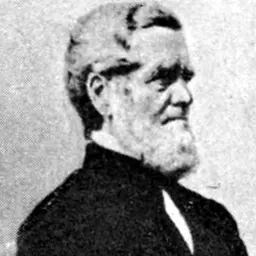
Sir Edmund Beckett-Denison, 4th Baronet (28 January 1787 – 24 May 1874) was a railway promoter and politician.
Early life Beckett was born at Gledhow Hall, in Leeds, on 29 January 1787. He was a son of banker Sir John Beckett, 1st Baronet (1743–1826), and his wife, Mary, whose father was Christopher Wilson, Bishop of Bristol.
Career In 1818, Beckett settled in Doncaster, becoming its richest citizen. His wealth came from his share in the Beckett family bank. He became active in municipal and county politics, and in the 1841 general election was elected Tory MP for the West Riding. Having expected an unopposed return in 1847, he withdrew when the Liberals nominated Richard Cobden, but was returned at a by-election in 1848 and sat until 1859. He was close to Sir Robert Peel (he supplied Peel with the horse that threw and fatally injured him); although he voted against the repeal of the Corn Laws in 1846, by 1848 he opposed a return to protection and by 1857 described himself in Dod as a Liberal.
Edmund Beckett, 1st Baron Grimthorpe (1816–1905), who married Fanny Catherine (1823–1901), daughter of John Lonsdale, 89th Bishop of Lichfield. William Beckett (1826–1890), who married the Hon. Helen Duncombe, daughter of William Duncombe, 2nd Baron Feversham. Christopher Beckett Denison (1825–1884), who died unmarried. Mary Beckett, who married Charles Wilson Faber and was the mother of Edmund Beckett Faber, 1st Baron Faber.
Through his wife Beckett inherited the estate of Thomas Denison (d. 1765). On 17 November 1872, he inherited the baronetcy of Beckett. He had assumed the additional surname, Denison, by letters patent in 1816, but resumed his original surname by the same process on succeeding to the baronetcy in 1872.
The surviving evidence shows Beckett to be tough and uncompromising. At his death even the local Tory paper, in its obituary, described him as "brusque in his manner, impatient to a degree of human vanity in all its ugly shapes, and with little trace of sentiment or poetry of any description".
Beckett died at Doncaster, aged 87, on 24 May 1874, his wife having died on 27 March that year. A funeral service was held on 29 May at Christ Church, Doncaster, after which he was buried there in a family vault. He was succeeded in the baronetcy by his eldest son, Edmund Beckett, 1st Baron Grimthorpe.
Don’t just read it —
keep it.
Full-length biographies made to live with: read them, listen on the way to work, watch them tonight.
- E-book
- Audio
- Video
Instant download · yours to keep · every purchase keeps this site free
Important facts
People in Sir Edmund Beckett, 4th Baronet's life
Named in this biography and alive at the same time




Related people
Same field, nearest in time

Contemporaries
People whose lives overlapped Sir Edmund Beckett, 4th Baronet's


Frequently asked questions
Who was Sir Edmund Beckett, 4th Baronet?
British politician
When was Sir Edmund Beckett, 4th Baronet born?
Sir Edmund Beckett, 4th Baronet was born in 1787.
When did Sir Edmund Beckett, 4th Baronet die?
Sir Edmund Beckett, 4th Baronet died in 1874.
What was Sir Edmund Beckett, 4th Baronet's occupation?
Sir Edmund Beckett, 4th Baronet was a politician.
What nationality was Sir Edmund Beckett, 4th Baronet?
Sir Edmund Beckett, 4th Baronet was British.
Sources & further reading
· Wikipedia: Sir Edmund Beckett, 4th Baronet
· DBpedia: Sir Edmund Beckett, 4th Baronet
Cite this page
APA: Biography.guide. (2026). Sir Edmund Beckett, 4th Baronet. https://biography.guide/sir-edmund-beckett-4th-baronet/
MLA: "Sir Edmund Beckett, 4th Baronet." Biography.guide, https://biography.guide/sir-edmund-beckett-4th-baronet/.
Chicago: "Sir Edmund Beckett, 4th Baronet." Biography.guide. https://biography.guide/sir-edmund-beckett-4th-baronet/.
Data last updated: 2026-09-20 · Spot an error? Report a correction.
Page generated 2026-09-27 05:32 UTC