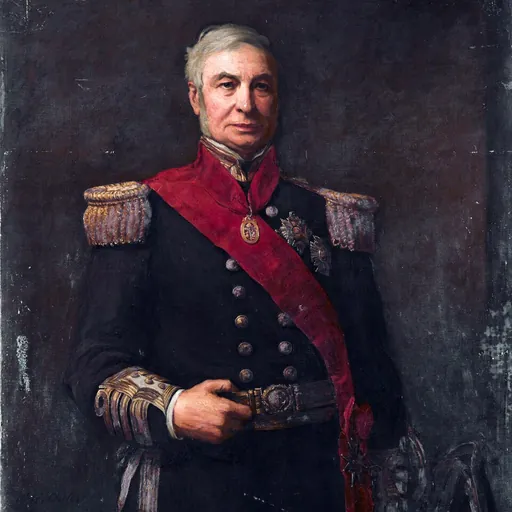
About Sir Alexander Milne, 1st Baronet
Lived 1806 – 1896 (aged 90). Sir Alexander Milne, 1st Baronet was a British naval officer.
Admiral of the Fleet Sir Alexander Milne, 1st Baronet, (10 November 1806 – 29 December 1896) was a Royal Navy officer. As a captain on the North America and West Indies Station he was employed capturing slave-traders and carrying out fishery protection duties. He served as a Junior Naval Lord under both Liberal and Conservative administrations and was put in charge of organising British and French transports during the Crimean War. He became Commander-in-Chief, North America and West Indies Station and in this role he acted with diplomacy, especially in response to the Trent Affair on 8 November 1861 during the American Civil War, when , commanded by Union Captain Charles Wilkes, intercepted the British mail packet and removed, as contraband of war, two Confederate diplomats, James Mason and John Slidell. He became First Naval Lord in the third Derby–Disraeli ministry in July 1866 and in this role took advantage of the Government's focus on spending reduction to ask fundamental questions about naval strategy. He again became First Naval Lord in the first Gladstone ministry in November 1872, remaining in office under the second Disraeli ministry and identifying the critical need for trade protection at times of war and demanding new cruisers to protect British merchant shipping.
Early career
Milne was born the second son of the Admiral Sir David Milne and Grace Milne (daughter of Sir Alexander Purves, Bt). His older brother David was later known as David Milne-Home.
His father purchased 10 York Place, Edinburgh in 1814 and the family lived there.
Milne joined the Royal Navy in February 1817. Over the next few years he served in the sixth-rate , third-rate , second-rate and third-rate . He became an acting lieutenant in the sloop on the coast of Brazil in June 1827 and was promoted to the substantive rank of lieutenant on 8 September 1827. when he was put in charge of organising British and French transports during the Crimean War. and appointed Knight Commander of the Order of the Bath (Civil) on 20 December 1858, Milne became Fourth Naval Lord in the second Derby–Disraeli ministry in April 1859. and promoted to vice-admiral on 13 April 1865.
Milne became First Naval Lord in the third Derby ministry in July 1866 and in this role took advantage of the Government's focus on spending reduction to ask fundamental questions about naval strategy. and advanced to Knight Grand Cross of the Order of the Bath on 20 May 1871. "In the autumn of 1870 the Mediterranean Squadron, under the command of Sir Alexander Milne joined up with the Channel Squadron for the purpose of carrying out combined manoeuvres off the coast of Portugal, and Sir Alexander, being the senior admiral, took supreme command. The low freeboard, fully rigged turret-ship had joined the Channel Squadron a short time before, and the combined fleet put to sea from Vigo". That night the Captain capsized and sank and "only the gunner and seventeen men were saved."
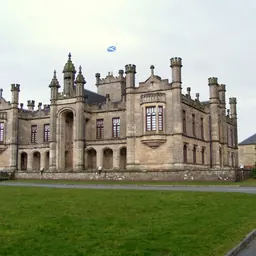
In retirement he was a member of the Royal Commission Appointed to Enquire into the Defence of British Possessions and Commerce Abroad. Promoted to Admiral of the Fleet on 10 June 1881, he lived at Inveresk House in Inveresk where he died from pneumonia on 29 December 1896. He was buried in Inveresk churchyard on 2 January 1897: the grave lies on the north edge of the original churchyard, near the north-west corner.
Family In 1850 he married Euphemia Cochran (d.1889). They had two daughters and one son (Archibald Berkeley Milne).
Don’t just read it —
keep it.
Full-length biographies made to live with: read them, listen on the way to work, watch them tonight.
- E-book
- Audio
- Video
Instant download · yours to keep · every purchase keeps this site free
Important facts
People in Sir Alexander Milne, 1st Baronet's life
Named in this biography and alive at the same time



Related people
Same field, nearest in time


Contemporaries
People whose lives overlapped Sir Alexander Milne, 1st Baronet's





Frequently asked questions
Who was Sir Alexander Milne, 1st Baronet?
British admiral (1806–1896)
When was Sir Alexander Milne, 1st Baronet born?
Sir Alexander Milne, 1st Baronet was born on 10 November 1806 in Inveresk.
When did Sir Alexander Milne, 1st Baronet die?
Sir Alexander Milne, 1st Baronet died on 29 December 1896 in Inveresk.
What was Sir Alexander Milne, 1st Baronet's occupation?
Sir Alexander Milne, 1st Baronet was a naval officer.
What nationality was Sir Alexander Milne, 1st Baronet?
Sir Alexander Milne, 1st Baronet was British.
Sources & further reading
· Wikipedia: Sir Alexander Milne, 1st Baronet
· DBpedia: Sir Alexander Milne, 1st Baronet
Cite this page
APA: Biography.guide. (2026). Sir Alexander Milne, 1st Baronet. https://biography.guide/sir-alexander-milne-1st-baronet/
MLA: "Sir Alexander Milne, 1st Baronet." Biography.guide, https://biography.guide/sir-alexander-milne-1st-baronet/.
Chicago: "Sir Alexander Milne, 1st Baronet." Biography.guide. https://biography.guide/sir-alexander-milne-1st-baronet/.
Data last updated: 2026-09-20 · Spot an error? Report a correction.
Page generated 2026-09-27 05:09 UTC