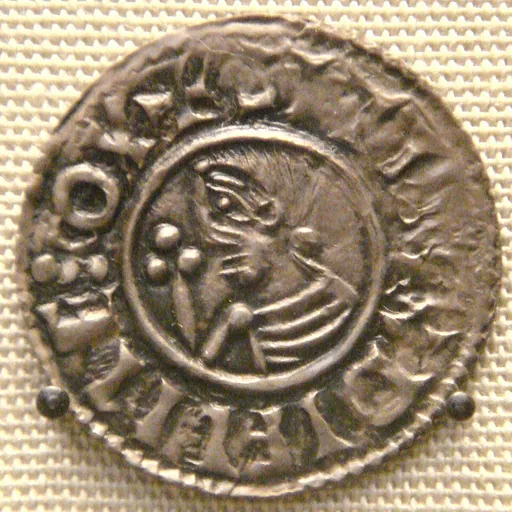
Sigtrygg Silkbeard
Hiberno-Norse King of Dublin
About Sigtrygg Silkbeard
Lived 970 – 1042 (aged 71–72). Sigtrygg Silkbeard was a king.
Sigtrygg II Silkbeard Olafsson (also Sihtric, Sitric and Sitrick in Irish texts; or Sigtryg and Sigtryggr in Scandinavian texts) was a Hiberno-Norse king of Dublin (possibly AD 989–994; restored or began 995–1000; restored 1000 and abdicated 1036) of the Uí Ímair dynasty. He was caught up in the abortive Leinster revolt of 999–1000, after which he was forced to submit to the King of Munster, Brian Boru. His family also conducted a double-marriage alliance with Boru, although he later realigned himself with the main leaders of the Leinster revolt of 1012–1014. He has a prominent role in the 12th-century Irish medieval text Cogadh Gaedhil re Gallaibh and the 13th-century Icelandic Njal's Saga, as the main Norse leader at the Battle of Clontarf.
Sigtrygg's long reign spanned 46 years, until his abdication in 1036. During that period, his armies saw action in four of the five Irish provinces of the time. In particular, he conducted a long series of raids into territories such as Meath, Wicklow, Ulster, and perhaps even the coast of Wales. He also battled with rival Norse kings, especially in Cork and Waterford.
He went on a pilgrimage to Rome in 1028 and is associated with the foundation of Christ Church Cathedral in Dublin. Although Dublin underwent several reversals-of-fortune throughout his reign, on the whole, trade in the city flourished. He died at age 72 in 1042. and the sister of his successor, King Máel Mórda of Leinster. Sigtrygg's paternal half-brother was Glúniairn, or "Iron-knee", who ruled as King of Dublin from 980-989.
An incident involving the ransom of one of Sigtrygg's sons, late in his reign, in which "seven score British horse" were mentioned in the list of demands, The Irish annals record little information about Sigtrygg, his family or Dublin during these first five years of his reign. Benjamin Hudson claims this was because of the arrival of the future King of Norway, Olaf Tryggvason, who took up residence in Dublin for a few years after marrying Sigtrygg's sister Gytha.
Hudson argues that Tryggvason's return to Norway in 994 coincided with the temporary expulsion of Sigtrygg from Dublin by his rival Ivar of Waterford. Ivar may have already ruled there from 989 until forced-out by Sigtrygg in 993; much depends on interpretation. Nevertheless, Sigtrygg was back within a year. In 995, he and his nephew, Muirchertach Ua Congalaich, attacked the church at Donaghpatrick in County Meath. while the Annals of Inisfallen date Brian's capture of the city to 1 January 1000. In any case, in 1000, Brian plundered the city, burned the Norse fortress, and expelled Sigtrygg. Both tribes refused to help him. Sigtrygg never forgot the Ulaid's refusal of aid when he fled from Dublin and, in 1002, he had his revenge when his soldiers served in Brian's campaign against the Ulaid and ravaged their lands. They served under Brian against the Ulaid again in 1005, and against the Northern Uí Néill in 1006 and 1007. Only fragments survive of the verses in the Sigtryggsdrápa, a drápa composed by the skald Gunnlaug Illugason while visiting Sigtrygg's court. Around 1012, relations between Brian and Leinster had become so strained that revolt broke out among the Leinstermen. Sigtrygg arrived in Orkney for Sigurd's Yule feast, where he sat in a high seat between the two brothers-in-law, Earl Sigurd of Orkney and Earl Gilli of the Southern Isles. Despite Sigurd's initial hesitance, and against the advice of his men, he eventually agreed to arrive in Dublin by Palm Sunday with all his men, on the condition that if Brian was slain, Sigurd would marry Gormflaith and become King of Ireland. where he promised Bróðir too that, if successful, he would be allowed to marry Gormflaith and become King of Ireland; the terms of this agreement were kept-secret. Óspak was dissatisfied with the arrangement, and refused to "fight against so good a king". According to Irish sources, Sigtrygg did not take part in the battle, but held his garrison in reserve in Dublin. The Cogadh Gaedhil re Gallaibh records that Sigtrygg was able to observe the progress of the battle and the movement of the battle standards from the ramparts of his fortress. As the modern Irish medievalist historian Donnchadh Ó Corráin notes, Sigtrygg "wisely kept within the city and lived to tell the tale". Njal's Saga records that Sigtrygg was on the wing opposite Óspak of Man for the whole battle, and that Óspak eventually put the king to flight.
Reign after Clontarf Immediately after Clontarf, Sigtrygg's fortunes appear to have declined, even though he emerged with his kingdom intact. Máel Sechnaill, now again recognised as high king, was undoubtedly the battle's main beneficiary. These captives would either have been ransomed or sold off into Dublin's lucrative slave trade. When Sigtrygg raided south in 1021, he was defeated at Delgany in County Wicklow In 1022, the Dublin fleet sailed north against the Ulaid, only to be destroyed in a naval battle against Niall mac Eochaid, after which the Norse crews and ships were taken prisoner. The great Irish princes began to compete for the High Kingship, and the political situation in Ireland became chaotic as there was no clear choice for supremacy. Sigtrygg formed a new alliance with the men of Brega. In 1027, Sigtrygg's son Olaf joined Donnchad of Brega in a raid on Staholmock, County Meath. Sigtrygg rallied to the fight again at Lickblaw (near Castlepollard, Westmeath) where Donnchad and Roen were slain. Sigtrygg was forced to pay a ransom of 1,200 cows, 140 British horses, 60 ounces of gold and of silver, "the sword of Carlus", the Irish hostages of Leinster and Leath Cuinn, "four hostages to Ua Riagain as a security for peace, and the full value of the life of the third hostage". The incident illustrates the importance of ransoming noble captives, as a means of political manipulation, increasing one's own revenues and exhausting the resources of one's foes. A Dublin colony was established in Gwynedd, and for the following years Sigtrygg was at the height of his power. In 1035, he plundered the celebrated stone church of Ardbraccan in Meath, burned 200 men inside, and carried another 200 off into captivity. Ragnall was the grandson of the Ivar, Sigtrygg's earliest rival, who had contested for Dublin decades before. Glúniairn was killed by the people of South Brega in 1031. Godfrey was killed in Wales in 1036 by one Sitric, "son of Glúniairn"—as factionalism was common among Viking settlers, this could have been the same Glúniairn as Sigtrygg's half-brother, thus making Godfrey and his killer cousins. Sigtrygg's daughter Cellach died in the same month as her father.
Sigtrygg was also, according to the Oxford Dictionary of National Biography, "a patron of the arts, a benefactor of the church, and an economic innovator". It is thus possible to attribute the origins of the establishment of territorial bishoprics in Ireland on the Roman model, one of the most important results of 11th-century Irish Church Reform, to Sigtrygg. He went on to found Christ Church Cathedral in Dublin, which today is the oldest building in Dublin, but relatively young in comparison to the many monastic cathedrals in the rest of Ireland. Like many of the other coastal cathedrals in Ireland, it is of Hiberno-Norse origin. The cathedral, initially a wooden building, was rebuilt in stone in the 1180s following the arrival of the Anglo-Normans to Ireland, led by Richard de Clare, 2nd Earl of Pembroke.
Don’t just read it —
keep it.
Full-length biographies made to live with: read them, listen on the way to work, watch them tonight.
- E-book
- Audio
- Video
Instant download · yours to keep · every purchase keeps this site free
Important facts
Family & relationships
People in Sigtrygg Silkbeard's life
Named in this biography and alive at the same time

Related people
Same field, nearest in time





Contemporaries
People whose lives overlapped Sigtrygg Silkbeard's



Frequently asked questions
Who was Sigtrygg Silkbeard?
Hiberno-Norse King of Dublin
When was Sigtrygg Silkbeard born?
Sigtrygg Silkbeard was born in 970 in Dublin.
When did Sigtrygg Silkbeard die?
Sigtrygg Silkbeard died in 1042 in Dublin.
What was Sigtrygg Silkbeard's occupation?
Sigtrygg Silkbeard was a king.
What nationality was Sigtrygg Silkbeard?
Sigtrygg Silkbeard's recorded nationality: Kingdom of Dublin.
Sources & further reading
· Wikipedia: Sigtrygg Silkbeard
Cite this page
APA: Biography.guide. (2026). Sigtrygg Silkbeard. https://biography.guide/sigtrygg-silkbeard/
MLA: "Sigtrygg Silkbeard." Biography.guide, https://biography.guide/sigtrygg-silkbeard/.
Chicago: "Sigtrygg Silkbeard." Biography.guide. https://biography.guide/sigtrygg-silkbeard/.
Data last updated: 2026-09-22 · Spot an error? Report a correction.
Portrait: Wikimedia Commons · author & licence
Page generated 2026-09-27 05:01 UTC