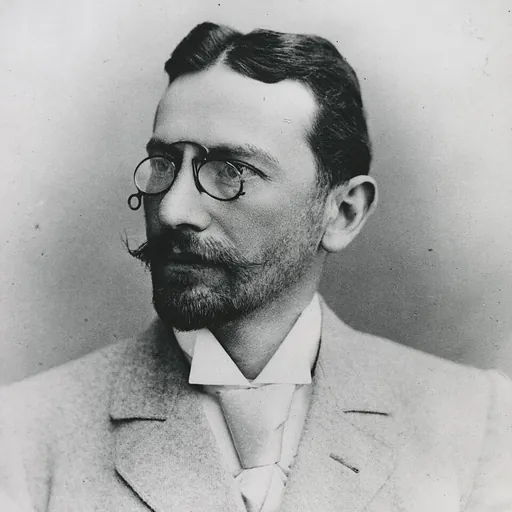
Siegbert Tarrasch
German chess player, chess writer, and chess theoretician
About Siegbert Tarrasch
Lived 1862 – 1934 (aged 71). Siegbert Tarrasch was a German chess player, writer, chess theoretician and physician.
Siegbert Tarrasch (; 5 March 1862 – 17 February 1934) was a German chess player, considered to have been among the strongest players and most influential theoreticians of the late 19th and early 20th century.
Life Tarrasch was born in Breslau, in what was then Prussian Silesia and now is Poland. Having finished school in 1880, he left Breslau to study medicine in Berlin and then in Halle. With his family, he settled in Nuremberg, Bavaria, and later in Munich, setting up a successful medical practice. He had five children. Tarrasch was Jewish, converted to Christianity in 1909, and was a patriotic German who lost a son in World War I, yet he faced antisemitism in the early stages of the Third Reich.
Chess career
A medical doctor by profession, Tarrasch may have been the best player in the world in the early 1890s. He scored heavily against the ageing World Champion Wilhelm Steinitz in tournaments (+3−0=1) but refused an opportunity to challenge Steinitz for the world title in 1892 because of the demands of his medical practice.
Soon afterwards, in St. Petersburg in 1893, Tarrasch drew a hard-fought match against Steinitz's challenger Mikhail Chigorin (+9−9=4) after leading most of the way. He also won four major tournaments in succession: Breslau 1889, Manchester 1890, Dresden 1892, and Leipzig 1894.
However, after Emanuel Lasker became world chess champion in 1894, Tarrasch could not match him. Fred Reinfeld wrote: "Tarrasch was destined to play second fiddle for the rest of his life." For example, Lasker scored much better against mutual opponents, e.g. vs. Chigorin, Tarrasch had +2 over 34 games while Lasker scored +7 in 21; vs. Akiba Rubinstein, Tarrasch was −8 without a single win, while Lasker scored +2−1=2; vs. David Janowski, Tarrasch scored +3 compared to Lasker's huge +22; vs. Géza Maróczy, Tarrasch was +1 over 16 games while Lasker scored +4−0=1, vs. Richard Teichmann Tarrasch scored +8−5=2, while Lasker beat him all four tournament games. However, Tarrasch had a narrow plus score against Harry Nelson Pillsbury of +6−5=2, while Lasker was even +5−5=4. Still, Tarrasch remained a powerful player, demolishing Frank Marshall in a match in 1905 (+8−1=8), and winning Ostend 1907 over Schlechter, Janowski, Marshall, Burn, and Chigorin.
By the time Lasker finally agreed to give Tarrasch a world title match in 1908, there was no love lost between them. The story goes that when they were introduced at the opening of their 1908 championship match, Tarrasch clicked his heels, bowed stiffly, and said, "To you, Dr. Lasker, I have only three words, check and mate"—then left the room. Lasker would beat Tarrasch convincingly in their match +8−3=5.
Tarrasch continued to be one of the leading players in the world. He finished fourth in the very strong St. Petersburg 1914 chess tournament, behind only World Champion Emanuel Lasker, and future World Champions José Raúl Capablanca and Alexander Alekhine. His win against Capablanca in the 19th round, though much less famous than Lasker's win against Capablanca the round before, was essential to enable Lasker to achieve his famous come-from-behind victory over Capablanca in the tournament.
Tarrasch lost +0-5=1 to Lasker in a 1916 match.
Chess teachings Tarrasch was a very influential chess writer, and was called Praeceptor Germaniae, meaning "Teacher of Germany." He took some of Wilhelm Steinitz's ideas (e.g. control of the center, , ) and made them more accessible to the average chess player. In other areas, he departed from Steinitz. He emphasized piece much more than Steinitz did, and disliked cramped positions, saying that they "had the germ of defeat."
Tarrasch formulated a very important rule in rook endgames that is often called the Tarrasch rule:
The rooks belong behind passed pawns, behind their own in order to support their advance, behind the enemy's in order to impede their advance.
Chess publications In 1895, Tarrasch's book Dreihundert Schachpartien was published. It was first translated into English in 1959 by Robin Ault and John Kirwan in a limited edition and a commercial edition in 1999 when S. Schwarz put out Three Hundred Chess Games. Tarrasch released Die moderne Schachpartie in 1912, but it has not been translated yet. He wrote a famous book about the St. Petersburg 1914 chess tournament, which was translated into English in 1993.
Clash with hypermodern school
He was a target of the hypermodern school, led by Richard Réti, Aron Nimzowitsch, and Savielly Tartakower, all of whom criticized his ideas as dogmatic. However, many modern masters regard Tarrasch's actual play as not dogmatic. According to American grandmaster Andrew Soltis, Tarrasch's chess was "all about piece mobility".
As an example of his playing style see his victory on the Black side of the Advance French against Louis Paulsen (Nuremberg 1888):
Contributions to opening theory A number of chess openings are named after Tarrasch, with the most notable being:
Famous Tarrasch combinations
Don’t just read it —
keep it.
Full-length biographies made to live with: read them, listen on the way to work, watch them tonight.
- E-book
- Audio
- Video
Instant download · yours to keep · every purchase keeps this site free
Important facts
People in Siegbert Tarrasch's life
Named in this biography and alive at the same time




Related people
Same field, nearest in time

Contemporaries
People whose lives overlapped Siegbert Tarrasch's




Frequently asked questions
Who was Siegbert Tarrasch?
German chess player, chess writer, and chess theoretician (1862–1934)
When was Siegbert Tarrasch born?
Siegbert Tarrasch was born on 5 March 1862 in Wrocław.
When did Siegbert Tarrasch die?
Siegbert Tarrasch died on 17 February 1934 in Munich.
What was Siegbert Tarrasch's occupation?
Siegbert Tarrasch was a chess player, writer, chess theoretician and physician.
What nationality was Siegbert Tarrasch?
Siegbert Tarrasch was German.
Sources & further reading
· Wikipedia: Siegbert Tarrasch
Cite this page
APA: Biography.guide. (2026). Siegbert Tarrasch. https://biography.guide/siegbert-tarrasch/
MLA: "Siegbert Tarrasch." Biography.guide, https://biography.guide/siegbert-tarrasch/.
Chicago: "Siegbert Tarrasch." Biography.guide. https://biography.guide/siegbert-tarrasch/.
Data last updated: 2026-09-22 · Spot an error? Report a correction.
Portrait: Wikimedia Commons · author & licence
Page generated 2026-09-27 05:01 UTC