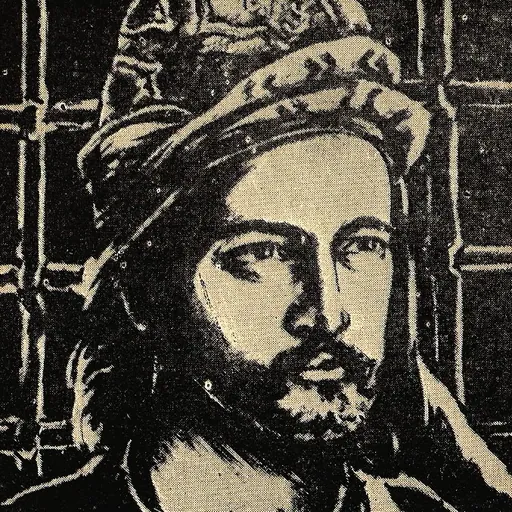
Shihab al-Din Suhrawardi
Persian philosopher and founder of the school of Illuminationism
About Shihab al-Din Suhrawardi
Lived 1155 – 1191 (aged 35–36). Shihab al-Din Suhrawardi was an Arab philosopher, writer and poet.
Opening page from the manuscript of Hikmat al-ʿIshraq transcribed by Sayyid Muhammad Munshi for the library of sultan Mehmed II. Istanbul, dated 1477-8 (882 AH). Topkapı Palace Museum Shihāb al-Dīn Abū al-Futūḥ Yaḥyā ibn Ḥabash ibn Amīrak al-Suhrawardī (, also known as Sohrevardi; 1154–1191) was a Persian philosopher and founder of the Iranian school of Illuminationism, an important school in Iranian and Islamic philosophy.
He is referred to by the honorific title Shaikh al-ʿIshraq "Master of Illumination" and Shaikh al-Maqtul "the Murdered Master", in reference to his execution for heresy. Mulla Sadra, the Persian sage of the Safavid era described Suhrawardi as the "Reviver of the Traces of the Pahlavi (Iranian) Sages", and Suhrawardi, in his magnum opus "The Philosophy of Illumination", thought of himself as a reviver or resuscitator of the ancient tradition of Persian wisdom. Suhrawardi provided a new Platonistic critique of the peripatetic school of Avicenna that was dominant in his time, writing on logic, physics, epistemology, psychology, and metaphysics.
Life Of Persian stock, Suhrawardi was born in 1154 in Suhraward, a village located between the towns of Zanjan and Bijar Garrus in Iran. which Corbin specifies in various ways as the "project of reviving the philosophy of ancient Persia".
In 1186, at the age of thirty-two, he completed his magnum opus, The Philosophy of Illumination.
There are several contradictory reports of his death. The most commonly held view is that he was executed sometime between 1191 and 1208 in Aleppo on charges of cultivating Batini teachings and philosophy, by the order of al-Malik al-Zahir, son of Saladin.
Influences on Suhrawardi Suhrawardi was a strong defender of Peripatetic philosophy, until he was influenced by those whom he described as those who "have traveled the path of God", like - as noted by Suhrawardi - Plato from the Greek tradition, Hermes (Thoth) from Egypt, and Pythagoras the Phoenician, and also figures in the Persian tradition. His philosophical project aims to revive the lost hikma of east and west.
In his work Alwah Imadi, Suhrawardi offers an esoteric interpretation of Ferdowsi's Epic of Kings (Shah Nama) in which figures such as Fereydun, Zahak, Kay Khusraw "Whoever knows philosophy (hikmat) and perseveres in thanking and sanctifying the Light of the Lights, will be endowed with royal glory (kharreh) and with luminous splendor (farreh), and—as we have said elsewhere—divine light will further bestow upon him the cloak of royal power and value. Such a person shall then become the natural ruler of the universe. He shall be given aid from the high heavens, and whatever he commands shall be obeyed; and his dreams and inspirations will reach their uppermost, perfect pinnacle."
و هر که حکمت بداند و بر سپاس و تقدیس نور الانوار مداومت نماید، او را خرّه کیانی بدهند و فرّ نورانی ببخشند، و بارقی الاهی او را کسوت هیبت و بهاء بپوشاند و رئیس طبیعی شود عالم را، و او را از عالم اعلا نصرت رسد و سخن او در عالم علوی مسموع باشد، و خواب و الهام او به کمال رسد.»
Suhrawardi and Illumination school According to Hossein Nasr since Sheykh Ishraq was not translated into Western languages in the medieval period, Europeans had little knowledge about Suhrawardi and his philosophy. His school is ignored even now by later scholars. Sheykh Ishraq tried to pose a new perspective on questions like the question of Existence. He not only caused peripatetic philosophers to confront new questions but also gave new life to the body of philosophy after Avicenna.
According to John Walbridge, Suhrawardi's critique on peripatetic philosophy can be counted as an important turning point for his successors. Suhrawardi tried to criticize Avicennism in a new approach. Although Suhrawardi first was a pioneer of peripatetic philosophy, he later became a Platonist following a mystical experience. He is also considered as the one who revived the ancient wisdom of Persia by his philosophy of Illumination. His followers include other Kurdish and Persian philosophers such as Shahrazuri and Qutb al-Din al-Shirazi who tried to continue the way of their teacher. Suhrawardi made a distinction between two approaches in his Illuminationism: one approach is discursive and the other is intuitive.
Scholarly views on Suhrawardi There are different and contradictory views regarding the character of Suhrawardi's school. Some scholars such as Hossein Ziai believe that the most important aspects of his thought are his logic and critique of the peripatetic conception of definitions.
Writings Suhrawardi left over 50 writings in Persian and Arabic.
Persian writings Partaw Nama ("Treatise on Illumination") Hayakal al-Nur al-Suhrawardi [Sohravardi, Shihaboddin Yahya] (1154–91) Hayakil al-nur ("The Temples of Light"), ed. M.A. Abu Rayyan, Cairo: al-Maktaba al-Tijariyyah al-Kubra, 1957. (The Persian version appears in oeuvres vol. III.) Alwah-i Imadi ("The tablets dedicated to Imad al-Din") Lughat-i Muran ("The language of Termites") Risalat al-Tayr ("The Treatise of the Bird") Safir-i Simurgh ("The Calling of the Simurgh") Ruzi ba Jama'at Sufiyaan ("A Day with the Community of Sufis") Fi Halat al-Tufulliyah ("On the State of Childhood") Awaz-i Par-i Jebrail ("The Chant of Gabriel's Wing") Aql-i Surkh ("The Red Intellect") Fi Haqiqat al-'Ishaq ("On the Reality of Love") Bustan al-Qolub ("The Garden of Hearts")
Arabic writings Kitab al-talwihat Kitab al-moqawamat Kitab al-mashari' wa'l-motarahat, Arabic texts edited with introduction in French by H. Corbin, Tehran: Imperial Iranian Academy of Philosophy, and Paris: Adrien Maisonneuve, 1976; vol II: I. Le Livre de la Théosophie oriental (Kitab Hikmat al-ishraq) 2. Le Symbole de foi des philosophes. 3. Le Récit de l'Exil occidental, Arabic texts edited with introduction in French by H. Corbin, Tehran: Imperial Iranian Academy of Philosophy, and Paris: Adrien Maisonneuve, 1977; vol III: oeuvres en persan, Persian texts edited with introduction in Persian by S.H. Nasr, introduction in French by H. Corbin, Tehran: Imperial Iranian Academy of Philosophy, and Paris: Adrien Maisonneuve, 1977. (Only the metaphysics of the three texts in Vol. I were published.) Vol. III contains a Persian version of the Hayakil al-nur, ed. and trans. H. Corbin L'Archange empourpré: quinze traités et récits mystiques, Paris: Fayard, 1976, contains translations of most of the texts in vol. III of oeuvres philosophiques et mystiques, plus four others. Corbin provides introductions to each treatise, and includes several extracts from commentaries on the texts. W.M. Thackston, Jr, The Mystical and Visionary Treatises of Shihabuddin Yahya Suhrawardi, London: Octagon Press, 1982, provides an English translation of most of the treatises in vol. III of oeuvres philosophiques et mystiques, which eschews all but the most basic annotation; it is therefore less useful than Corbin's translation from a philosophical point of view) Mantiq al-talwihat, ed. A.A. Fayyaz, Tehran: Tehran University Press, 1955. The logic of the Kitab al-talwihat (The Intimations) Kitab hikmat al-ishraq (The Philosophy of Illumination), trans H. Corbin, ed. and intro. C. Jambet, Le livre de la sagesse orientale: Kitab Hikmat al-Ishraq, Lagrasse: Verdier, 1986. (Corbin's translation of the Prologue and the Second Part (The Divine Lights), together with the introduction of Shams al-Din al-Shahrazuri and liberal extracts from the commentaries of Qutb al-Din al-Shirazi and Mulla Sadra. Published after Corbin's death, this copiously annotated translation gives to the reader without Arabic immediate access to al-Suhrawardi's illuminationist method and language)
English translations The Philosophy of Illumination: A New Critical Edition of the Text of Hikmat Al-Ishraq, edited by John Walbridge and Hossein Ziai, Provo, Brigham Young University Press, 1999. The Shape of Light: Hayakal al-Nur, interpreted by Shaykh Tosun Bayrak al-Jerrahi al-Halveti, Fons Vitae, 1998. The Mystical & Visionary Treatises of Suhrawardi, Translated by W.M. Thackson, Jr., London, The Octagon Press, 1982.
Don’t just read it —
keep it.
Full-length biographies made to live with: read them, listen on the way to work, watch them tonight.
- E-book
- Audio
- Video
Instant download · yours to keep · every purchase keeps this site free
Important facts
People in Shihab al-Din Suhrawardi's life
Named in this biography and alive at the same time
Related people
Same field, nearest in time

Contemporaries
People whose lives overlapped Shihab al-Din Suhrawardi's


Frequently asked questions
Who was Shihab al-Din Suhrawardi?
Persian philosopher and founder of the school of Illuminationism
When was Shihab al-Din Suhrawardi born?
Shihab al-Din Suhrawardi was born in 1155 in Sohrevard.
When did Shihab al-Din Suhrawardi die?
Shihab al-Din Suhrawardi died in 1191 in Aleppo.
What was Shihab al-Din Suhrawardi's occupation?
Shihab al-Din Suhrawardi was a philosopher, writer and poet.
What nationality was Shihab al-Din Suhrawardi?
Shihab al-Din Suhrawardi was Arab.
Sources & further reading
· Wikipedia: Shihab al-Din Suhrawardi
· DBpedia: Shihab al-Din Yahya ibn Habash Suhrawardi
Cite this page
APA: Biography.guide. (2026). Shihab al-Din Suhrawardi. https://biography.guide/shihab-al-din-suhrawardi/
MLA: "Shihab al-Din Suhrawardi." Biography.guide, https://biography.guide/shihab-al-din-suhrawardi/.
Chicago: "Shihab al-Din Suhrawardi." Biography.guide. https://biography.guide/shihab-al-din-suhrawardi/.
Data last updated: 2026-09-24 · Spot an error? Report a correction.
Portrait: Wikimedia Commons · author & licence
Page generated 2026-09-27 05:08 UTC