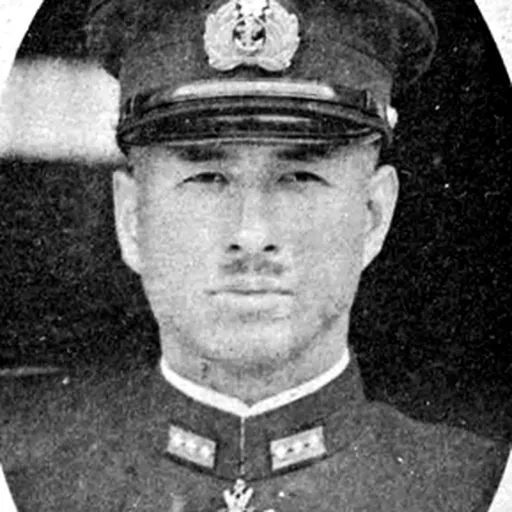
Shigematsu Sakaibara
Admiral in the Imperial Japanese Navy and the Japanese garrison commander on Wake Island during World War II
About Shigematsu Sakaibara
Lived 1898 – 1947 (aged 48). Shigematsu Sakaibara was a Japanese military officer.
was an admiral in the Imperial Japanese Navy, the Japanese garrison commander on Wake Island during World War II, and a convicted war criminal.
He was responsible for ordering the Wake Island massacre, in which 98 American civilians were murdered by Japanese soldiers. Following Japan's surrender, Sakaibara was tried for war crimes and executed for his involvement.
Biography A native of Yamagata prefecture in northern Japan, Sakaibara was a graduate of the 46th class of the Imperial Japanese Navy Academy in 1918, placing 36th in a class of 124. He served his midshipman tour on the cruiser Tokiwa, and after his commission as an ensign, was assigned to Hirado. He later served on the destroyer Kaba and battleship Mutsu.
As a sub-lieutenant, he served on the Iwate and after his promotion to lieutenant on December 1, 1924, he was assigned to the Hiei, Yura, and Sendai. He was chief gunnery officer on the Tatsuta. Promoted to lieutenant commander in 1930, he served as chief gunnery officer on Takao in 1934, followed by Mutsu in 1935. He was executive officer on Chikuma in 1939. After his promotion to captain in 1940, he served in a number of staff positions.
After the Battle of Wake Island on December 23, 1941, Sakaibara was appointed the garrison commander of the Japanese occupation force. Fearing an imminent attempt by American forces to retake the island, Sakaibara put 98 American civilians they had captured to work building a series of bunkers and fortifications in preparation for a suspected amphibious invasion.
On October 5, 1943, aircraft from USS Yorktown bombed Wake Island. Two days later, Sakaibara ordered the beheading of an American civilian worker who was caught stealing. Fearing an invasion, Sakaibara ordered the rest of them to be killed. They were taken to the northern end of the island, blindfolded and machine-gunned. One prisoner (whose name has never been discovered) escaped, carved a message into a rock about the incident but was then recaptured and personally beheaded by Sakaibara.
However, despite the massive assembly, the attack never came. Instead the United States Navy established a submarine blockade, causing the Japanese garrison to starve. United States forces bombed the island periodically from 1942 until Japan's surrender in 1945.
Sakaibara was promoted to rear admiral a year later, on October 15, 1944. The Japanese garrison on Wake Island formally surrendered to the United States on September 4, 1945.
After the war, Sakaibara, his subordinate, Lieutenant Commander Shoichi Tachibana, and Toraji Ito, were taken into custody by the American occupation authorities. They initially claimed that the victims were killed in a bombing raid by U.S. forces, but later confessed to the massacre.
Sakaibara, Tachibana, and Ito were extradited to Kwajalein Island, where they were tried for war crimes by a U.S. military commission. Ito killed himself in custody. Sakaibara and Tachibana were both found guilty and sentenced to death in December 1945. Tachibana's sentence was commuted to life in prison, and he was sent to Sugamo Prison to serve out his sentence. Sakaibara was extradited to Guam for execution.
Just before he was sentenced, Sakaibara read out a final statement to the commission. He admitted that what he did was wrong and said he wished that he had never heard of Wake Island. However, Sakaibara also claimed that the United States had no moral authority to try him or others after using nuclear weapons on Japan. With that statement, many people in Sakaibara's hometown saw him as a victim of victor's justice.
Sakaibara was hanged in Guam on June 19, 1947. Until the end, he maintained, "I think my trial was entirely unfair and the proceeding unfair, and the sentence too harsh, but I obey with pleasure."
Don’t just read it —
keep it.
Full-length biographies made to live with: read them, listen on the way to work, watch them tonight.
- E-book
- Audio
- Video
Instant download · yours to keep · every purchase keeps this site free
Important facts
Related people
Same field, nearest in time



Contemporaries
People whose lives overlapped Shigematsu Sakaibara's



Frequently asked questions
Who was Shigematsu Sakaibara?
admiral in the Imperial Japanese Navy and the Japanese garrison commander on Wake Island during World War II
When was Shigematsu Sakaibara born?
Shigematsu Sakaibara was born on 28 December 1898 in Yamagata Prefecture.
When did Shigematsu Sakaibara die?
Shigematsu Sakaibara died on 18 June 1947 in Guam.
What was Shigematsu Sakaibara's occupation?
Shigematsu Sakaibara was a military officer.
What nationality was Shigematsu Sakaibara?
Shigematsu Sakaibara was Japanese.
Sources & further reading
· Wikipedia: Shigematsu Sakaibara
· DBpedia: Shigematsu Sakaibara
Cite this page
APA: Biography.guide. (2026). Shigematsu Sakaibara. https://biography.guide/shigematsu-sakaibara/
MLA: "Shigematsu Sakaibara." Biography.guide, https://biography.guide/shigematsu-sakaibara/.
Chicago: "Shigematsu Sakaibara." Biography.guide. https://biography.guide/shigematsu-sakaibara/.
Data last updated: 2026-09-22 · Spot an error? Report a correction.
Portrait: Wikimedia Commons · author & licence
Page generated 2026-09-27 05:03 UTC