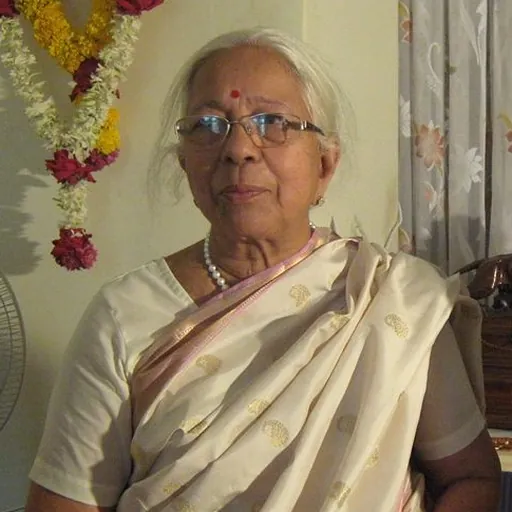
About Shashikala Kakodkar
Lived 1935 – 2016 (aged 81). Shashikala Kakodkar was an Indian politician.
Shashikala Kakodkar (7 January 1935 – 28 October 2016), also known as Tai , was an Indian politician and a leader of the Maharashtrawadi Gomantak Party (MGP). She served as the second Chief Minister of Goa, Daman and Diu from 1973 to 1979, and was the president of the MGP. She is the first and only woman to serve as the Chief Minister of Goa, Daman and Diu.
Early life and background Shashikala Kakodkar was born on 7 January 1935 at Pernem, Goa,
Kakodkar completed her elementary education from the Mushtifund Saunstha and completed her matriculation from the People's High School in Nova Goa (now Panjim). At age eleven, she participated in Goa's liberation movement by shouting patriotic slogans, and was beaten by Portuguese police officers for doing so. She graduated from Karnatak University, Dharwad, with a Bachelor of Arts degree, where she studied anthropology, sociology and history. She completed her postgraduate M.A. degree from Bombay's Elphinstone College.
Entry into politics Kakodkar was engaged in social work ever since her return from Bombay after obtaining her postgraduate education. In the 1972 Goa, Daman & Diu Legislative Assembly election, Kakodkar successfully contested as a Maharashtrawadi Gomantak Party candidate from the Bicholim constituency. On 12 August 1973, her father died in office, and the legislators of the Maharashtrawadi Gomantak Party unanimously selected her as the next Chief Minister.
Tenure as Chief Minister
First Shashikala Kakodkar Ministry Shashikala Kakodkar was sworn in as the Chief Minister of Goa, Daman and Diu on 13 August 1973 at 11:20 p.m. by the then-Lieutenant governor of Goa, Daman and Diu Sisirkumar Banerjee at the Raj Bhavan. Along with Kakodkar, Pratapsingh Rane and A. K. S. Usgaonkar were sworn in as Cabinet Ministers. Her own post of Minister of State was kept vacant till the end of the term.
Kakodkar took over the eleven portfolios held over by her father Dayanand Bandodkar, and created four more. They included General Administration, Secretariat Administration, Home, Finance, Confidential & Vigilance Department, Industry, Public Works Department, Education, Information & Tourism, Public Health, Small Savings, Public Assistance, Provedoria, Social Welfare, and Goa Archives. In a marked departure from the earlier stand taken by her party, Kakodkar declared that the question of Goa's merger with Maharashtra was a dead issue, and that both Marathi and Konkani were the official languages of Goa. She also established the Goa Board of Secondary & Higher Secondary Education in 1975.
Shashikala Kakodkar's government also took steps towards land reforms. Her government enacted the Goa, Daman and Diu Mundkar (Protection from Eviction) Act, 1975 and the Goa, Daman and Diu Agricultural Tenancy (5th Amendment) Act, 1976. The Supreme Court of India upheld the constitutional validity of the Goa, Daman and Diu Agricultural Tenancy (5th Amendment) Act, 1976 in Union Territory of Goa, Daman and Diu v. Lakshmibai Narayan Patil.
Some of the other important legislation enacted by the first Shashikala Kakodkar Ministry include the Goa, Daman & Diu Irrigation Act, 1973; Goa, Daman & Diu Chit Funds Act, 1973; Goa, Daman & Diu Barge tax Act, 1973; Goa, Daman & Diu Highways Act, 1974; Goa, Daman & Diu Town and Country Planning Act, 1974; Goa, Daman & Diu Motor Vehicles Act, 1974; Goa, Daman & Diu Secondary and Higher Secondary Education Board Act, 1975; Goa, Daman & Diu Public Gambling, Act 1976 and the Goa, Daman & Diu Habitual Offenders Act, 1976.
Shashikala Kakodkar was criticised by the opposition for alleged favouritism towards her husband Gurudatt Kakodkar in granting transport and cement licenses and tyre dealerships. The opposition had also alleged that the structural design of the Kala Academy was given to her brother-in-law Sharad Vengurlekar. However, none of these charges could be proved.
It was in these circumstances that Shashikala Kakodkar led the Maharashtrawadi Gomantak Party in the 1977 Goa Legislative Assembly election.
Second Shashikala Kakodkar ministry In the Assembly elections of 1977 which were held after the Emergency, Kakodkar faced a challenge leading the party. The resignation of her cabinet Minister Pratapsingh Rane and MLAs Jaisingrao Rane and Punaji Achrekar; allegations of corruption and favouritism were the major challenges faced by Kakodkar. In her manifesto, Kakodkar spoke against the Emergency and the demand for full-fledged statehood to Goa. Her manifesto contained the issue of developing Konkani language (while continuing support to Marathi as an important state language). She also promised an efficient administration, rapid socio-economic development, rise in standard of living, balanced regional development, a High Court for Goa and extension of education, health and agricultural productivity. Sarto Esteves cites Kakodkar's leadership capacities as the reason for the Maharashtrawadi Gomantak Party forming the government in 1977. Minister A. K. S. Usgaonkar faced a shock defeat in his Pale, Goa constituency. Kakodkar's cabinet included Shankar Laad and Vinayak Dharma Chodankar as Cabinet Ministers, while Raul Hilario Fernandes was appointed as a Minister of State. Narayan Fugro was appointed as the Speaker and Makanbhai Morarji Bhatela the Deputy Speaker.
To curb unemployment in Goa, Kakodkar established eleven industrial estates during her second term as the Chief Minister. In 1977, Kakodkar's government beautified the Ponda Fort at Farmagudi, Goa and installed an equestrian statue of Chhatrapati Shivaji there. As a result of their anti-party activities, the M. G. Party's Executive Body served a show-cause notice upon MLAs Desai and Narvekar. When the M. G. Party's Executive met on 21 January 1979, Chief Minister Kakodkar stated how both the MLAs had engaged in anti-party activities since June 1978. Kakodkar also spoke about the manner in which MLAs Dilkush Desai and Dayanand Narvekar made irresponsible remarks, took an anti-government stance in the Legislative Assembly and engaged in attempts to destabilise the government. On 28 April 1979, President's rule was imposed in Goa, Daman and Diu for six months with a provision for its extension. The then Prime Minister of India Morarji Desai rationalised that political horse trading should not take place in pursuance of forming a new government. The Prime Minister's opinion was criticised by some as being against the established parliamentary tradition of the person commanding the largest majority (Shankar Laad in the present case) being invited to form the government. The Leader of the Opposition in the Assembly, Ananta Narcinva (Babu) Naik, criticised the imposition of President's Rule by accusing Prime Minister of India Morarji Desai of having "squarely slaughtered" democracy by not allowing the Shankar Laad group of 17 legislators to form the new government. Shashikala Kakodkar's supporters welcomed the imposition of the President's Rule. from the North Goa (Lok Sabha constituency). Rane Sardesai remains the only woman ever elected to the Parliament of India from Goa.
Praise and criticism Political commentators like Sarto Esteves have lavished praise on Kakodkar for her victory in the 1977 Goa Legislative Assembly election and for her contribution to education, agriculture, industries and social and medical services. Esteves praises her abilities and behaviour which depicted that "Goans could ensure political stability and run the administration of the Territory without constant and continual overseeing by the Centre [New Delhi]." Kakodkar's government also faced a major embarrassment after the annual financial budget was leaked in the Marathi daily Gomantak, even before it was placed before the Assembly.
In December 1975, the Goemchya Ramponkarancho Ekvott (G. R. E.) was formally established at the Institute Menezes Braganza. In 1976, the Goemchya Ramponkarancho Ekvott (G. R. E.) forwarded the first memorandum to Chief Minister Kakodkar. However, the response of the government failed to respond favourably and accused the G. R. E. of misleading the traditional fishermen. Around this time, the Union Government started various schemes to develop the fishing industry. These schemes were supplemented by government aid and the fishermen were encouraged to seek loans from the banks. The big fishing trawler-owners invested in large-scale fishing for huge profits. The livelihood of the Ramponkars was threatened but the government failed to respond to their woes. By 1978, the fishing sector in Goa had been highly mechanised and most trawler owners had political connections. A morcha by ramponkars to the Secretariat in Panaji turned violent resulting in stone pelting. Memorandums were submitted to the Prime Minister of India, Union Fisheries Minister and all Members of the Parliament. For the first time, the issue was debated in the Parliament of India and a representative of the N. F. F. was sent to New Delhi to demand a Central Marine Bill. In September 1978, a delegation of the N. F. F. was informed that a model bill would be circulated in all the fishing states to introduce a legislation in their respective Vidhan Sabhas. In 1978, the All Goa Students' Union and the All India Students' Organization, Goa unit, launched a movement demanding concession in bus fares for all bona fide students. The student community in Goa felt that all students should get a 50% concession in bus fares like fellow students in other states of India. The private bus owner's lobby led by the All Goa Bus Owners' Association was very powerful then and also had the backing of the Kakodkar-led government. The student bodies demanded that the government should provide a concession of 50% for all bona fide students in Goa.
On 29 December 1978, the students issued a press note announcing their decision to pay only concessional fare from January 1979 should the government delay their demand. They fixed the concessional fare table and set up a committee to deal with any complaints of resistance from bus operators. Student commuters were told to immediately report any resistance to student representatives. The agitation spread across Goa like wildfire. Buses were burnt The students braved lathi charges and tear gas. Pratapsingh Rane became the Chief Minister of Goa and Dayanand Narvekar secured a berth in his Ministry. Ramakant Khalap was appointed as the Opposition leader in the Assembly.
Belekar points out
Formation of the Bhausaheb Bandodkar Gomantak Party Kakodkar decided to return to the Maharashtrawadi Gomantak Party. The party was then led by Mukund Shinkre. A historic meeting to facilitate Kakodkar's return to the party was organised by the Maharashtrawadi Gomantak Party's stalwarts such as Dr. Wilfred Menezes Mesquita, J. J. Rodrigues and Shankar Bandekar. But the talks failed and Kakodkar established a new political party called the Bhausaheb Bandodkar Gomantak Party of which she became the President.
Return to Maharashtrawadi Gomantak Party Kakodkar rejoined the Maharashtrawadi Gomantak Party by merging the Bhausaheb Bandodkar Gomantak Party into the Maharashtrawadi Gomantak Party. Kakodkar was allotted the portfolios of Education, Art & Culture, Transport and Fisheries. Kakodkar's policy of providing government grants to primary (Class I to IV) schools in Goa mandated that grants would be allotted only to schools imparting primary level education in Konkani or Marathi. The policy would be implemented from June 1990. Kakodkar managed to convince the then Chief Minister of Goa Dr. Luis Proto Barbosa and the Official Language Minister Churchill Alemao who too supported the decision. Kakodkar also decided not to permit the establishment of any new primary schools imparting education in English, but this policy was not adhered to by the subsequent governments.
On 4 December 1990, Shashikala Kakodkar along with the Deputy Chief Minister Ramakant Khalap and three other Maharashtrawadi Gomantak Party ministers from the PDF Government resigned after differences within Goa's first coalition government.
Post 1990 politics Kakodkar was elected to the Goa Legislative Assembly in the 1994 elections from the Maem constituency as a Maharashtrawadi Gomantak Party candidate. In 1999, Kakodkar contested the Goa Legislative Assembly as from the Maem constituency as a Maharashtrawadi Gomantak Party candidate but was defeated by Prakash Fadte of the Bharatiya Janata Party. Kakodkar contested her last election unsuccessfully as a Maharashtrawadi Gomantak Party candidate from the Maem constituency and was defeated by Harish Zantye of the Indian National Congress. After the defeat in the 2002 elections, Kakodkar did not contest any subsequent election.
Other positions held Kakodkar served as the Chairperson of the Kala Academy. She was the chairperson, Goa, Daman and Diu Industrial Development Corporation; chairperson, Goa, Daman and Diu State Sports Council; chairperson, Goa Cancer Society; President, Red Cross Committee (Goa Branch) In October 1998, Kakodkar was appointed the Chairperson of the Goa Bal Bhavan.
From 1991 to 1992, Kakodkar also served as the Chairperson of the Committee on Petitions and a member of the Committee on Public Undertakings in the Goa Legislative Assembly.
Social activism and philanthropy Kakodkar also assisted the Goa Football Association in reviving the Bandodkar Gold Trophy. She was a patron of many social and religious organisations.
In 2006, Kakodkar participated in the Marathi Bachao Aandolan movement during the tenure of Luizinho Faleiro as Goa's Education Minister against making English a compulsory language at the primary level.
Honours Shashikala Kakodkar received an honorary doctorate by her alma mater, the Karnatak University of Dharwad, in 2014.
Death Kakodkar died on 28 October 2016 at the Bandodkar House in Altinho, Panaji after a prolonged illness. The Government of Goa declared a two-day state mourning in her honour. She was cremated on 29 October 2016 at the St. Inez crematorium in Panaji with full state honours.
Don’t just read it —
keep it.
Full-length biographies made to live with: read them, listen on the way to work, watch them tonight.
- E-book
- Audio
- Video
Instant download · yours to keep · every purchase keeps this site free
Important facts
People in Shashikala Kakodkar's life
Named in this biography and alive at the same time






Related people
Same field, nearest in time




Contemporaries
People whose lives overlapped Shashikala Kakodkar's


Frequently asked questions
Who was Shashikala Kakodkar?
Indian politician
When was Shashikala Kakodkar born?
Shashikala Kakodkar was born on 7 January 1935 in Pernem.
When did Shashikala Kakodkar die?
Shashikala Kakodkar died on 28 October 2016 in Goa, Panaji.
What was Shashikala Kakodkar's occupation?
Shashikala Kakodkar was a politician.
What nationality was Shashikala Kakodkar?
Shashikala Kakodkar was Indian.
Sources & further reading
· Wikipedia: Shashikala Kakodkar
· DBpedia: Shashikala Kakodkar
Cite this page
APA: Biography.guide. (2026). Shashikala Kakodkar. https://biography.guide/shashikala-kakodkar/
MLA: "Shashikala Kakodkar." Biography.guide, https://biography.guide/shashikala-kakodkar/.
Chicago: "Shashikala Kakodkar." Biography.guide. https://biography.guide/shashikala-kakodkar/.
Data last updated: 2026-09-22 · Spot an error? Report a correction.
Portrait: Wikimedia Commons · author & licence
Page generated 2026-09-27 05:02 UTC