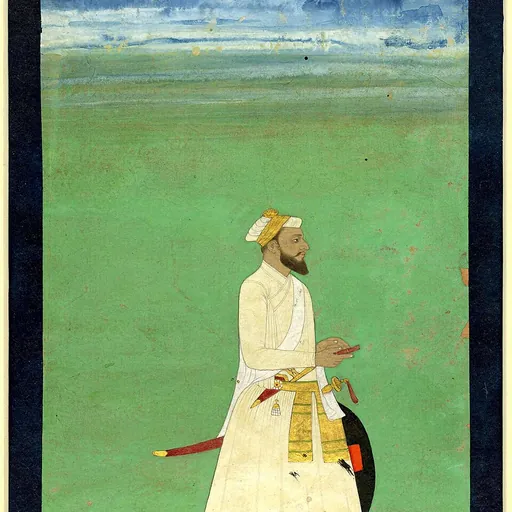
About Shaista Khan
Shaista Khan was a soldier.
Mirza Abu Talib (b. 22 November 1600 – d. 1694), better known as Shaista Khan, was a general and the Subahdar of Bengal Subah. He was maternal uncle to the Mughal Emperor Aurangzeb, and acted as a key figure during his reign. Shaista Khan initially governed the Deccan, where he clashed with the Maratha ruler Shivaji and was humiliated by him. However, he was most notable for his tenure as the governor of Bengal from 1664 to 1688. Under Shaista Khan's authority, the city of Dhaka and Mughal power in the province attained their greatest heights. His achievements include construction of notable mosques such as the Sat Gambuj Mosque and masterminding the conquest of Chittagong. Shaista Khan was also responsible for sparking the Anglo-Mughal War with the East India Company.
Early life According to the diary of William Hedges, the first governor of the East India Company in Bengal, the birthday of Shaista Khan was on 22 November.
Khan was of Persian origin. His grandfather Mirza Ghiyas Beg and father Abu'l-Hasan Asaf Khan were the wazirs of the Mughal emperors Jahangir and Shah Jahan, respectively. He also had familial connections with the imperial dynasty, having been a paternal nephew of the empress Nur Jahan and the brother of the empress Mumtaz Mahal. Jahangir awarded the title of Mirza to Shaista Khan in recognition of his family's service and position in the Mughal court.
Khan trained and served with the Mughal army and court, winning multiple promotions and being appointed governor of various provinces. He also developed a reputation as a successful military commander and grew close to his nephew, the prince Aurangzeb, when the duo fought against the Sultanate of Golconda. However, the territory was also fiercely contested by the ruler of the Shivaji Maharaj, who had acquired a big reputation after him killing of Adilshahi general Afzal Khan in the Battle of Pratapgarh. In January 1660, Shaista Khan arrived at Aurangabad and quickly advanced, seizing Pune, the centre of Shivaji's realm. He also captured the fort of Chakan and Kalyan and north Konkan after heavy fighting with the Marathas. The Marathas were banned from entering the city of Pune, and Mughal distance from the locals turned out to be an error. Shaista was responsible for heavily mass destruct pune city and its innocent civilians.
Attack by Shivaji on Shaista in Pune On the evening of 5 April 1663, a wedding reception had obtained special permission for holding a procession. Maharaj Shivaji and many of his men disguised as the bridegroom's procession members and some as Mughal soldiers entered Pune where in the Lal Mahal Shaista Khan was residing. Others entered in small parties dressed as labourers and soldiers of Maratha generals serving under Shaista Khan. After midnight, they raided the Nawab's compound and then entered the palace in an attempt to assassinate him. Maharaj Shivaji himself faced Shaista Khan directly, Shaista Khan in fear to save his life jumped out of a window in an attempt to escape but during this Shivaji Maharaj cut off 3 fingers of Shaista Khan. Though Shaista escaped this event, it heavily damaged his reputation and was humiliating for him A 20th-century depiction of Maharaj Shivaji (right) attacking Shaista Khan as he tries to flee by artist M.V. Dhurandhar After this event Aurangzeb angrily transferred Shaista Khan to Bengal, refusing to give him an audience at the time of the transfer, as per custom.
Subahdar of Bengal
On the death of Mir Jumla II in 1663, Shaista Khan was appointed the Subahdar of Bengal. As governor, he encouraged trade with Europe, Southeast Asia, and other parts of India. He consolidated his power by signing trade agreements with European powers. Despite his powerful position, he remained loyal to Aurangzeb, often mediating trade disputes and rivalries. In 1666, Shaista Khan led the campaign to Chittagong and expelled the Portuguese and Magh defenders with 300 flotillas. The Mughal forces even forced the Portuguese in Sandwip Island to relinquish their bases to be used as Mughal naval operation. He made diplomatic efforts to gain the support of the Dutch East India Company as well as Portugal. With the direct support of the Dutch army, Shaista Khan led the Mughals in an attack on the Arakanese held Sandwip under the command of Ibn Husain, which lay in Arakanese control. The previous Siege of Hooghly by Shaishta Khan was considered by Saugata Bhaduri, a professor from Jawaharlal Nehru University, as an attempt by the empire to threaten the Portuguese settlers in Bengal to assist them in the conquest of Chittagong.
Mughal forces succeeded in capturing the island in November 1665. Among his daughters were Iran Dukht Begum known as Bibi Pari, Turan Dukht Begum known as Bibi Biban and Shamshad Banu Begum. His oldest son, Buzurg Umed Khan, served as the governor of Allahabad. Another of Shaista Khan's sons, Khuda Banda Khan was married to a daughter of the grand vizier Asad Khan. He served as a general for Muhammad Azam Shah, and fell in battle fighting Bahadur Shah I. Khuda Banda's son, who was also entitled Khuda Banda Khan, was made the Diwan of Asaf Jah I, the Nizam of Hyderabad. One of his daughters was married to Ruhullah Khan, son of Khalilullah Khan of Yazd in 1660. Another daughter was married in 1678 to Zulfiqar Khan Nusrat Jung, son of Asad Khan and Mihr-un-Nissa Begum, daughter of Asaf Khan. Another daughter was married to Itiqad Khan and died in 1688.
Legacy In his late years, Shaista Khan left Dhaka and returned to Delhi. His legacy was the expansion of Dhaka into a regional centre of trade, politics and culture; a thriving and prosperous city from a small township. It is said that he made currency of Bangladeshi taka so strong that eight 'mon' (around 295 kilogram) processed rice or 'chaal' could be bought with one taka. The Shaista Khan Mosque is a massive standing monument to Shaista Khan, built on his palace grounds. Incorporating unique elements of Bengali and Mughal architecture, it is a major tourist attraction and a valued historical monument protected by the government of Bangladesh today.
Don’t just read it —
keep it.
Full-length biographies made to live with: read them, listen on the way to work, watch them tonight.
- E-book
- Audio
- Video
Instant download · yours to keep · every purchase keeps this site free
Important facts
Family & relationships
Related people
Same field, nearest in time




Frequently asked questions
Who was Shaista Khan?
17th century Mughal general and provincial governor
What was Shaista Khan's occupation?
Shaista Khan was a soldier.
Sources & further reading
Cite this page
APA: Biography.guide. (2026). Shaista Khan. https://biography.guide/shaista-khan/
MLA: "Shaista Khan." Biography.guide, https://biography.guide/shaista-khan/.
Chicago: "Shaista Khan." Biography.guide. https://biography.guide/shaista-khan/.
Data last updated: 2026-09-21 · Spot an error? Report a correction.
Portrait: Wikimedia Commons · author & licence
Page generated 2026-09-27 05:00 UTC