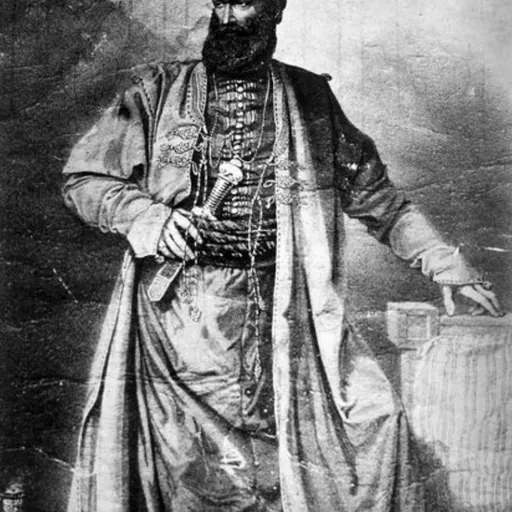
About Set Khan Astvatsatourian
Lived 1780 – 1842 (aged 61–62). Set Khan Astvatsatourian was a diplomat and businessperson.
Set Khan Astvatsatourian was an Iranian–Armenian businessman, Iran's ambassador to Great Britain, envoy to the Ottoman Empire, military advisor to Fath-Ali Shah, the second Qajar shah (king) of Iran. Set Khan played a leading role in the modernization of the Persian military, working with close friend Abbas Mirza, the Crown Prince of Iran, to reform the military during The Great Game. Set Khan is immortalized in stone holding his Ottoman-jeweled dagger within the "Asia Group" statuary at the Prince Albert Memorial in London's Hyde Park.
Early life Set was born to a family that was among the well-known Armenian and Georgian families brought to Iran during the reign of Agha Muhammad Khan Qajar, and dispersed throughout Iran for political reasons. Set learned the Armenian and Persian languages in the private school of the Armenian Church in Bushire. After receiving an education and learning the Armenian language, Set was sent at the age of thirteen to be educated in English at a school in Bombay, where he also learned Hindi. After completing his education, he worked for an English merchant in India.
For the next decade, Set Khan worked in the Qajar government in Tabriz. After returning to Iran, Set Khan again travelled to London, but this time as a military advisor alongside ambassador Mirza Saleh Shirazi. Following these initial trips to London, Set Khan took several additional trips to England in an ambassadorial capacity.
In 1828 Set Khan was selected to deliver a letter from Fath-Ali Shah to Ottoman Sultan Mahmud II, who honored him with a Liakat Medal , a jewel-studded dagger, the title bey, and the title of Sedghi Beig, which means the honest one. His mission was successful, and as a result, he earned the favor of Fath-Ali Shah, who issued two farmans as his reward.
It was thought that the imperial powers of the West—Russia in the North and the British to the South—could be held at bay by the adoption of European education and military technology. In these conditions, Set Khan's exploitation of the copper mines of Azerbaijan can be seen as a major advancement for the Persian military reform effort because previously all significant quantities of copper for canon smelting had been imported from the Ottoman Empire. Set Khan was able to effectively meet the Qajar government's need for domestic weapons production.
Don’t just read it —
keep it.
Full-length biographies made to live with: read them, listen on the way to work, watch them tonight.
- E-book
- Audio
- Video
Instant download · yours to keep · every purchase keeps this site free
Important facts
People in Set Khan Astvatsatourian's life
Named in this biography and alive at the same time

Related people
Same field, nearest in time


Contemporaries
People whose lives overlapped Set Khan Astvatsatourian's



Frequently asked questions
Who was Set Khan Astvatsatourian?
Persian diplomat
When was Set Khan Astvatsatourian born?
Set Khan Astvatsatourian was born in 1780.
When did Set Khan Astvatsatourian die?
Set Khan Astvatsatourian died in 1842 in Tehran.
What was Set Khan Astvatsatourian's occupation?
Set Khan Astvatsatourian was a diplomat and businessperson.
What nationality was Set Khan Astvatsatourian?
Set Khan Astvatsatourian's recorded nationality: Qajar Iran.
Sources & further reading
· Wikipedia: Set Khan Astvatsatourian
· DBpedia: Set Khan Astvatsatourian
Cite this page
APA: Biography.guide. (2026). Set Khan Astvatsatourian. https://biography.guide/set-khan-astvatsatourian/
MLA: "Set Khan Astvatsatourian." Biography.guide, https://biography.guide/set-khan-astvatsatourian/.
Chicago: "Set Khan Astvatsatourian." Biography.guide. https://biography.guide/set-khan-astvatsatourian/.
Data last updated: 2026-09-23 · Spot an error? Report a correction.
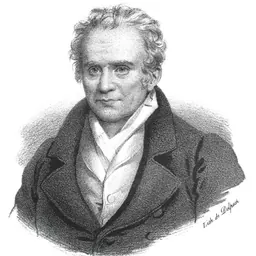
Portrait: Wikimedia Commons · author & licence
Page generated 2026-09-27 05:04 UTC