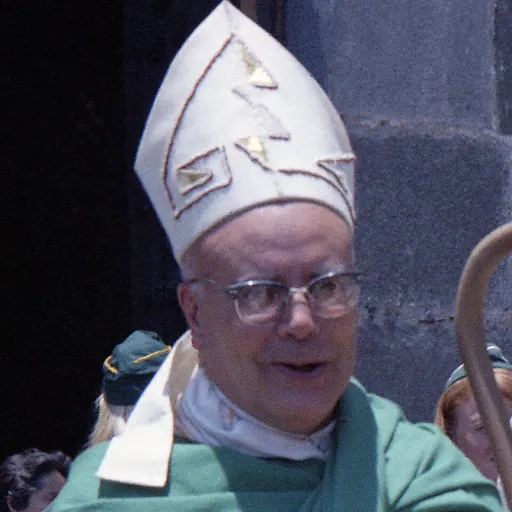
About Sergio Méndez Arceo
Lived 1907 – 1992 (aged 84). Sergio Méndez Arceo was a Mexican catholic priest, catholic bishop and historian.
Sergio Méndez Arceo (28 October 1907 in Tlalpan – 5 February 1992 in Morelos) was a Mexican Roman Catholic bishop and activist. A product of a wealthy family, Méndez Arceo's father was a successful lawyer and his uncle was a prominent archbishop believed to be involved in the church-state conflict of the 1920s. Méndez Arceo graduated from the Pontifical Gregorian University of Rome and served as a seminary professor in Mexico. He became Roman Catholic Bishop of Cuernavaca, Morelos, in 1953 and served in that capacity until 1983. He was a progenitor of Latin American liberation theology.
Basic ecclesial communities Sergio Méndez Arceo was Bishop of the Cuernavaca diocese in the Mexican state of Morelos. He is often cited as the force behind the growth of basic ecclesial communities (CEB) in Mexico during the 1970s. The first groups arose in Mexico in 1967 under Méndez Arceo, and by the 1970s CEBs were operating throughout Mexico, 70% in rural regions with the remainder in working-class urban areas. Méndez Arceo and the CEB's often removed the emphasis on the church's hierarchy, instead pushing for a greater dialogue between church leaders, non-clergy members and the members of the surrounding community. Members of the CEB's would meet with priests and discuss social, political and economic issues they felt needed attention. Following the meetings, priests would confer with Méndez Arceo weekly to discuss possible solutions to the issues of the members of the community.
CIDOC Méndez Arceo supported Ivan Illich, an Austrian philosopher of Croatian and Jewish origin, in setting up the Intercultural Documentation Center (CIDOC) at his diocese in Cuernavaca in 1961. Illich is stated as having pronounced to Méndez Arceo; "I would like to start, under your auspices, a center for de-Yankeefication." The Center was a research center and offered language courses to missionaries from North America and to volunteers of the Alliance for Progress program. Illich however was stated as having the goal of countering the participation of the Vatican in the "modern development" of the Third World. He believed that the Church should view itself as guest of the host country and, through the center, relayed this belief. The conservative members of the Church denounced the school, and for a time forbade clergy from studying at the location. The ban however was altered following Méndez Arceo's trip to Rome where he pleaded the case for the CIDOC. It was decided that priests and nuns may study at the CIDOC as long as their superiors monitored their progress.
Liberation theology During the Second Vatican Council, he formally requested the Supreme Pontiff to lift the excommunication for Freemasons.
Méndez Arceo was a believer in liberation theology, a belief which led him to be named the "Red Bishop" and a "scandalous supporter of socialism". In 1970 Méndez Arceo stated "Christianity and socialism can co-exist" and he encouraged then president of Mexico Luis Echeverría to form a committee of notable citizens to examine Mexico's most serious social and economic problems. Echeverría viewed Arceo as the foremost proponent of liberation theology and favored his emphasis on redistribution of wealth to the poor. Echeverría believed the clergy could help the people of Mexico learn the best means of organizing themselves in a capitalist society. The means of organizing in Arceo's view was labor unions, which he viewed as "essential to the base of community organizing." For the workers whom Arceo provided support for in his Sunday homilies, his title was Don Sergio, an honorific title in the Spanish language.
Upon his retirement Méndez Arceo founded the Center for Meetings and Dialogue (CED) in Cuernavaca to serve as an umbrella organization for other social and activist programs in the state of Morelos. The role of the CED was to help assist in the continuation of his life work in the field of liberation theology. Today, the CED "provides a regional mechanism for progressive popular organizations" as well as housing statewide meetings in various fields such as women's empowerment, human rights, education, and environmental protection.
Activism Sergio Méndez Arceo was an advocate of the "spirit of Vatican II", to social action programs.
Criticism
Some say that Sergio Méndez Arceo's actions and views made him too controversial, to the point that it limited his ability to form collegiality with other Mexican bishops and the episcopate; also that he politicized his diocese and its communities, and in doing so was opposed to the government. Roderic Ai Camp in Crossing Swords: Politics and Religion in Mexico states that this is wrong, and asserts "empirical data ... states that religion in Cuernavaca is associated with increased PRI support." The Institutional Revolutionary Party (PRI), being the then ruling party.
In 1983 when Méndez Arceo retired, Juan Jesús Posadas Ocampo became bishop of the diocese of Cuernavaca.
It later become known that the United States Federal Bureau of Investigation (FBI) produced a report on Méndez Arceo stating he was friendly to the Farabundo Martí National Liberation Front (FMLN) of El Salvador and the Sandinista National Liberation Front (FSLN) of Nicaragua, which took power in 1979 following the collapse of the Somoza regime. The FBI further alleged Méndez Arceo's diocese collected intelligence, bought and sold guns, and served as couriers for communist guerrillas of El Salvador. Méndez Arceo was further accused of being contacted by the Soviet Union Committee for State Security (KGB) and Cuban General Intelligence Directorate (DGI).
In an article in the Catholic periodical The Athanasian, it is claimed that Arceo was in fact a crypto-Freemason; and that there were and are many more like him in the Vatican hierarchy.
Documentary In 2024, a feature-length documentary titled Red Bishop directed by Francesco Taboada Tabone was premiered on The 78th International Film Exhibition at Mexico City's National Film Archive. The documentary portrays the life of Sergio Méndez Arceo and includes both unreleased material and interviews with multiple relevant figures in liberation theology, including Leonardo Boff, Enrique Dussel, and Gabriel Chávez de la Mora.
The documentary later had a comercial release in Mexican cinemas on April 9th, 2026.
Don’t just read it —
keep it.
Full-length biographies made to live with: read them, listen on the way to work, watch them tonight.
- E-book
- Audio
- Video
Instant download · yours to keep · every purchase keeps this site free
Important facts
People in Sergio Méndez Arceo's life
Named in this biography and alive at the same time





Related people
Same field, nearest in time


Contemporaries
People whose lives overlapped Sergio Méndez Arceo's
Frequently asked questions
Who was Sergio Méndez Arceo?
Catholic bishop (1907-1992)
When was Sergio Méndez Arceo born?
Sergio Méndez Arceo was born on 28 October 1907 in Tlalpan.
When did Sergio Méndez Arceo die?
Sergio Méndez Arceo died on 5 February 1992 in Morelos.
What was Sergio Méndez Arceo's occupation?
Sergio Méndez Arceo was a catholic priest, catholic bishop and historian.
What nationality was Sergio Méndez Arceo?
Sergio Méndez Arceo was Mexican.
Sources & further reading
· Wikipedia: Sergio Méndez Arceo
· DBpedia: Sergio Méndez Arceo
Cite this page
APA: Biography.guide. (2026). Sergio Méndez Arceo. https://biography.guide/sergio-mendez-arceo/
MLA: "Sergio Méndez Arceo." Biography.guide, https://biography.guide/sergio-mendez-arceo/.
Chicago: "Sergio Méndez Arceo." Biography.guide. https://biography.guide/sergio-mendez-arceo/.
Data last updated: 2026-09-20 · Spot an error? Report a correction.
Page generated 2026-09-27 05:10 UTC