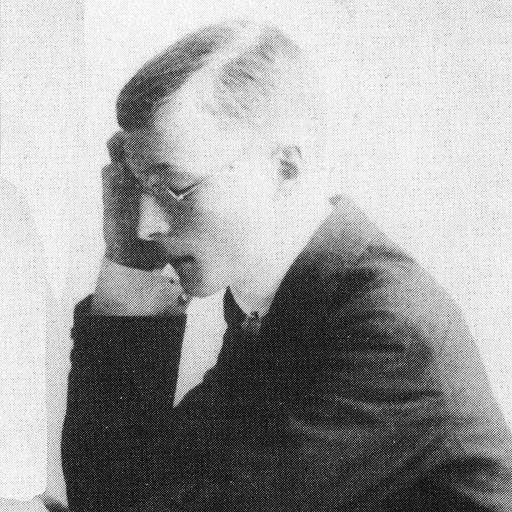
About Sergey Nabokov
Lived 1900 – 1945 (aged 44). Sergey Nabokov was a Russian and French teacher and poet.
Sergey Vladimirovich Nabokov (Russian: Сергей Владимирович Набоков; 12 March 1900 – 9 January 1945) was a Russian poet and pedagogue. He died in a Nazi concentration camp located in Neuengamme. He was the brother of Vladimir Nabokov.
Life
Russia Sergey was born in Saint Petersburg into the noble Nabokov family. His father was the noted Russian lawyer and statesman Vladimir Dmitrievich Nabokov. His mother, Elena Ivanovna, was the daughter of philanthropist Ivan Rukavishnikov. Sergey was the second son, being 11 months younger than Vladimir.
Unlike his older brother, Sergey was a shy, awkward boy. He had poor eyesight and a severe stutter. He developed a strong passion for music around the age of ten, playing fragments of piano operas and going to concerts with his father.
Sergey spent the first years of his life at the Nabokov house on Bolshaya Morskaya Street in Saint Petersburg, and at the family's suburban estate in Vyra, near Siversky. He began his education at Tenishevski's school, where he studied for five years, and then transferred to the First Junior High School.
When Sergey was 15, Vladimir found a page of his diary faked symptoms of typhus, and the brothers were ignored. In April 1919, before the beginning of Bolshevik rule, the Nabokov family left Russia forever and settled in Berlin.
Europe
Sergey studied Russian and French philology at Christ's College, Cambridge, while Vladimir attended Trinity College at the same time. They spent much time together, often playing tennis. The brothers were quite different, with Sergey being tall, slim, blond, with pink skin, with an elegant aesthetic, and cheerful but sensitive.
According to contemporaries, Sergey Nabokov was a nice, intelligent young man who spoke four languages fluently, knew French and Russian poetry, and loved music and theater, which made him very different from his brother. In Paris, he taught English and Russian while fending off starvation. He wrote poems but they are not preserved.
In the Paris of the late 1920s, Sergey met Hermann Thieme, the son of the Austrian insurance tycoon Carl Thieme, who became the love of his life. The two moved to Weissenstein Castle, Matrei in East Tyrol. In the 1930s, they traveled together around Europe. ) and was put under observation. After this incident, Sergey began to openly criticize the Nazi authorities in daily conversations.
On 24 November 1943, Sergey Nabokov was arrested again on charges of "statements hostile to the state" and "Anglo-Saxon sympathies" and on 15 December was sent to KL Neuengamme, where he was given the number 28631. The exact reason for his second arrest is unknown. Vladimir wrote that his brother was arrested as a "British spy". Eyewitnesses said that Sergey showed exceptional resistance, helped the weak, and shared food and clothing.
On 9 January 1945, four months before the liberation of the concentration camp, Sergey Nabokov died of dysentery and hunger. After returning to Europe, Nabokov never visited Germany, despite having lived there for 15 years.
Vladimir Nabokov's works Sergey was mentioned in Vladimir's autobiography Speak, Memory: An Autobiography Revisited. According to Brian Boyd, Vladimir was tormented by the thought that he did not love his brother enough, and there was a long history of inattentiveness, mindless ridicule, and neglect. In 1945, Nabokov wrote, in a letter to E. Wilson: "The Germans sent my second brother to one of the worst concentration camps (near Hamburg), where he disappeared. This message struck me because in my opinion Sergey was the last person who, in my opinion, could have been arrested (for his "Anglo-Saxon sympathies"): a harmless, idle, touching person..."
Some literary scholars point to the possibility of Sergey Nabokov's character informing the main characters of the novels The Real Life of Sebastian Knight, Bend Sinister, and Ada or Ardor: A Family Chronicle. Others point to the complex interactions of the gay character Kinbote in the novel Pale Fire. The death of his brother and other war tragedies led Nabokov to reflect deeply on the nature of evil in the world, while also attempting to distance himself from terrible events.
While he was writing Lolita, Vladimir Nabokov began to write a novel about conjoined twins, one of whom was in love with the other, but he abandoned this idea in favor of Lolita.
Other works In the film Mademoiselle O (1993), based on the autobiographical works of Vladimir Nabokov, the role of Sergey is played by Grigory Klalov. According to critics, the film is partly a tribute to Sergey. His image is compared with the image of the governess "Mademoiselle": after many years the author feels guilty and regrets both. In the movie, Sergey is portrayed as a nice, emotional younger brother, in sharp contrast to the cold and distant older brother.
Sergey's life is fictionalized in the novel The Unreal Life of Sergey Nabokov by Paul Russell.
Don’t just read it —
keep it.
Full-length biographies made to live with: read them, listen on the way to work, watch them tonight.
- E-book
- Audio
- Video
Instant download · yours to keep · every purchase keeps this site free
Important facts
People in Sergey Nabokov's life
Named in this biography and alive at the same time



Related people
Same field, nearest in time


Contemporaries
People whose lives overlapped Sergey Nabokov's



Frequently asked questions
Who was Sergey Nabokov?
Russian poet and pedagogist
When was Sergey Nabokov born?
Sergey Nabokov was born on 12 March 1900 in Saint Petersburg.
When did Sergey Nabokov die?
Sergey Nabokov died on 9 January 1945 in Neuengamme concentration camp.
What was Sergey Nabokov's occupation?
Sergey Nabokov was a teacher and poet.
What nationality was Sergey Nabokov?
Sergey Nabokov was Russian and French.
Sources & further reading
Cite this page
APA: Biography.guide. (2026). Sergey Nabokov. https://biography.guide/sergey-nabokov/
MLA: "Sergey Nabokov." Biography.guide, https://biography.guide/sergey-nabokov/.
Chicago: "Sergey Nabokov." Biography.guide. https://biography.guide/sergey-nabokov/.
Data last updated: 2026-09-23 · Spot an error? Report a correction.
Portrait: Wikimedia Commons · author & licence
Page generated 2026-09-27 05:07 UTC