
About Seppo Mikkola
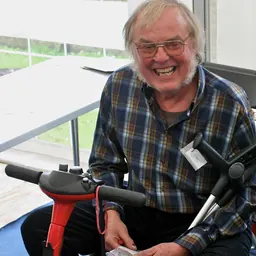
Born 1947. Seppo Mikkola is a Finnish astronomer.
Seppo Mikkola (born 1947) is a Finnish astronomer. He is a senior lecturer at the University of Turku and staff member at Tuorla Observatory.
Mikkola is a leading expert in celestial mechanics. He has made fundamental contributions to the theory of regularization of motion in the gravitational N-body problem. Mikkola was a member of the team that determined the unusual orbit of 3753 Cruithne. He was also the a member of the team that identified 524522 Zoozve as a quasi-satellite of Venus, in 2004, two years after the actual discovery of the object.
Named after him Asteroid 3381 Mikkola
Don’t just read it —
keep it.
Full-length biographies made to live with: read them, listen on the way to work, watch them tonight.
- E-book
- Audio
- Video
Instant download · yours to keep · every purchase keeps this site free
Important facts
Related people
Same field, nearest in time





Contemporaries
People whose lives overlapped Seppo Mikkola's



Frequently asked questions
Who is Seppo Mikkola?
Finnish astronomer
When was Seppo Mikkola born?
Seppo Mikkola was born in 1947.
What is Seppo Mikkola's occupation?
Seppo Mikkola is an astronomer.
What nationality is Seppo Mikkola?
Seppo Mikkola is Finnish.
Sources & further reading
Cite this page
APA: Biography.guide. (2026). Seppo Mikkola. https://biography.guide/seppo-mikkola/
MLA: "Seppo Mikkola." Biography.guide, https://biography.guide/seppo-mikkola/.
Chicago: "Seppo Mikkola." Biography.guide. https://biography.guide/seppo-mikkola/.
Data last updated: 2026-09-20 · Spot an error? Report a correction.
Page generated 2026-09-27 05:18 UTC