About Seneka Bibile
Lived 1920 – 1977 (aged 57). Seneka Bibile was an Indian academic.
Senaka Bibile (; 13 February 1920 – 29 September 1977) was a Sri Lankan pharmacologist, academic, and medical education pioneer. He was the founder of the Sri Lanka National Pharmaceuticals Policy, which became a global model for rational pharmaceutical policies, adopted by the World Health Organization (WHO), the United Nations Conference on Trade and Development (UNCTAD), and the Non-Aligned Movement. He also established the State Pharmaceuticals Corporation of Sri Lanka (SPC) to regulate drug imports and reduce costs. As Dean of the Faculty of Medicine, University of Peradeniya, he pioneered medical education reforms, establishing Sri Lanka’s first Medical Education Unit (MEU). Bibile is widely regarded as one of Sri Lanka’s greatest medical benefactors due to his contributions to affordable healthcare and medical education.
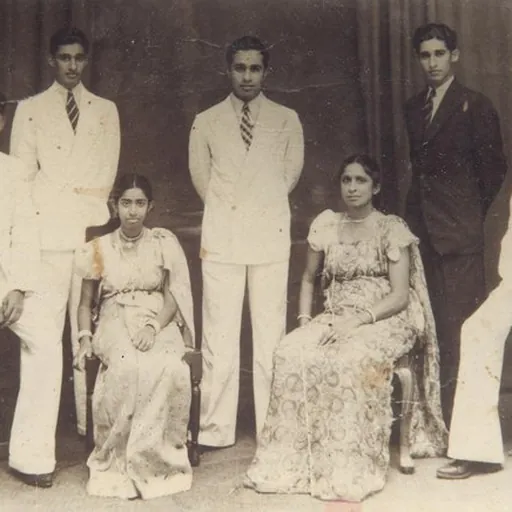
Early life and education Bibile family. Left to right: Charles William Bibile (father), Sylvester Chandra Bibile, Sujatha Doris Ranawana (Nee Bibile), Senaka William Bibile, Sylvia Jayawardena Bibile (mother), Henry Ananda Bibile, Cuda Banda Bibile.
Senaka Bibile was born on 13 February 1920 at Kataluwa Walawwa in Ahangama, Galle, Sri Lanka, to an aristocratic family.
His father, Charles William Bibile, was a Rate Mahatmaya or Chief Native Feudal Official of Wellassa, his mother Sylvia Jayawardena of Kataluwa Walauwa, the manor house of the Obeyesekere - Jayawardena family. The Bibile family claimed descent from a 16th-century Vedda chieftain.
Bibile received his primary and secondary education at Trinity College, Kandy. At Trinity College, Bibile excelled academically, winning prizes in science and biology, and in extracurriculars, earning rugby colours and starring in school dramas. He was a prefect and a cadet, demonstrating early signs of leadership material. Financial difficulties after his father's death were mitigated by a philanthropist's support, enabling him to continue his education. Bibile's early exposure to rural poverty, through visits with his father to remote villages and volunteer work with Trinity College's Social Service Union in Mahaiyawa slums, shaped his commitment to social justice and healthcare equity.
He entered the Medical College, Colombo, graduating in 1945 with a first-class honours MBBS degree, securing the Djunjishaw Dadabhoy Gold Medal in Medicine and Rockwood Gold Medal in Surgery. Influenced by Marxist and socialist ideologies, he inspired peers like Carlo Fonseka during his student years.
In 1949, he pursued postgraduate studies at the University of Edinburgh, earning a PhD in pharmacology in 1952 for his thesis on biological assays of cortical hormones.
Academic career Bibile joined the University of Ceylon in 1947 as a lecturer in pharmacology, leading a research team under Professor Cullumbine, Professor of Physiology, from 1947 to 1949. following the Bibile-Wickremasinghe report, co-authored with Dr S.A. Wickremasinghe and presented to Prime Minister Sirimavo Bandaranaike in 1971.
Senaka Bibile was a fierce critic of multinational pharmaceutical companies, arguing they prioritized profits over people's health by promoting expensive branded drugs, a practice widely believed at the time to involve Pharmaceutical companies in Sri Lanka making considerable money by selling drugs under their trade names and providing biased information against generic drugs. In 1959, he compiled the Ceylon Hospital Formulary, listing about 630 drugs by their generic names, reducing the number of imported drugs from over 4,000 to 171 by 1972. Bibile's contributions were acknowledged at the 35th World Health Assembly in Geneva in May 1982.
After Bibile's death, the United National Party government of 1977 relaxed import restrictions, weakening the policy by allowing unrestricted imports, though the SPC continued operations to supply affordable drugs.
Political activities Bibile was a Trotskyist and a member of the Lanka Sama Samaja Party (LSSP), serving as treasurer of its Youth Leagues.
Legacy Bibile’s legacy endures through the SPC, the National Medicinal Drugs Policy (NMDP), and the annual Senaka Bibile Memorial Oration, organized by the Sri Lanka Medical Association (SLMA) according to some sources, while others report it is held under the auspices of the Kandy Society of Medicine.
His educational reforms inspired generations, notably through the Students Involved in Rational Health Action (SIRHA), founded in 1992 by medical students like Prof. Indika Karunathilake, who became Sri Lanka’s first Professor in Medical Education in 2015. His policies continue to influence Sri Lanka’s healthcare system, with calls to revive the NMDP to address medicine shortages and economic challenges.
Publications Bibile authored numerous publications, contributing significantly to pharmacology, medical education, and pharmaceutical policy.
Don’t just read it —
keep it.
Full-length biographies made to live with: read them, listen on the way to work, watch them tonight.
- E-book
- Audio
- Video
Instant download · yours to keep · every purchase keeps this site free
Important facts
People in Seneka Bibile's life
Named in this biography and alive at the same time
Related people
Same field, nearest in time



Contemporaries
People whose lives overlapped Seneka Bibile's






Frequently asked questions
Who was Seneka Bibile?
Sri Lankan politician (1920-1977)
When was Seneka Bibile born?
Seneka Bibile was born on 13 February 1920 in Walauwa.
When did Seneka Bibile die?
Seneka Bibile died on 29 September 1977 in Guyana.
What was Seneka Bibile's occupation?
Seneka Bibile was an academic.
What nationality was Seneka Bibile?
Seneka Bibile was Indian.
Sources & further reading
Cite this page
APA: Biography.guide. (2026). Seneka Bibile. https://biography.guide/seneka-bibile/
MLA: "Seneka Bibile." Biography.guide, https://biography.guide/seneka-bibile/.
Chicago: "Seneka Bibile." Biography.guide. https://biography.guide/seneka-bibile/.
Data last updated: 2026-09-21 · Spot an error? Report a correction.
Portrait: Wikimedia Commons · author & licence
Page generated 2026-09-27 05:00 UTC