About Seneb
Lived 2600 BC – 2528 BC. Seneb was a priest.
Seneb was a high-ranking court official in the Old Kingdom of Ancient Egypt, circa 2520 BC. A dwarf, Seneb was a person of considerable importance and wealth who owned thousands of cattle, held twenty palaces and religious titles and was married to a high-ranking priestess of average size with whom he had three children. His successful career and the lavishness of his burial arrangements are indicative of the acceptance given to dwarfs in ancient Egyptian society, whose texts advocated the acceptance and integration of those with physical disabilities. He is one of the most notable disabled people in Ancient Egyptian history.
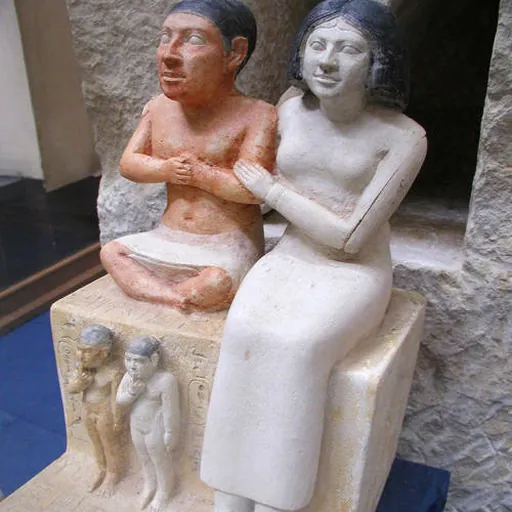
Seneb is depicted with his wife and children in a painted sculpture from his tomb, rediscovered in 1926, that is a famous example of Old Kingdom art. It shows him sitting cross-legged on a block of stone with his wife embracing him and his children standing below him where the legs of a full-size person would ordinarily have been. The composition of the scene thus achieves a harmonious symmetry. It depicts Seneb realistically with the facial features and shortened limbs of an individual with achondroplasia, a common form of dwarfism. Paintings and carvings in the tomb give his titles and depict various scenes from his life, such as carrying out inspections of his estate and holding symbols of his office.
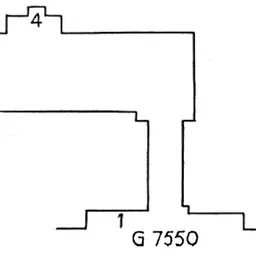
Discovery and location of Seneb's tomb Map of the Giza Necropolis. Seneb's tomb was found in the western cemetery (the West Field) Seneb was buried in a mastaba – a flat-roofed brick tomb – located in the West Field of the Giza Necropolis near modern Cairo, where a large complex of ancient Egyptian royal tombs and mortuary structures was built, including the Great Pyramid. It was rediscovered by the German archaeologist Hermann Junker in 1926. The tomb is situated close to that of another dwarf, Perniankhu, a high-ranking royal courtier who may have been Seneb's father. Its date was long uncertain but is now firmly attributed to the reign of Djedefre (2528–2520 BC). His wife's name also appears in the nearby tomb of an official, Ankh-ib, suggesting that the families of Seneb, Perniankhu and Ankh-ib may have been related. Seneb was apparently buried with his wife, but no trace remains of the bodies, and the tomb was looted long ago, like most of the others at Giza. It was one of the first known attempts at building a ceiling dome over a square chamber, with the dome resting on jutting bricks at the corners of the room.
The rectangular interior of Seneb's mastaba contained two cult niches with a false door and cavities containing stone chests. Three statues were found within the chests – the painted limestone sculpture of Seneb and his family and two other statues in wood and granite. The wooden one disintegrated when it was discovered but Junker recorded that it had been about high and depicted Seneb standing with a walking-staff in one hand and a sceptre in the other. The remnants of the wooden statue are now in the Roemer- und Pelizaeus-Museum Hildesheim in Germany, in a very fragmentary state; the outline of a curled wig can still be made out, as can the pose of the left arm, which was held forward at the elbow. Seneb's 1.5 ton sarcophagus is part of the collection of the Egyptian Museum of the University of Leipzig.
Sculpture of Seneb and his family
The limestone sculpture of Seneb and his family is part of the collection of the Egyptian Museum in Cairo. It depicts Seneb and his wife sitting next to each other with their children in the lower register. Seneb is depicted sitting cross-legged on a block of stone with his arms folded in a position characteristic of a scribe. His wife Senetites sits alongside him, wearing a long robe with long sleeves and a wig covering her natural hair, which can be glimpsed on her forehead. She encircles him with her arms in a gesture of affection and support. She is shown with a slight smile on her face to signify her contentment and happiness. though the third child was not depicted on the sculpture - presumably for reasons of symmetry. They were named after Seneb's royal masters; his son was called Radjedef-Ankh ("May Radjedef live"), his eldest daughter was Awib-Khufu ("Happy is Khufu") and his younger daughter was Smeret-Radjedef ("Companion of Radjedef"). preserving an appearance of normality without disguising Seneb's unusual physique. An alternative diagnosis is dysmelia – a condition that produces short arms and legs. Seneb's wife Senites is portrayed far less realistically; her depiction is of a piece with other contemporary portraits of high-ranking Egyptian women.
Role and position
Seneb's name means "healthy" – perhaps given by his mother as a wish for survival when he was a baby. Many Egyptians possessed similar names, not to denote an absence of disease, but rather to convey a positive message of healthiness and vigour.
Dwarfism was not seen as a defect in ancient Egypt, unlike in many other cultures. Egyptian texts advised the acceptance of those with physical or mental disabilities, and there were even two dwarf gods, Bes and Ptah. A number of dwarfs gained prestigious roles and were given lavish burials in proximity to their royal masters. Seneb's career is documented on his false door and the plinths of his statues, which record twenty titles (referring to a ceremonial or cult boat), "overseer of the jwḥw" (possibly referring to animal-tenders), and "keeper of the God's seal of the Wn-ḥr-b3w boat" (referring to a papyrus bark used in certain festivals). His titles suggest that he might have started his career as an official in charge of royal linen and possibly also pets, a role in which other dwarfs are known to have served, and subsequently gained higher-ranking posts in charge of royal or cult boats. Alternatively, he could have been born into a high-ranking family and was given roles appropriate to his birth rank. Seneb also carried out religious rites in his dual role as a priest. He was titled "Priest of Wadjet", priest of "the large bull which is at the head of Sṯpt" and of the bull Mrḥw. He participated in the funeral services for the Pharaohs Khufu, the builder of the Great Pyramid, and his successor Djedefre (Radjedef). He is depicted using what were evidently custom-made items of furniture, such as low stools and a specially adapted litter with a low back and large side-panels to conceal his legs.
As with the sculpture, Seneb's size required the creator of the reliefs to make some unusual artistic choices. The standard convention of depicting higher status through physical size was maintained by portraying Seneb as being larger than his retainers, although this was clearly the opposite of the situation that actually existed. On the other hand, he is still shown with the physical characteristics of a dwarf. Unusually for such a relief, his wife is not pictured alongside him but appears separately. This may have been done to avoid the complications that would have arisen from needing to depict the couple's relative sizes realistically while still portraying Seneb as the larger party, as convention would have dictated. Seneb is also not shown carrying out typical male activities such as hunting, which was presumably impractical for someone of his stature, although one relief shows him pulling on papyrus reeds to guide his boat through the marshes of the Nile Delta.
Don’t just read it —
keep it.
Full-length biographies made to live with: read them, listen on the way to work, watch them tonight.
- E-book
- Audio
- Video
Instant download · yours to keep · every purchase keeps this site free
Important facts
People in Seneb's life
Named in this biography and alive at the same time

Related people
Same field, nearest in time





Contemporaries
People whose lives overlapped Seneb's


Frequently asked questions
Who was Seneb?
ancient Egyptian official, priest
When was Seneb born?
Seneb was born in 2600 BC.
When did Seneb die?
Seneb died in 2528 BC.
What was Seneb's occupation?
Seneb was a priest.
Sources & further reading
Cite this page
APA: Biography.guide. (2026). Seneb. https://biography.guide/seneb/
MLA: "Seneb." Biography.guide, https://biography.guide/seneb/.
Chicago: "Seneb." Biography.guide. https://biography.guide/seneb/.
Data last updated: 2026-09-20 · Spot an error? Report a correction.
Page generated 2026-09-27 05:10 UTC