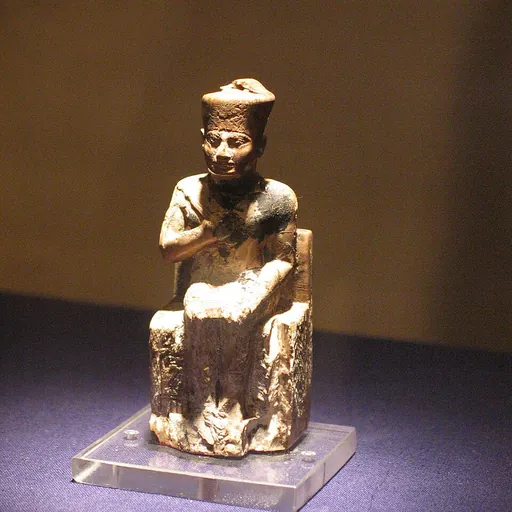
About Khufu
Lived 2700 BC – 2566 BC. Khufu was an Egyptian statesperson and pharaoh.
Family
Origin
The royal family of Khufu was quite large. It is uncertain if Khufu was actually the biological son of Sneferu. Egyptologists believe Sneferu was Khufu's father, but only because it was handed down by later historians that the eldest son or a selected descendant would inherit the throne. In 1925, the tomb of queen Hetepheres I was found east of Khufu's pyramid. It contained many precious grave goods, and several inscriptions give her the title Mut-nesut (meaning "mother of a king"), together with the name of king Sneferu. Therefore, it seemed clear at first that Hetepheres was the wife of Sneferu, and that they were Khufu's parents. More recently, however, some have doubted this theory, because Hetepheres is not known to have borne the title Hemet-nesut (meaning "king's wife"), a title indispensable to confirm a queen's royal status.
Instead of the spouse's title, Hetepheres bore only the title Sat-netjer-khetef (verbatim: "daughter of his divine body"; symbolically: "king's bodily daughter"), a title mentioned for the first time.
Family tree The following list presents family members, which can be assigned to Khufu with certainty.
Wepemnofret, a son of Khufu, from the stela of his Tomb G 1201, c. 2585 BC Princess Nefertiabet, likely sister of Khufu, from her Giza tomb, a. 2580 BC. Louvre Museum E 15591. Spouses: Hetepheres II: Wife of prince Kawab, later married to king Djedefre
Grandchildren:
One of them was found at the Dakhla Oasis in the Libyan Desert. Khufu's serekh name is carved in a rock inscription reporting the "Mefat-travelling in the year after the 13th (biennial) cattle count under Hor-Medjedu", reignal year 27.
Several papyrus fragments, known as the Diary of Merer, were found at Khufu's harbor at Wadi al-Jarf. They log the transport of limestone blocks from Tura to the Great Pyramid of Giza in the "year after the 13th cattle count under Hor-Medjedw". The ancient historian Herodotus gives 50 years, and the ancient historian Manetho even credits him 63 years of reign. These figures are now considered an exaggeration or a misinterpretation of antiquated sources.
Wadi Maghareh
At Wadi Maghareh in the Sinai a rock inscription depicts Khufu with the double crown. Khufu sent several expeditions in an attempt to find turquoise and copper mines. Like other kings, such as Sekhemkhet, Sneferu and Sahure, who are also depicted in impressive reliefs there, he was looking for those two precious materials. Khufu also entertained contacts with Byblos. He sent several expeditions to Byblos in an attempt to trade copper tools and weapons for precious Lebanon cedar wood. This kind of wood was essential for building large and stable funerary boats and indeed the boats discovered at the Great Pyramid were made of it.
Wadi al-Jarf New evidence regarding political activities under Khufu's reign has recently been found at the site of the ancient port of Wadi al-Jarf on the Red Sea coast in the east of Egypt. The first traces of such a harbour were excavated in 1823 by John Gardner Wilkinson and James Burton, but the site was quickly abandoned and then forgotten over time. In 1954, French scholars François Bissey and René Chabot-Morisseau re-excavated the harbour, but their works were brought to an end by the Suez Crisis in 1956. In June 2011, an archaeological team led by French Egyptologists Pierre Tallet and Gregory Marouard, organized by the French Institute of Oriental Archeology (IFAO), restarted work at the site. Among other material, a collection of hundreds of papyrus fragments were found in 2013 dating back 4,500 years. The papyrus is currently exhibited at the Egyptian Museum in Cairo. The Egyptian archaeologist Zahi Hawass called this ancient papyrus "the greatest discovery in Egypt in the 21st century."
Ten of these papyri are very well preserved. The majority of these documents date to the 27th year of Khufu's reign and describe how the central administration sent food and supplies to the sailors and wharf workers. The dating of these important documents is secured by phrases typical for the Old Kingdom period, as well as the fact that the letters are addressed to the king himself, using his Horus name. This was typical when the king in question was still alive; when the ruler was dead he was addressed by his cartouche name or birth name. One document is of special interest: the diary of Merer, an official involved in the building of the Great Pyramid. Using the diary, researchers were able to reconstruct three months of his life, providing new insight into the everyday lives of people of the Fourth Dynasty. These papyri are the earliest examples of imprinted papyri ever found in Egypt. Another inscription, found on the limestone walls of the harbor, mentions the head of the royal scribes controlling the exchange of goods: Idu.
Today the little statue is restored and on display in the Egyptian Museum of Cairo in room 32 under its inventory number JE 36143.
Deitrich Wildung has examined the representation of Nubian features in Egyptian iconography since the predynastic era and has argued that Khufu had these specific, Nubian features and this was represented in his statues.
Head of pharaoh, possibly Khufu in ivory displayed in Altes Museum Excavations at Saqqara in 2001 and 2003 revealed a pair of terracotta statues depicting a lion goddess (possibly Bastet or Sekhmet). On her feet two figures of childlike kings are preserved. While the right figurine can be identified as king Khufu by his Horus name, the left one depicts king Pepy I of 6th dynasty, called by his birth name. The figurines of Pepy were added to the statue groups in later times, because they were placed separately and at a distance from the deity.
This is inconsistent with a typical statue group of the Old Kingdom—normally all statue groups were built as an artistic unit. The two statue groups are similar to each other in size and scale but differ in that one lion goddess holds a scepter. The excavators point out that the statues were restored during the Middle Kingdom, after they were broken apart. However, it seems that the reason for the restoration lay more in an interest in the goddess, than in a royal cult around the king figures: their names were covered with gypsum.
The Palermo Stone reports on its fragment C-2 the creation of two oversize standing statues for the king; one is said to have been made of copper, the other of pure gold.
Two further objects are on display at the Roemer- und Pelizaeus-Museum Hildesheim. These are also made of alabaster. One of them shows the head of a cat goddess (most probably Bastet or Sekhmet). The position of her right arm suggests that the bust once belonged to a statue group similar to the well-known triad of Menkaure.
Several statue heads might have belonged to Khufu. One of them is the so-called "Brooklyn head" of the Brooklyn Museum in New York City. It is 54.3 cm large and made of pink granite. Because of its chubby cheeks the head is assigned to Khufu as well as to king Huni. A similar object is on display at the State Collection of Egyptian Art in Munich. The head is made of limestone and is comparatively small at only 5.7 cm.
Reliefs Khufu is depicted in several relief fragments found scattered in his necropolis and elsewhere. All reliefs were made of finely polished limestone. Some of them originate from the ruined pyramid temple and the destroyed causeway, where they once covered the walls completely. Others were found re-used in the pyramid necropolis of king Amenemhet I at Lisht and at Tanis and Bubastis. A third one shows the earliest known depiction of royal warfare: the scene is called "archers prepare", since it shows archers drawing their bows. And a fourth example shows the king with the double crown impaling a hippopotamus.
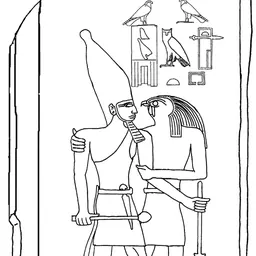
At the Wadi Maghareh in Sinai a rock inscription contains Khufu's names and titles and reports: "Hor-Medjedu, Khnum-Khuf, Bikuj-Nebu, the great god and smiter of the troglodytes, all protection and life are with him". The work-off of the relief is similar to that of king Snefru. In one scene king Khufu wears the double-crown; nearby, the depiction of the god Thoth is visible. In another scene, close by, Khufu wears the Atef-crown while smiting an enemy. In this scene the god Wepwawet is present.
None of the numerous relief fragments shows king Khufu offering to a god. This is remarkable, since reliefs of Sneferu and those of all kings from Menkaura onward show the king offering to a deity. It is possible that the lack of this special depiction influenced later ancient Greek historians in their assumptions that Khufu could have actually closed all temples and prohibited any sacrifice.
Pyramid complex
The pyramid complex of Khufu was erected in the northeastern section of the plateau of Giza. It is possible that the lack of building space, the lack of local limestone quarries and the loosened ground at Dahshur forced Khufu to move north, away from the pyramid of his predecessor Sneferu. Khufu chose the high end of a natural plateau so that his future pyramid would be widely visible. Khufu decided to call his pyramid Akhet-Khufu (meaning "horizon of Khufu").
Recent archeological studies suggest that a Nile connected harbor was functioning at Giza during Khufu's reign. Sediment cores from the floodplain show deposits consistent with an Old Kingdom port, which is also known as "Khufu's harbor". Researchers argue that this harbor likely allowed stones and supplies to be transported for the construction of Khufu's pyramid complex.
The Great Pyramid has a base measurement of 750 x 750 ft (≙ 230.4 x 230.4 m) and today a height of . Once it had been high, but the pyramidion and the limestone casing are completely lost due to stone robbery. The lack of the casing allows a full view of the inner core of the pyramid. It was erected in small steps by more or less roughly hewn blocks of dark limestone. The casing was made of nearly white limestone. The outer surface of the casing stones were finely polished so the pyramid shimmered in bright, natural lime-white when new. The pyramidion might have been covered in electrum, but there is no archaeological proof of that. The inner corridors and chambers have walls and ceilings made of polished granite, one of the hardest stones known in Khufu's time. The mortar used was a mixture of gypsum, sand, pulverized limestone and water.
A tight corridor heading south at the western end of the chamber and an unfinished shaft at the eastern middle might indicate that the subterranean chamber was the oldest of the three chambers and that the original building plan contained a simple chamber complex with several rooms and corridors. But for unknown reasons the works were stopped and two further chambers were built inside the pyramid. Remarkable is the so-called Grand Gallery leading to the king's chamber: It has a corbelled arch ceiling and measures in height and in length. The gallery has an important static function; it diverts the weight of the stone mass above the king's chamber into the surrounding pyramid core.
Middle Kingdom Reused building materials found at the pyramid complex of Amenemhat I with Khufu's cartouche on it that is thought originally to have been part of Khufu's Mortuary temple in Giza. At Wadi Hammamat a rock inscription dates back to the 12th dynasty. It lists five cartouche names: Khufu, Djedefra, Khafra, Baufra and Djedefhor. Because all royal names are written inside cartouches, it was often believed that Baufra and Djedefhor once had ruled for short time, but contemporary sources entitle them as mere princes. Khufu's attendance roll call in this list might indicate that he and his followers were worshipped as patron saints. This theory is promoted by findings such as alabaster vessels with Khufu's name found at Koptos, the pilgrimage destination of Wadi Hammamat travellers.
New Kingdom During the New Kingdom the necropolis of Khufu and the local mortuary cults were reorganized and Giza became an important economic and cultic destination again. During the Eighteenth Dynasty king Amenhotep II erected a memorial temple and a royal fame stele close to the Great Sphinx. His son and throne follower Thutmose IV freed the Sphinx from sand and placed a memorial stele—known as the "Dream Stele"—between its front paws. The two steles' inscriptions are similar in their narrative contents, but neither of them gives specific information about the true builder of the Great Sphinx.
In ancient Greek traditions
Manetho The later Egyptian historian Manetho called Khufu "Sûphis" and credited him with a rulership of 63 years. He also mentions that Khufu built the Great Pyramid, then he claims that his contemporary Herodotus says that the pyramid was built by a king "Khéops". Manetho thought "Khéops" and "Sûphis" to be two different kings. Manetho also says that Khufu received a contempt against the gods and that he had written a sacred book about that and that he (Manetho) received that book during his travel through Egypt. The story about the alleged "Sacred Book" is questioned by modern Egyptologists, for it would be highly unusual that a pharaoh wrote books and that such a precious document could be sold away so easily.
Herodotus The Greek historian Herodotus instead depicts Khufu as a heretic and cruel tyrant. In his literary work Historiae, Book II, chapter 124–126, he writes: "As long as Rhámpsinîtos was king, as they told me, there was nothing but orderly rule in Egypt, and the land prospered greatly. But after him Khéops became king over them and brought them to every kind of suffering: He closed all the temples; after this he kept the priests from sacrificing there and then he forced all the Egyptians to work for him. So some were ordered to draw stones from the stone quarries in the Arabian mountains to the Nile, and others he forced to receive the stones after they had been carried over the river in boats, and to draw them to those called the Libyan mountains. And they worked by 100,000 men at a time, for each three months continually. Of this oppression there passed ten years while the causeway was made by which they drew the stones, which causeway they built, and it is a work not much less, as it appears to me, than the pyramid. For the length of it is 5 furlongs and the breadth 10 fathoms and the height, where it is highest, 8 fathoms, and it is made of polished stone and with figures carved upon it. For this, they said, 10 years were spent, and for the underground chambers on the hill upon which the pyramids stand, which he caused to be made as sepulchral chambers for himself in an island, having conducted thither a channel from the Nile.
For the making of the pyramid itself there passed a period of 20 years; and the pyramid is square, each side measuring 800 feet, and the height of it is the same. It is built of stone smoothed and fitted together in the most perfect manner, not one of the stones being less than 30 feet in length. This pyramid was made after the manner of steps, which some call 'rows' and others 'bases': When they had first made it thus, they raised the remaining stones with devices made of short pieces of timber, lifting them first from the ground to the first stage of the steps, and when the stone got up to this it was placed upon another machine standing on the first stage, and so from this it was drawn to the second upon another machine; for as many as were the courses of the steps, so many machines there were also, or perhaps they transferred one and the same machine, made so as easily to be carried, to each stage successively, in order that they might take up the stones; for let it be told in both ways, according as it is reported. However, that may be, the highest parts of it were finished first, and afterwards they proceeded to finish that which came next to them, and lastly they finished the parts of it near the ground and the lowest ranges.
On the pyramid it is declared in Egyptian writing how much was spent on radishes and onions and leeks for the workmen, and if I remember correctly what the interpreter said while reading this inscription for me, a sum of 1600 silver talents was spent. Kheops moreover came to such a pitch of evilness, that being in want of money he sent his own daughter to a brothel and ordered her to obtain from those who came a certain amount of money (how much it was they did not tell me). But she not only obtained the sum that was appointed by her father, but she also formed a design for herself privately to leave behind her a memorial: She requested each man who came in to her to give her one stone for her building project. And of these stones, they told me, the pyramid was built which stands in front of the great pyramid in the middle of the three, each side being 150 feet in length."
The best known story about Khufu and his pyramid can be found in the book Hitat (completely: al-Mawāʿiẓ wa-'l-iʿtibār fī ḏikr al-ḫiṭaṭ wa-'l-ʾāṯār), written in 1430 by Muhammad al-Maqrizi (1364–1442). This book contains several collected theories and myths about Khufu, especially about the Great Pyramid. Though King Khufu himself is seldom mentioned, many Arab writers were convinced that the Great Pyramid (and the others, too) were built by the god Hermes (named Idris by the Arabs).
The famous Lamentation Texts from the First Intermediate Period reveal some interesting views about the monumental tombs from the past; they were at that time seen as proof of vanity. However, they give no hint of a negative reputation of the kings themselves, and thus they do not judge Khufu in a negative way.
Another hint to Khufu's bad reputation within the Greek and Roman folk might be hidden in the Coptic reading of Khufu's name. The Egyptian hieroglyphs forming the name "Khufu" are read in Coptic as "Shêfet", which actually would mean "bad luck" or "sinful" in their language. The Coptic reading derives from a later pronunciation of Khufu as "Shufu", which in turn led to the Greek reading "Suphis". Possibly the bad meaning of the Coptic reading of "Khufu" was unconsciously copied by the Greek and Roman authors. The narrations of Diodorus, for example, are credited with more trust than those of Herodotus, because Diodorus collected the tales with much more scepsis. The fact that Diodorus credits the Giza pyramid to Greek kings, might be reasoned in legends of his lifetimes and that the pyramids were demonstrably reused in late periods by Greek and Roman kings and noblemen. In 1939, Nagib Mahfuz wrote the novel Khufu's Wisdom, which is based on the stories of Papyrus Westcar.
In 1997, French author Guy Rachet published the novel series Le roman des pyramides, including five volumes, of which the first two (Le temple soleil and Rêve de pierre) use Khufu and his tomb as a theme. In 2004, spiritualist Page Bryant published the novel The Second Coming of the Star Gods, which deals with Khufu's alleged celestial origin. The novel The Legend of The Vampire Khufu, published by Raymond Mayotte in 2010, deals with king Khufu awakening in his pyramid as a vampire.
Films which deal with Khufu, or have the Great Pyramid as a subject, include Howard Hawks' Land of the Pharaohs from 1955, a fictional account of the building of the Great Pyramid of Khufu, and Roland Emmerich's Stargate from 1994, in which an extraterrestrial device is found near the pyramids.
Khufu and his pyramid are the subject of pseudoscientific theories purporting that Khufu's pyramid was built with the help of extraterrestrials and that Khufu simply seized and re-used the monument, ignoring archaeological evidence or even falsifying it.
A near-Earth asteroid bears Khufu's name: 3362 Khufu.
Khufu and his pyramid are referenced in several computer games such as Tomb Raider – The Last Revelation, in which the player must enter Khufu's pyramid and face the god Seth as the final boss. Another example is Duck Tales 2 for the Game Boy; the player here must guide Uncle Scrooge through a trap-loaded Khufu's pyramid. In the classic action role playing game Titan Quest, the Giza Plateau is a large desert region in Egypt, where the tomb of Khufu and the Great Sphinx can be found. He is also mentioned in Assassin's Creed Origins, where the player can find his tomb.
Don’t just read it —
keep it.
Full-length biographies made to live with: read them, listen on the way to work, watch them tonight.
- E-book
- Audio
- Video
Instant download · yours to keep · every purchase keeps this site free
Important facts
more
Salhuk, Kheops, SuphisPeople in Khufu's life
Named in this biography and alive at the same time




Related people
Same field, nearest in time

Contemporaries
People whose lives overlapped Khufu's

Frequently asked questions
Who was Khufu?
Fourth Dynasty ancient Egyptian pharaoh
When was Khufu born?
Khufu was born in 2700 BC.
When did Khufu die?
Khufu died in 2566 BC.
What was Khufu's occupation?
Khufu was a statesperson and pharaoh.
What nationality was Khufu?
Khufu was Egyptian.
Sources & further reading
Cite this page
APA: Biography.guide. (2026). Khufu. https://biography.guide/khufu/
MLA: "Khufu." Biography.guide, https://biography.guide/khufu/.
Chicago: "Khufu." Biography.guide. https://biography.guide/khufu/.
Data last updated: 2026-09-22 · Spot an error? Report a correction.
Portrait: Wikimedia Commons · author & licence
Page generated 2026-09-27 05:03 UTC