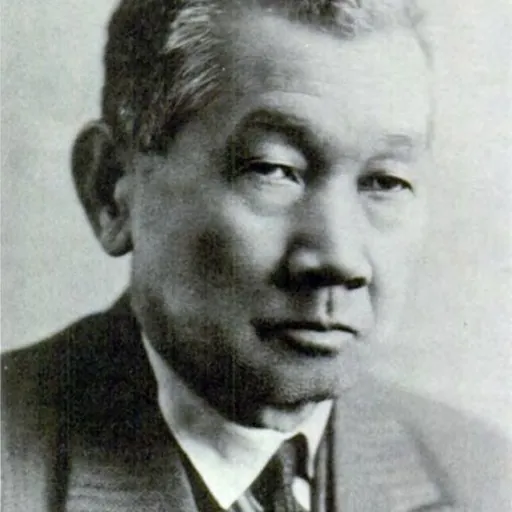
About Sen Katayama
Lived 1859 – 1933 (aged 73). Sen Katayama was a Japanese journalist, human rights defender, teacher, trade unionist, farmer and politician, known for Communist Party USA and Japanese Communist Party.
, born , was an early Japanese Marxist political activist and journalist, one of the original members of the CPUSA and co-founder, in 1922, of the Japanese Communist Party. After 1884, he spent most of his life abroad, especially in the United States and the Soviet Union, where he was very active in the international socialist community, and after 1920, the communist community. Katayama had a weak base inside Japan, and was little known there. However, in the rest of the world, he was widely hailed as a leading spokesman for the Japanese socialist and communist movements.
Early life and education
Sugataro Yabuki was the second son born to Kunizo and Kichi Yabuki in 1859 in the Hadeki district of what would later become Japan's Okayama Prefecture. He was adopted by the Katayama family at nineteen and took the name Sen Katayama, becoming the Katayamas' "first son" after his birth mother was deserted by her husband. The adoption avoided Katayama's conscription and allowed him to continue his education. In his autobiography, , Katayama admitted that he was fortunate not to have been the first born in his birth family, as it saved him from some of the responsibilities that burdened some of his acquaintances.
In 1878, Katayama travelled to Tokyo to apprentice as a printer while studying at a small preparatory school, the Oka-Juku, where he formed a friendship with , nephew of one of the founders of Mitsubishi. Iwasaki's departure for Yale University inspired Katayama to work his way to the United States, where he attended Maryville College in Maryville, Tennessee and Grinnell College, from which he graduated in 1892, proceeding to the Andover Theological Seminary and then to Yale Divinity School. During this period, Katayama became a Christian and a socialist.
Career
Katayama returned to Japan in 1896 and from 1897 to 1901 edited , the organ of the and .
Katayama was a founding member of the Social Democratic Party, Japan's first socialist party, in 1901, but was forced to disband by the government one day later. He returned to America in 1903 at the urging of Iwasaki to look into rice-farming opportunities. During this trip he attended the Second International Socialist Congress in Amsterdam where he gained recognition for shaking hands with the Russian delegate, G. V. Plekhanov, in a gesture of amity between the Russian and Japanese peoples, despite the then-ongoing Russo-Japanese War.
In 1904, he attended an American Socialist Party convention in Chicago. He settled in Texas and his main business became rice farming. When his crop failed he became employed by a Japanese restaurant owner in Houston, Tsunekichi Okasaki, who bought of land in Texas with the plan that Katayama farm it. In late 1905, the two borrowed $100,000 from Iwasaki to fund the rice harvest, together forming a "Nippon Kono Kabushiki-gaisha" (Japan Farming Company) to develop the project, with Katayama as managing director. However, the company quickly dissolved, reputedly over Katayama's socialist leanings, and he returned to Japan in 1907, rejoined the socialist movement, and pursued a career in journalism. Postage stamp issued in the USSR in 1967, with a portrait of Sen Katayama (1859-1933). He was arrested and jailed for his participation in the Tokyo Streetcar Strike of 1912, and after his release he left for California. Attracted by the success of the Bolshevik Revolution of 1917–1918, Katayama became an active communist and an officer for the Communist International. He travelled to Mexico and later to Moscow, where he was hailed as a leader of the Japanese communist movement. He remained in the Soviet Union until his death on November 5, 1933, and his ashes buried in the Kremlin Wall Necropolis in Red Square.
Personal life Katayama had two children by his first wife, Fude, who died in 1903, and another daughter by his second wife, Hari Tama, whom he married in 1907.
Works The Labor Movement in Japan. Chicago: Charles H. Kerr & Co., 1918. Japan and Soviet Russia, The People's Russian Information Bureau, 1919.
Don’t just read it —
keep it.
Full-length biographies made to live with: read them, listen on the way to work, watch them tonight.
- E-book
- Audio
- Video
Instant download · yours to keep · every purchase keeps this site free
Important facts
Related people
Same field, nearest in time

Contemporaries
People whose lives overlapped Sen Katayama's



Frequently asked questions
Who was Sen Katayama?
Japanese journalist (1859–1933)
When was Sen Katayama born?
Sen Katayama was born on 26 December 1859 in Kumenan.
When did Sen Katayama die?
Sen Katayama died on 5 November 1933 in Moscow.
What was Sen Katayama's occupation?
Sen Katayama was a journalist, human rights defender, teacher, trade unionist, farmer and politician.
What was Sen Katayama known for?
Sen Katayama was known for Communist Party USA and Japanese Communist Party.
What nationality was Sen Katayama?
Sen Katayama was Japanese.
Sources & further reading
Cite this page
APA: Biography.guide. (2026). Sen Katayama. https://biography.guide/sen-katayama/
MLA: "Sen Katayama." Biography.guide, https://biography.guide/sen-katayama/.
Chicago: "Sen Katayama." Biography.guide. https://biography.guide/sen-katayama/.
Data last updated: 2026-09-23 · Spot an error? Report a correction.
Portrait: Wikimedia Commons · author & licence
Page generated 2026-09-27 05:07 UTC