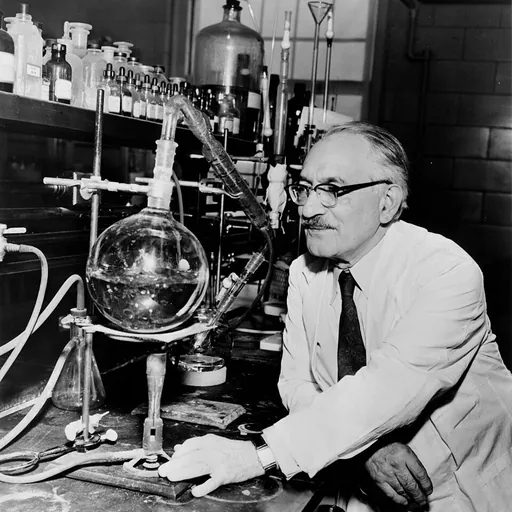
Selman Abraham Waksman
American scientist, biochemist, microbiologist who discovered Streptomycin and many antibiotics
About Selman Abraham Waksman
Lived 1888 – 1973 (aged 85). Selman Abraham Waksman was an American and Russian biochemist, autobiographer, physician, microbiologist, university teacher and inventor.
Selman Abraham Waksman ( – August 16, 1973) was a Russian-born American inventor, biochemist and microbiologist, whose research into the decomposition of organisms that live in soil enabled the discovery of streptomycin and several other antibiotics. For his work he won the 1952 Nobel Prize in Physiology or Medicine.
Waksman emigrated to the United States in 1910 and became a naturalized U.S. citizen in 1916.
In 2005, Waksman was granted an ACS National Historic Chemical Landmark in recognition of the significant work of his lab in isolating more than 15 antibiotics, including streptomycin, which was the first effective treatment for tuberculosis.
Early life and education Selman Waksman was born on , to Jewish parents in , in Kiev Governorate of the Russian Empire (present-day Vinnytsia Oblast, Ukraine). He was the son of Fradia (London) and Jacob Waksman. In 1910, shortly after receiving his diploma from the Fifth Gymnasium in Odessa, he immigrated to the United States and became a naturalized American citizen in 1916. He was appointed as a research fellow at the University of California, Berkeley, and in 1918 he was awarded his doctor of philosophy in biochemistry.
Career He joined the faculty at Rutgers University in the Department of Biochemistry and Microbiology.
At Rutgers, Waksman's team discovered several antibiotics, including actinomycin, clavacin, streptothricin, streptomycin, grisein, neomycin, fradicin, candicidin, candidin. Waksman co-discovered streptomycin with Albert Schatz. Streptomycin was the first effective drug against gram-negative bacteria using half of his patent royalties, Waksman created the Waksman Foundation for Microbiology. At a meeting of the board of trustees of the foundation, held in July 1951, he urged the building of a facility for work in microbiology, named the Waksman Institute of Microbiology, which is located on the Busch Campus of Rutgers University in Piscataway, New Jersey. The foundation's first president, Waksman, was succeeded in this position by his son, Byron H. Waksman, from 1970 to 2000.
Research Streptomycin
Waksman had been studying the Streptomyces family of organisms since his college student days and had, for a time, been studying the organism Streptomyces griseus. Streptomycin was isolated from S. griseus and found effective against tuberculosis by one of Waksman's graduate students, Albert Schatz. These results were later confirmed by Elizabeth Bugie Gregory, whose name was also published on "Streptomycin, a Substance Exhibiting Antibiotic Activity Against Gram-Positive and Gram-Negative Bacteria" with Schatz and Waksman. However, Bugie's name was not on the second key paper in 1944, which was regarding the efficacy of streptomycin against tuberculosis in test tubes, as Schatz claimed Bugie was not involved with the experiment. This was submitted under an attorney of the Rutgers Research and Endowment Foundation.
Controversy
The details and credit for the discovery of streptomycin and its usefulness as an antibiotic were strongly contested by Albert Schatz, leading to litigation in 1950. However, it was possible that Waksman did not see Schatz's contribution as significantly as Schatz saw his contributions. Waksman noted that Schatz was away at the military in 1943, adding that he was only in the lab for three months and only played a small role in discovering streptomycin. Schatz was awarded $120,000 for patent rights and 3% of royalties. The Lancet claimed that "the Nobel committee made a considerable mistake by failing to recognize Schatz's contribution."
Systematic experiments to test several strains of antibiotics against several different disease organisms were underway in Waksman's laboratory at the time. Their classic approach was to explore a complete matrix with rows consisting of antibiotics and columns consisting of different diseases. The bacteria which produced the antibiotic streptomycin were discovered by Schatz in the farmland outside his lab and tested by him.
Marine bacteria Waksman's research also examined the role of bacteria in marine systems, with a particular focus on the role of bacteria in nutrient cycles. Waksman examined the degradation of alginic acid, cellulose, and zooplankton. Waksman, working with Cornelia Carey, Margaret Hotchkiss, Yvette Hardman, and Donald Johnston, conducted multiple studies on the actions of bacteria in marine systems which included quantifying the abundance and viability of bacteria in seawater., examining the impact of copper on bacterial growth, estimating the impact of bacterial activity on the nitrogen cycle, and a separation of bacteria into groups based on habitat use in seawater, on plankton, or in the sediments.
Other tributes involve anti-fouling paint for the Navy, the use of enzymes in laundry detergents, and the practice of Concord grape rootstock to safeguard French vineyards from fungal infections.
Awards and honors Waksman acquired many awards and honors, including the Nobel Prize in Physiology or Medicine in 1952; the Star of the Rising Sun granted to him by the emperor of Japan, and the rank of Commandeur in the French Légion d'honneur. He won the Nobel Prize for "ingenious, systematic, and successful studies of the soil microbes that led to the discovery of streptomycin." Schatz protested being left out of the award, even sending a letter to Gustaf VI Adolf, the King of Sweden, but the State did not have any influence over the Nobel Prize Committee's decision and they ruled that he was a mere lab assistant working under a scientist.
Publications Selman Waksman was the author or co-author of over 400 scientific papers, as well as 28 books and 14 scientific pamphlets. Enzymes (1926) Humus: origin, chemical composition, and importance in nature (1936, 1938) Principles of Soil Microbiology (1927, 1932) My Life with the Microbes (1954) (an autobiography)
Personal life Waksman was married to Deborah B. Mitnik. They had one son, Byron H. Waksman, M.D., who was an assistant professor at Harvard University Medical School, and Professor of Microbiology at Yale University Medical School.
Selman Waksman died on August 16, 1973, at a Hyannis, Massachusetts, hospital and was interred at the Woods Hole Village Cemetery in Woods Hole, Massachusetts.
Don’t just read it —
keep it.
Full-length biographies made to live with: read them, listen on the way to work, watch them tonight.
- E-book
- Audio
- Video
Instant download · yours to keep · every purchase keeps this site free
Important facts
more
S A Waksman, SA WaksmanPeople in Selman Abraham Waksman's life
Named in this biography and alive at the same time





Related people
Same field, nearest in time


Contemporaries
People whose lives overlapped Selman Abraham Waksman's


Frequently asked questions
Who was Selman Abraham Waksman?
American scientist, biochemist, microbiologist who discovered Streptomycin and many antibiotics
When was Selman Abraham Waksman born?
Selman Abraham Waksman was born on 22 July 1888 in Nova Pryluka.
When did Selman Abraham Waksman die?
Selman Abraham Waksman died on 16 August 1973 in Woods Hole.
What was Selman Abraham Waksman's occupation?
Selman Abraham Waksman was a biochemist, autobiographer, physician, microbiologist, university teacher and inventor.
What nationality was Selman Abraham Waksman?
Selman Abraham Waksman was American and Russian.
Sources & further reading
· Wikipedia: Selman Abraham Waksman
Cite this page
APA: Biography.guide. (2026). Selman Abraham Waksman. https://biography.guide/selman-abraham-waksman/
MLA: "Selman Abraham Waksman." Biography.guide, https://biography.guide/selman-abraham-waksman/.
Chicago: "Selman Abraham Waksman." Biography.guide. https://biography.guide/selman-abraham-waksman/.
Data last updated: 2026-09-22 · Spot an error? Report a correction.
Portrait: Wikimedia Commons · author & licence
Page generated 2026-09-27 05:04 UTC