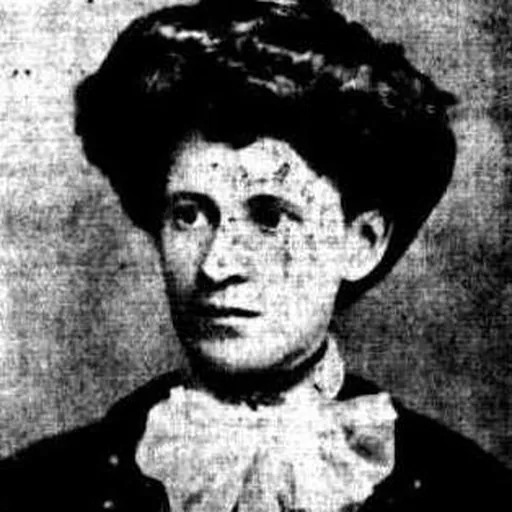
Selina Siggins
Australian trade unionist, first woman to stand for the Australian House of Representatives
About Selina Siggins
Lived 1878 – 1964 (aged 86). Selina Siggins was an Australian trade unionist.
Selina Sarah Elizabeth Siggins (née Charters, previously Anderson; 12 May 1878 – 30 November 1964) was an Australian political activist who became the first woman to stand for the Australian House of Representatives. She ran as an independent at the 1903 federal election, the first at which women were eligible to be candidates. Although she spent most of her life in New South Wales, in 1918 she also became one of the first two women to stand for the Parliament of South Australia. Siggins was introduced to politics through her involvement in the labour movement, and initially supported the Labor Party. She eventually fell out with the party over its refusal to endorse her as a candidate. Her final run for parliament came at the 1922 federal election, where she became the first woman to stand for the Country Party.
Early life Siggins was born on 12 May 1878 near the small mining town of Hill End, New South Wales. She was the only child of Sarah Charlotte (née Lawrence) and James Charters. Her father, "an elderly, illiterate labourer" born in Ireland, died the year after her birth. Her English-born mother remarried in 1880 to Jerome Anderson, and her daughter took his surname. Siggins attended the Tambaroora Public School, and in 1893 won a prize for an essay about the local district. Little else is known about her childhood, but by 1903 she was living in a boardinghouse in Elizabeth Street, Sydney, and working as an artist and photographic retoucher.
In June 1904, Siggins launched a defamation suit against Henry Beech, a storekeeper in her home town of Hill End. She sought damages of £1,000, claiming he had made statements implying she was "a woman of libidinous and licentious nature and disposition". Her suit was unsuccessful. By 1906, Siggins had been elected to the state executive of the Australian Labor Party. She campaigned for Labor candidates at the 1907 state election, but later distanced herself from the party. and she subsequently told the paper that she had felt she had been treated unfairly by the central executive.
In December 1909, Siggins and her husband moved to New Zealand. In 1911, Siggins was recruited by the Grey Industrial and Political Council to work as an organiser in the Grey District, on the West Coast of the South Island. She campaigned for Paddy Webb, the Socialist candidate in Grey, at the 1911 general election. Siggins eventually returned to Australia, living in Adelaide for several years before settling in Wellington, New South Wales. In 1922, she became the first woman delegate at the annual conference of the Farmers' and Settlers' Association of New South Wales. In an interview with The Daily Telegraph, she said she could be described as a "moderate protectionist" and "independent labour" candidate. Running in the Division of Dalley, in Sydney's eastern suburbs, Siggins won 17.7 percent of the vote to finish runner-up to William Wilks of the Free Trade Party. However, she never formally nominated for the election. According to The Sydney Morning Herald, she failed to lodge her deposit by the deadline, although she told the Evening News that her withdrawal was due to ill health. In 1909, Siggins announced her intention to stand for the Division of Robertson at the next election. She again hoped to secure the endorsement of the Labor Party, but the party had already preselected a candidate, William Johnson. She requested that a second ballot be held, but the party refused and she announced that she would run as an independent. Siggins "attacked both the Labor Party and socialism" during the campaign.
Personal life Siggins' husband was an Irish-born widower, Christopher Hewitt Siggins, whom she married on 1 January 1908 in Wellington, New South Wales. The couple had no children. They eventually retired to Sydney, owning a property near Canterbury Park Racecourse where they had stables and trained racehorses. but was refused a licence. She was widowed in 1946, and died in Ashbury on 30 November 1964, aged 86. She was buried at the Field of Mars Cemetery.
Don’t just read it —
keep it.
Full-length biographies made to live with: read them, listen on the way to work, watch them tonight.
- E-book
- Audio
- Video
Instant download · yours to keep · every purchase keeps this site free
Important facts
People in Selina Siggins's life
Named in this biography and alive at the same time



Related people
Same field, nearest in time


Contemporaries
People whose lives overlapped Selina Siggins's





Frequently asked questions
Who was Selina Siggins?
Australian trade unionist, first woman to stand for the Australian House of Representatives
When was Selina Siggins born?
Selina Siggins was born on 12 May 1878 in Hill End.
When did Selina Siggins die?
Selina Siggins died on 30 November 1964 in Ashbury.
What was Selina Siggins's occupation?
Selina Siggins was a trade unionist.
What nationality was Selina Siggins?
Selina Siggins was Australian.
Sources & further reading
Cite this page
APA: Biography.guide. (2026). Selina Siggins. https://biography.guide/selina-siggins/
MLA: "Selina Siggins." Biography.guide, https://biography.guide/selina-siggins/.
Chicago: "Selina Siggins." Biography.guide. https://biography.guide/selina-siggins/.
Data last updated: 2026-09-20 · Spot an error? Report a correction.
Portrait: Wikimedia Commons · author & licence
Page generated 2026-09-27 04:57 UTC