
About Sekai Holland
Born 1942. Sekai Holland is a Zimbabwean politician, human rights defender and minister.
Sekai Holland (born 1942) is a Zimbabwean former politician who served as Minister of State for National Healing, Reconciliation and Integration in the administrations of President Robert Mugabe and Prime Minister Morgan Tsvangirai. Sekai has been involved in campaigning on a number of human rights issues, including those relating to Aboriginal Australians, apartheid in South Africa and the women's rights and democracy in Zimbabwe.
Her father, the writer and magazine editor Masotsha Mike Hove, was elected in 1953 as a special representative to the first Federation of Rhodesia and Nyasaland parliament. He had the distinction of being the first African allowed to be designated an "employee" under the regulations pertaining to the Rhodesian Guild of Journalists in Southern Rhodesia.
She has dedicated her life to campaigning for human rights, democracy and the empowerment of woman. She was recognised in 2012 with the Sydney Peace Prize, Australia's only international prize for peace.
Education and career Sekai Holland travelled to Australia as a student, where she attended the Australian National University in Canberra, where she met her future husband, Jim Holland, the son of an Australian diplomat. Later moving to Sydney, she became Director of the Free Zimbabwe Centre, established in opposition to the Rhodesia Information Centre, operated by the white minority government of Ian Smith, and initially known as the Alternative Rhodesia Information Centre. In 1979, Holland completed a Bachelor of Arts (Communication) at the University of Technology Sydney, from where she was awarded an honorary doctorate in 2013. Following Zimbabwe's independence in 1980, she and her husband returned to the country to be part of the nation-building project.
In the 1980s and 1990s, Sekai completed a Master of Science (Agricultural Journalism) at the University of Wisconsin (Madison), and worked in a number of volunteer and paid roles including: Director: Free Zimbabwe Centre Sydney, Australia 1971 – 1980 Founding member of Southern Africa Liberation Centre, Sydney Australia 1971 – 1980 Representative of Zimbabwe African National Union: Australasia, South East Asia and the Far East 1974 – 1976 Treasurer: Association of Women's Clubs 1980 – 1986 Zimbabwe Institute of Mass Communications (Harare): Founder Research Coordinator 1981 National Chairperson: Association of Women's Clubs (AWC) 1986 – 1999 Lecturer in Media Studies: 1982 – 1987 Consultant with Martinelli and Associates as Sociologist for Water and Sanitation Project in Matebeleland South: 1987 – 1989 Media Coordinator: European Union Delegation in Zimbabwe: 1990 – 1991 Sociologist for German Bank in Swaziland Dam Project for the Government of Swaziland 1992 Consultant: Association of Women's Clubs (AWC) 1999 – ongoing
Political career Movement for Democratic Change Founding Member: 1999 Secretary for International Affairs (MDC) 1999 – 2003 Secretary for Policy and Research (MDC) 2006 – 2011 Candidate for MDC Mberengwa East Constituency 2000 and 2005 Parliamentary Elections Elected to Senate for Chizhanje Electorate on the edge of Harare, March 2008 national elections Appointed Special Minister of State and Co-Minister in Organ for National Healing, Reconciliation and Integration, March 2009–13.
Awarded the Sydney Peace Prize 2012 Founder and Leader of MDC Renewal 2014 Expelled from Parliament along with all other MDC Renewal MPs, 21 March 2015. Withdrew from all political parties following fragmentation and violence in MDC Focused on grassroots community organising from 2015 with the National Peace Trust, which was renamed the Zimbabwe Peacebuilding Initiative (ZimPI) in 2019.
Human rights campaigns
Anti-Apartheid Movement Sekai was a founder of the Anti-Apartheid Movement in Australia in the late 1960s, she helped to establish the Murrawina Child Care Centre in Redfern, and she worked actively with the Aboriginal community on the land rights campaign.
Rights of Women Sekai helped resuscitate the important but moribund Association of Women's Clubs (AWC – 60 000 members), a grassroots rural women's development organisation established in 1938 by an 18-year-old African woman. With Sekai as its National Chairperson AWC became active in speaking for the rights of women against the increasingly repressive Mugabe government. The leadership was gazetted and banned from AWC by the government. Sekai made a Supreme Court challenge against the government's action and won, making history with the human rights case 'Sekai Holland and Others vs the Ministry of Labour, Social Welfare and Public Service'.
Democratic change In 1998–99 Sekai became convinced that development through NGO activity was impossible under the Mugabe government, and with Morgan Tsvangirai, she started the opposition Movement for Democratic Change (MDC) as a real alternative to one-party rule.' Professor Stuart Rees, Chair of the Sydney Peace Foundation said, 'In addition to her work for the education of rural women and her founding of Australia's anti-Apartheid movement fifty years ago, Sekai Holland has been a significant leader of non-violent, democracy campaigns, and is a key figure in her country's national dialogue on how to heal the deep wounds of social conflict.'
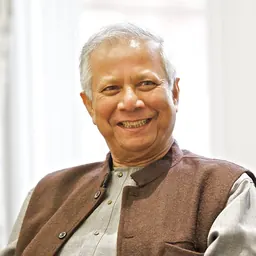
Sometimes perceived as controversial, the prize's previous recipients have included Professor Muhammad Yunus, Archbishop Desmond Tutu, Mary Robinson (former United Nations High Commissioner for Human Rights, and former President of Ireland), Dr Hanan Ashrawi, former Governor General Sir William Deane, Australia's 'Father of Reconciliation' Patrick Dodson, the Indian novelist and human rights campaigner Arundhati Roy and the distinguished American academic and activist, Professor Noam Chomsky.
Sekai Holland traveled to Australia in November to give the City of Sydney Peace Prize Lecture in the Sydney Town Hall on Wednesday 7 November 2012, receiving the 2012 Peace Prize in a gala ceremony the next day.
Don’t just read it —
keep it.
Full-length biographies made to live with: read them, listen on the way to work, watch them tonight.
- E-book
- Audio
- Video
Instant download · yours to keep · every purchase keeps this site free
Important facts
People in Sekai Holland's life
Named in this biography and alive at the same time



Related people
Same field, nearest in time






Contemporaries
People whose lives overlapped Sekai Holland's


Frequently asked questions
Who is Sekai Holland?
Zimbabwean Senator
When was Sekai Holland born?
Sekai Holland was born in 1942 in Zimbabwe.
What is Sekai Holland's occupation?
Sekai Holland is a politician, human rights defender and minister.
What nationality is Sekai Holland?
Sekai Holland is Zimbabwean.
Sources & further reading
Cite this page
APA: Biography.guide. (2026). Sekai Holland. https://biography.guide/sekai-holland/
MLA: "Sekai Holland." Biography.guide, https://biography.guide/sekai-holland/.
Chicago: "Sekai Holland." Biography.guide. https://biography.guide/sekai-holland/.
Data last updated: 2026-09-22 · Spot an error? Report a correction.
Page generated 2026-09-27 05:32 UTC