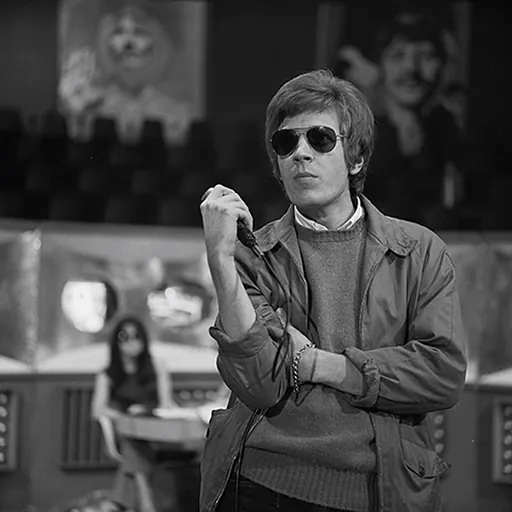
Scott Walker
British-American singer-songwriter, composer and record producer
About Scott Walker
Lived 1943 – 2019 (aged 76). Scott Walker was an American and British singer-songwriter, record producer, singer, composer, guitarist and musician.
Noel Scott Engel (January 9, 1943 – March 22, 2019), better known by his stage name Scott Walker, was an American-British singer-songwriter, composer, and record producer. Walker was known for his emotive baritone voice and his unorthodox career path, which took him from being a teen pop icon in the 1960s to an avant-garde musician from the 1990s to his death. Walker was most successful in the United Kingdom, where he achieved fame as a member of pop trio the Walker Brothers, who scored several hit singles during the mid-1960s, including two number-one hits on the UK singles chart with "Make It Easy on Yourself" and "The Sun Ain't Gonna Shine Anymore" (1966). He lived in the UK from 1965 onwards, and became a UK citizen in 1970.
After the Walker Brothers split in 1967, he began a solo career with the album Scott later that year. Strongly inspired by Belgian singer-songwriter Jacques Brel, Walker moved toward an increasingly challenging musical and lyrical style on the late 1960s baroque pop albums Scott 2 (1968), which reached number one in the UK; Scott 3 (1969); and Scott 4 (1969). After Scott 4 and its follow-up 'Til the Band Comes In (1970) failed commercially, Walker released a number of MOR covers albums, which he later disowned, to appease record companies. He reunited with the Walker Brothers in the mid-1970s. Walker progressed this style through The Drift (2006); Bish Bosch (2012); and Soused (2014), a collaboration with American drone metal band Sunn O))). The Guardian reflected on Walker's stylistic evolution in 2012: "imagine Andy Williams reinventing himself as Stockhausen".
Life and career Early life Noel Scott Engel was born on January 9, 1943, in Hamilton, Ohio, United States, the son of Elizabeth Marie (Fortier), who was from Montreal, Quebec, and Noel Walter Engel. His father was an oil industry manager whose work led the family to successive homes in Ohio, Texas, Colorado, and New York. Engel and his mother settled in California in 1956. Engel was interested in both music and performance and spent time as a child actor and singer in the mid to late 1950s, including roles in the Broadway musicals Pipe Dream and Plain and Fancy. Championed by singer and TV host Eddie Fisher, he appeared several times on Fisher's TV program. Engel cut some records including one named "Misery", which saw him briefly promoted as a teen idol.
1964–1967: The Walker Brothers
As a trio, the Walker Brothers cultivated a glossy-haired and handsome familial image. Prompted by Maus, each of the members took "Walker" as their stage surname. Scott continued to use the name Walker thereafter, with the brief exception of returning to his birth name for the original 1969 release of Scott 4 and in songwriting credits. Initially, John served as guitarist and main lead singer of the trio, with Gary on drums and Scott playing bass guitar and mostly singing harmony vocals. By early 1965, the group had made appearances on TV shows Hollywood A Go-Go and Shindig and had made initial recordings, but the start of their real success lay in the future and overseas.
Between 1965 and 1967, the group released the albums Take It Easy with the Walker Brothers (1965), Portrait (1966), and Images (1967), and two EPs, I Need You and Solo John/Solo Scott (both 1966). Following "The Sun Ain't Gonna Shine Anymore", the group's subsequent singles in 1966 were "(Baby) You Don't Have to Tell Me" (No. 13 UK), "Another Tear Falls" (No. 12 UK) and "Deadlier Than the Male" (No. 32 UK), the latter a co-write between Scott and Johnny Franz for the soundtrack of the film of the same name, while 1967 brought two more singles in "Stay With Me Baby" and "Walking in the Rain" (both of which reached No. 26 in the UK).
The Walkers' 1960s sound mixed Phil Spector's "wall of sound" technique with symphonic orchestrations featuring Britain's top musicians and arrangers, notably Ivor Raymonde. Scott served as effective co-producer of the band's records throughout this period, alongside their named producer Johnny Franz and engineer Peter Oliff. Many of their earlier numbers had a driving beat, but with the release of their third album, Images, in 1967, ballads predominated.
By 1967, John Walker's musical influence on the Walker Brothers had waned (although on Images he sang lead on a cover of "Blueberry Hill" and contributed two original compositions), which led to tensions between him and Scott. At the same time, Scott was finding the group a chafing experience: "There was a lot of pressure. I was coming up with all the material for the boys, and I was having to find songs and getting the sessions together. Everyone relied on me, and it just got on top of me. I think I just got irritated with it all."
Artistic differences and the stresses stemming from overwhelming pop stardom led to the break-up of the Walker Brothers in the summer of 1967, although they reunited temporarily for a tour of Japan in 1968.
1967–1974: Solo work For his solo career, Walker shed the Walker Brothers' mantle and worked in a style clearly glimpsed on Images. Initially, this led to a continuation of his previous band's success. Walker's first four solo albums — Scott (1967), Scott 2 (1968), Scott 3, and Scott Walker Sings Songs from his TV Series (both 1969) — all sold in large numbers, with Scott 2 topping the British charts. Walker also achieved two UK Top 20 singles during this period with "Joanna" (1968) and "Lights of Cincinnati" (1969).
During this period, Walker combined his earlier teen appeal with a darker, more idiosyncratic approach (which had been hinted at in songs like "Orpheus" on the Images album). While his vocal style remained consistent with the Walker Brothers, he now drove a fine line between classic ballads, Broadway hits and his own compositions, and also included risqué recordings of Jacques Brel songs (as translated by Mort Shuman, who was also responsible for the hit musical Jacques Brel is Alive and Well and Living in Paris). Walker's own original songs of this period were influenced by Brel and Léo Ferré as he explored European musical roots while expressing his own American experience and reaching a new maturity as a recording artist.
Walker continued to grow as a producer. In 1968 (during the brief Walker Brothers reunion and tour of Japan), he produced a single with the Japanese rock group the Carnabeats, featuring Gary Walker on vocals. Upon his return to the UK, he produced a solo album for the Walker Brothers' musical director and guitarist Terry Smith. In 1968, Walker also produced Ray Warleigh's First Album. According to Anthony Reynolds, "[Warleigh's] album, recorded on December 13 and released in the following year, had little in common with the more esoteric progressive jazz that Scott was digging at the time, and the result veered more toward pleasantly middle-of-the-road muzak than the jazz fusion just around the corner." building on an interest in lieder and classical musical modes.
At the peak of his fame in 1969, Walker was given his own BBC TV series, Scott, featuring solo Walker performances of ballads, big band standards, Brel songs, and his own compositions. Archival footage of the show is extremely rare as none of the footage conserved, though surviving audio recordings from the show were released in 2019 as the box set Live on Air 1968-1969. Scott 3, released in early 1969, was Walker's first album to be dominated by his own songwriting, though its follow-up, mid-1969's Scott Walker Sings Songs from his TV Series, featured no original material and exemplified the problems he was having in failing to balance his own creative desires with the demands of the entertainment industry and of his manager Maurice King, who seemed determined to mould his protégé into a new Andy Williams or Frank Sinatra.
Walker then entered a period of self-confessed artistic decline, during which he spent five years making records "by rote, just to get out of contract" Subsequent releases saw Walker revert to cover versions of popular film tunes, easy listening standards and a serious flirtation with country music. All of his next four albums - The Moviegoer (1972), Any Day Now, Stretch (both 1973), and We Had It All (1974) - feature no original material whatsoever. These four albums and the 1969 TV Series album would subsequently be disowned by Walker, and he would prevent them from ever being issued on CD (though Stretch and We Had It All did receive a CD release, without Walker's approval, by independent label BGO Records in the late 1990s).
In the 2006 documentary Scott Walker: 30 Century Man, Walker describes these as his "lost years" in terms of creativity. He has also confessed to having surrendered his direction due to outside pressure: The record company called me in [following the commercial failure of Scott 4] and carpeted me and said you've got to make a commercial record for us... I was acting in bad faith for many years during that time... I was trying to hang on. I should have stopped. I should have said, 'OK, forget it' and walked away. But I thought if I keep hanging on and making these bloody awful records... this is going to turn round if I just hang in long enough, and it didn't. It went from bad to worse... Neither No Regrets or Lines included any original material by Scott.
With the imminent demise of their record label, the Walkers collaborated on an album of original material that was in stark contrast to the soft rock/easy listening style of the previous two albums. The resulting album, Nite Flights, was released in 1978 with each of the Brothers writing and singing their own compositions (the opening four songs by Scott, the middle two by Gary and the final four by John). Scott's four songs – "Shut Out", "Fat Mama Kick", "Nite Flights" and "The Electrician" – were his first original compositions since 'Til the Band Comes In, and represented his first steps away from the MOR image and sound he had cultivated since the commercial failure of Scott 4. The extremely dark and discomforting sound of Scott's songs, particularly "The Electrician", was to prove a forerunner to the direction of his future solo work. Building on the critical and sales momentum of the compilation, his old label Phillips responded by issuing several compilations during the early 1980s, including Scott Walker Sings Jacques Brel.
In 1984, Walker released his first solo album in ten years, Climate of Hunter. The album furthered the complex and unnerving approach Walker had established on Nite Flights. While based loosely within the field of 1980s rock music, and featuring guest appearances by contemporary stars Billy Ocean and Mark Knopfler, it had a fragmented and trance-like approach. Soon afterwards, Walker was dropped by the label, and ceased to be managed by Bicknell, who later commented that his relationship with Walker "eventually just petered out."
Walker spent the late 1980s away from music, with only a brief cameo appearance in a 1987 Britvic TV advert (alongside other 1960s pop icons) to maintain his profile.
Tilt, Walker's first album for eleven years, was released in 1995, developing and expanding the working methods explored on Climate of Hunter. Variously described as "an anti-matter collision of rock and modern classical music", it was more consciously avant-garde than its predecessor with Walker now revealed as a fully-fledged modernist composer. Lyrically, subject matter included the life and murder of Pier Paolo Pasolini (and his relationship with Ninetto Davoli), cockfighting, the Holocaust, the First Gulf War, a conflation of the trials of Adolf Eichmann and Caroline of Brunswick, and a man talking to the corpse of Che Guevara.
In 2000, Walker curated the London South Bank Centre's annual summer live music festival, Meltdown, which has a tradition of celebrity curators. He did not perform at Meltdown himself, but wrote the music for the Richard Alston Dance Project item Thimblerigging. The following year he served as producer on Pulp's 2001 album We Love Life (whose track "Bad Cover Version" includes a mocking reference to the poor quality of "the second side of 'Til The Band Comes In").
In October 2003, Walker was given an award for his contribution to music by Q magazine, presented by Jarvis Cocker of Pulp. Walker received a standing ovation at the presentation. This award had been presented only twice before, the first time to Phil Spector, and the second to Brian Eno. The release of a retrospective box set, 5 Easy Pieces, comprising five themed discs spanning Walker's work with the Walker Brothers, his solo career (including film soundtrack work), and the two pieces composed for Ute Lemper, followed soon after. The British independent label 4AD Records signed Walker in early 2004.
2006–2019: Later years On May 8, 2006, Scott Walker released The Drift, his first album in eleven years (the same amount of time that separated his previous two albums Climate of Hunter and Tilt). Critical acclaim for the album garnered a Metacritic score of 85.
In both composition and atmosphere, The Drift was a continuation of the surreal, menacing, partially abstract approach displayed on Tilt. It featured jarring contrasts between loud and quiet sections; instrumentation was similar to Tilt in the use of rock instruments and a large orchestra, but the album also interpolated unnerving sound effects such as the distressed braying of a donkey, a demoniac Donald Duck impression, and (during a recording sequence captured on film) an orchestral percussionist punching a large cut of raw meat. Lyrical subjects included torture, disease, the relationship and eventual shared death of Mussolini and his mistress Clara Petacci, and a conflation of the 9/11 attacks with a nightmare shared by Elvis Presley and his dead twin brother Jesse. In contemporary interviews, Walker appeared more at ease with media attention, revealing a wish to produce albums more frequently and hinting at significant changes in the nature of his own material if and when it suits him. Although he mentioned the possibility of touring again with a compact, five-piece band in an interview with The Wire this never transpired.
In June 2006, Mojo and radio honored Scott Walker with the MOJO Icon Award: "Voted for by Mojo readers and Mojo4music users, the recipient of this award has enjoyed a spectacular career on a global scale". It was presented by Phil Alexander. A documentary film, Scott Walker: 30 Century Man, was completed in 2006 by filmmaker Stephen Kijak. Interviews were recorded with David Bowie (executive producer of the film), Brian Eno, Radiohead, Sting, Gavin Friday, Jarvis Cocker, Richard Hawley, Cathal Coughlan and many musicians associated with Walker over the years. The World Premiere of Scott Walker: 30 Century Man took place as part of the 50th London Film Festival. When The Independent released its list of "Ten must-see films" at the 50th London Film Festival, Scott Walker: 30 Century Man, was among them. A documentary on Walker containing a substantial amount of footage from the film was shown on BBC1 in May 2007 as part of the Imagine... strand, presented by Alan Yentob.
Walker released "Darkness" as part of Plague Songs, an album of songs for the Margate Exodus project, a re-telling of the Book of Exodus, the story of Moses and his search for the Promised Land. Ten singer-songwriters were commissioned by Artangel to write and record a song inspired by one of the ten biblical plagues. Walker's evocation of "Darkness" appears as the ninth.
On September 24, 2007, Walker released And Who Shall Go to the Ball? And What Shall Go to the Ball? as a limited, never-to-be-re-pressed edition. The 24-minute instrumental work was performed by the London Sinfonietta with solo cellist Philip Sheppard as music to a performance by London-based CandoCo Dance Company. The recording is currently unavailable. From November 13 to 15, 2008, Drifting and Tilting: The Songs of Scott Walker was staged at The Barbican, in London. It comprised eight songs, two from Tilt – "Farmer in the City" and "Patriot (a single)" – and the rest from The Drift: "Cossacks Are", "Jesse", "Clara (Benito's Dream)", "Buzzers", "Jolson and Jones" and "Cue". Each song was presented in a music-theatre manner, with the vocal parts taken by a number of singers, including Jarvis Cocker, Damon Albarn and Dot Allison. Walker collaborated with Bat for Lashes on the song "The Big Sleep" from her 2009 album Two Suns. He wrote the score for the ROH2 production of Jean Cocteau's 1932 play Duet for One, which was staged in the Linbury Studio in June 2011.
Walker's final solo album, Bish Bosch, was released on December 3, 2012, and was received with generally favourable reviews. In 2014, Walker collaborated with the American drone metal duo Sunn O))) on Soused. A year later, Walker composed the score for Brady Corbet's film The Childhood of a Leader; this was followed in 2018 by the score for Corbet's Vox Lux, which also featured music by Australian singer-songwriter Sia.
Collaborations As a record producer and guest performer, Walker worked with a number of artists and bands, including Pulp, Ute Lemper, Sunn O))), and Bat for Lashes.
Personal life Walker was survived by his daughter, Nicola Lee, from his marriage to Mette Teglbjaerg, which ended in divorce, and his granddaughter, Emmi-Lee, who lives with her mother in Denmark.
An only child, Walker was always reclusive and reluctant to discuss his private life. "He suffered depression, drank too much, took too many drugs and, like many of the great musicians of the 1960s, went missing in action", reported Simon Hattenstone in 2012. "He rarely talks to the media" and "has come across as sombre and taciturn." When asked, Walker agreed that he had found fame hard to deal with. "Well, I was an intense young guy."
Death Walker died at the age of 76 in London on March 22, 2019. His death was announced three days later by his record company 4AD, which announced cancer as the cause of death, while calling him "a unique and challenging titan at the forefront of British music". Tributes included those from Thom Yorke, Marc Almond and Neil Hannon.
Artistry and compositional approach Initially working as an interpreter of other people's songs, Scott Walker had developed his own songwriting skills by the heyday of the Walker Brothers and by the time of his first solo album in 1967. In a 1984 interview he spoke of difficulty in writing songs: "I don't write songs for pleasure. I can only write when I have to – like I'm under contract, or to finish an album."
Walker's late 1960s and 1970s work was relatively conventional. On a superficial level, it followed the melodic orchestral pop template used by singers such as Frank Sinatra, Andy Williams and Jack Jones – mainstream artists whose career path he was initially expected to follow. Crucial differences came via the more avant-garde orchestrations of his arrangers (primarily Angela Morley (at the time known as Wally Stott), Peter Knight and Reg Guest) and by Walker's own approach to lyrics, which involved a cinematic mise-en-scene approach once described as "unsettling short stories, all the more creepy for their delicate orchestral backdrop."
Legacy In 2018, Walker published Sundog, a book of selected lyrics. The book is divided into six sections: "The 60s", "Tilt", "The Drift", "Bish Bosch", "Soused" and "New Songs". The foreword to the book was written by Irish novelist Eimear McBride.
Many artists have expressed their admiration for Walker or cited him as an influence, including David Bowie, Marc Almond, Goldfrapp, Jarvis Cocker, Steven Wilson of Porcupine Tree, and Mikael Åkerfeldt of Opeth (particularly expressed in their joint project Storm Corrosion), Tim Bowness of No-Man, Leonard Cohen, East India Youth, Kevin Hufnagel, Ihsahn, Russell Mills, Dennis Rea, John Baizley of Baroness, Brian Eno.
Discography
Scott (1967) Scott 2 (1968) Scott 3 (1969) Scott Walker Sings Songs from his T.V. Series (1969) Scott 4 (1969) 'Til the Band Comes In (1970) The Moviegoer (1972) Any Day Now (1973) Stretch (1973) We Had It All (1974) Climate of Hunter (1984) Tilt (1995) Pola X OST (1999) The Drift (2006) And Who Shall Go to the Ball? And What Shall Go to the Ball? EP (2007) Bish Bosch (2012) Soused (2014, with Sunn O)))) The Childhood of a Leader OST (2016) Vox Lux OST (2018)
Don’t just read it —
keep it.
Full-length biographies made to live with: read them, listen on the way to work, watch them tonight.
- E-book
- Audio
- Video
Instant download · yours to keep · every purchase keeps this site free
Important facts
People in Scott Walker's life
Named in this biography and alive at the same time




Related people
Same field, nearest in time





Contemporaries
People whose lives overlapped Scott Walker's


Frequently asked questions
Who was Scott Walker?
British-American singer-songwriter, composer and record producer (1943–2019)
When was Scott Walker born?
Scott Walker was born on 9 January 1943 in Hamilton.
When did Scott Walker die?
Scott Walker died on 22 March 2019 in London.
What was Scott Walker's occupation?
Scott Walker was a singer-songwriter, record producer, singer, composer, guitarist and musician.
What nationality was Scott Walker?
Scott Walker was American and British.
Sources & further reading
· DBpedia: Scott Walker (singer)
Cite this page
APA: Biography.guide. (2026). Scott Walker. https://biography.guide/scott-walker/
MLA: "Scott Walker." Biography.guide, https://biography.guide/scott-walker/.
Chicago: "Scott Walker." Biography.guide. https://biography.guide/scott-walker/.
Data last updated: 2026-09-21 · Spot an error? Report a correction.
Portrait: Wikimedia Commons · author & licence
Page generated 2026-09-27 04:59 UTC