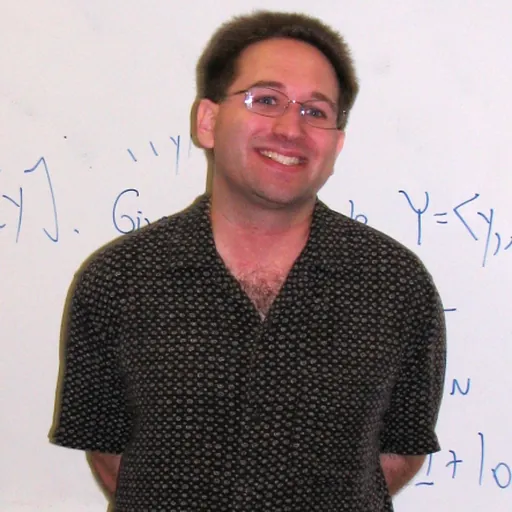
About Scott Aaronson
Born 1981. Scott Aaronson is an American computer scientist, known for Algebrization, Boson sampling and PostBQP.
Scott Joel Aaronson (born May 21, 1981) is an American theoretical computer scientist and Schlumberger Centennial Chair of Computer Science at the University of Texas at Austin. His primary areas of research are computational complexity theory and quantum computing.
Early life and education Aaronson grew up in the United States, though he spent a year in Asia when his father was posted to Hong Kong. He enrolled in a school there that permitted him to skip ahead several years in math, but upon returning to the US, he had difficulties in school, getting bad grades and having run-ins with teachers. He enrolled in The Clarkson School, a gifted education program run by Clarkson University, which enabled Aaronson to apply for colleges while only in his freshman year of high school. and where he resided at the Telluride House. He then attended the University of California, Berkeley, for his PhD, which he got in 2004 under the supervision of Umesh Vazirani.
As a child, Aaronson was particularly interested in mathematics. In part due to this, he felt drawn to theoretical computing, particularly computational complexity theory. At Cornell, he became interested in quantum computing and devoted himself to computational complexity and quantum computing. In summer 2022 he announced he would be working for a year at OpenAI on theoretical foundations of AI safety. He worked at the company for two years.
Popular work He is a founder of the Complexity Zoo wiki, which catalogs all classes of computational complexity. He is the author of the blog "Shtetl-Optimized".
In a Scientific American interview he answers why his blog is called shtetl-optimized, and explains his preoccupation with the past:
He also wrote the essay "Who Can Name The Bigger Number?". The latter work, widely distributed in academic computer science, uses the concept of Busy Beaver Numbers as described by Tibor Radó to illustrate the limits of computability in a pedagogic environment.
He has also taught a graduate-level survey course, "Quantum Computing Since Democritus", for which notes are available online, and have been published as a book by Cambridge University Press. It weaves together disparate topics into a cohesive whole, including quantum mechanics, complexity, free will, time travel, the anthropic principle and more. Many of these interdisciplinary applications of computational complexity were later fleshed out in his article, "Why Philosophers Should Care About Computational Complexity". Since then, Aaronson published a book entitled Quantum Computing Since Democritus based on the course.
An article of Aaronson's, "The Limits of Quantum Computers", was published in Scientific American, and he was a guest speaker at the 2007 Foundational Questions in Science Institute conference. Aaronson is frequently cited in the non-academic press, such as Science News, The Age, ZDNet, Slashdot, New Scientist, The New York Times, and Forbes magazine.
Awards Aaronson is one of two winners of the 2012 Alan T. Waterman Award. Best Student Paper Awards at the Computational Complexity Conference for the papers "Limitations of Quantum Advice and One-Way Communication" (2004) and "Quantum Certificate Complexity" (2003). Danny Lewin Best Student Paper Award at the Symposium on Theory of Computing for the paper "Lower Bounds for Local Search by Quantum Arguments" (2004). 2009 Presidential Early Career Award for Scientists and Engineers 2009 Sloan Research Fellowship 2017 Simons Investigator He was elected as an ACM Fellow in 2019 "for contributions to quantum computing and computational complexity". He was awarded the 2020 ACM Prize in Computing "for groundbreaking contributions to quantum computing". He was elected to the US National Academy of Sciences in 2026. Inaugural 2026 Luca Trevisan Award for Expository Work from ACM SIGACT
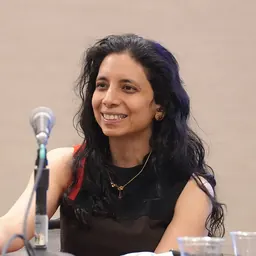
Personal life Aaronson is married to computer scientist Dana Moshkovitz. and has described himself as "radicalized in my Jewish and Zionist identities".
Don’t just read it —
keep it.
Full-length biographies made to live with: read them, listen on the way to work, watch them tonight.
- E-book
- Audio
- Video
Instant download · yours to keep · every purchase keeps this site free
Important facts
People in Scott Aaronson's life
Named in this biography and alive at the same time



Related people
Same field, nearest in time


Contemporaries
People whose lives overlapped Scott Aaronson's


Frequently asked questions
Who is Scott Aaronson?
American quantum computing researcher (1981-)
When was Scott Aaronson born?
Scott Aaronson was born on 21 May 1981 in Philadelphia.
What is Scott Aaronson's occupation?
Scott Aaronson is a computer scientist.
What is Scott Aaronson known for?
Scott Aaronson is known for Algebrization, Boson sampling and PostBQP.
What nationality is Scott Aaronson?
Scott Aaronson is American.
Sources & further reading
Cite this page
APA: Biography.guide. (2026). Scott Aaronson. https://biography.guide/scott-aaronson/
MLA: "Scott Aaronson." Biography.guide, https://biography.guide/scott-aaronson/.
Chicago: "Scott Aaronson." Biography.guide. https://biography.guide/scott-aaronson/.
Data last updated: 2026-09-23 · Spot an error? Report a correction.
Portrait: Wikimedia Commons · author & licence
Page generated 2026-09-27 05:07 UTC