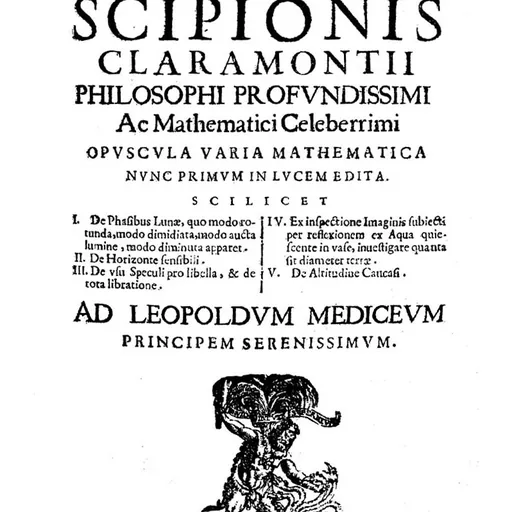
Scipione Chiaramonti
Italian astronomer and philosopher
About Scipione Chiaramonti
Lived 1565 – 1652 (aged 87). Scipione Chiaramonti was an astronomer, philosopher and mathematician.
Scipione Chiaramonti (21 June 1565 – 3 October 1652) was an Italian philosopher and noted opponent of Galileo. The son of a doctor, Scipione studied at the University of Ferrara, lodging first at the house of Cardinal Alessandro d’Este and later associating with the circle of Cardinal Curzio Sangiorgi. In 1588 he married Virginia Abbati, with whom he was to father twelve children (including at least seven boys). A scholar of many interests, with a solid knowledge of medieval and humanistic natural philosophy, Chiaramonti organised a "Lyceum" at his house, in which he taught mathematics, optics and perspective. The art theorist Matteo Zaccolini was among his disciples. In 1592 he met Galileo, passing through Cesena on his way to Pesaro, who described him as 'very gifted in mathematics'; the same year he graduated in philosophy.
Just as Galileo sought to interpret the phenomenon of comets in a way which supported Copernican heliocentrism, Chiaramonti explained it with the intention of supporting the traditional geocentric model. Chiaramonti was such a determined defender of classical astronomy that he rejected even the Tychonic system, which was by then commonly accepted among Jesuit scholars and other astronomers who did not agree with the views of Copernicus.
Despite the fundamental difference of views with Chiaramonti, Galileo maintained cordial relations with him at this time, referring to him positively in The Assayer as having conclusively proved the falsity of Tycho's model of the universe. Galileo's views may have hardened after Chiaramonti replied to Kepler's Shieldbearer in 1626 with his Apologia pro Antitychone. In this he reiterated what Benedetto Castelli described as "ridiculous and impossible" opinions on comets and stars. Mario Guiducci scorned him as a "cold, insipid Peripatetic" who needed "a good ironing." In 1629 he applied to the more prestigious university of Bologna to teach mathematics, but his appointment was blocked, with particularly strong opposition from Galileo's friend Cesare Marsili, who described him as "such an enemy of astronomers" ("tanto nemico degli astronomi"). In 1628 Chiaramonti published another attack on both Tycho and Copernicus, De Tribus Novis Stellis. This was concerned with three transient 'new stars' in 1572, 1600 and 1604. His purpose was to refute arguments that these were actual stars rather than sublunary events.
The publication of Galileo's Dialogue Concerning the Two Chief World Systems in Italian in 1632 and then in Latin in 1635, dealt a serious blow to Chiaramonti's scientific credibility. In the dialogue, arguments that he had used in past were placed in the mouth of Galileo's idiot character Simplicius in such way that, as Chiaramonti himself commented, only a "scempio" ("disgrace", "total mess") like Simplicio could possibly believe them. The character of Salivati firmly rebuts these points, dismissing "Antitycho" as a work hardly meriting serious attention, and referring to existence of sunspots, which not only darken the surface of the Sun, but cast a shadow on the whole of peripatetic philosophy.
Chiaramonti responded to Galileo almost at once with a dialogue of his own, the Difesa di Scipione Chiaramonti da Cesena al suo Antiticone (1633). In this he argued a position that "is neither well presented [i.e. by Salviati to Simplicio].... nor is it answered by him." Chiaramonti rewrote this entire section of Galileo's Dialogue, challenging Galileo's logic and inserting responses in the Salviati-Simplicio conversation to indicate what he would have said in place of Simplicio's weak replies. In a letter to Élie Diodati on 25 July 1634 Galileo complained that in the Difesa, Chiaramonti had allowed himself to be drawn into writing 'exaggerated' and 'reckless' things which, outside of present circumstances, could easily have been refuted.
The remainder of his attention returned to the territory of scholarly disputes; Giovanni Camillo Glorioso had criticised his De Tribus and in 1636 Charamonti published a refutation, Examen censurae Gloriosi, to which Glorioso replied the following year Castigatio examinis. To this Chiaramonti responded in turn with Castigatio Ioannis Camilli Gloriosi aduersus Scipionem Claramontium Caesenatem (1638). Glorioso's final contribution to this dispute was his Responsio (1641). As he died soon after, this allowed Chiaramonti the last word, which he took with a volume of more than 500 pages, summarising his Aristotelian positions on a wide range of topics, his Opus Scipionis Claramontis Caesenatis de Universo (1644). No less acrimonious was his dispute with Galileo's friend Fortunio Liceti, founded on the same wish to defend Aristotle against any modern observation or experiment. This polemic was opened by Chiaramonti in 1636 and was fought by exchange of pamphlets until 1648. While pursuing these extended arguments, Chiaramonti produced a number of systematic treatises which reaffirmed classical Aristotelian thinking, and in 1643, the year after Galileo's death, he published an attack on his views in Antiphilolaus.
Later life Chiaramonti's wife died in 1644; there is an account that at the age of eighty he remarried to a much younger wife, but the consensus is that soon after he widowed, he joined the Capuchin order to which four of his sons already belonged, and erected at his own expense a church dedicated to Saint Philip and Saint Cecilia. He died in Cesena on 3 October 1652.
Works
Don’t just read it —
keep it.
Full-length biographies made to live with: read them, listen on the way to work, watch them tonight.
- E-book
- Audio
- Video
Instant download · yours to keep · every purchase keeps this site free
Important facts
People in Scipione Chiaramonti's life
Named in this biography and alive at the same time




Related people
Same field, nearest in time



Contemporaries
People whose lives overlapped Scipione Chiaramonti's



Frequently asked questions
Who was Scipione Chiaramonti?
Italian astronomer and philosopher (1565-1652)
When was Scipione Chiaramonti born?
Scipione Chiaramonti was born on 21 June 1565 in Cesena.
When did Scipione Chiaramonti die?
Scipione Chiaramonti died on 3 October 1652 in Cesena.
What was Scipione Chiaramonti's occupation?
Scipione Chiaramonti was an astronomer, philosopher and mathematician.
Sources & further reading
· Wikipedia: Scipione Chiaramonti
· DBpedia: Scipione Chiaramonti
Cite this page
APA: Biography.guide. (2026). Scipione Chiaramonti. https://biography.guide/scipione-chiaramonti/
MLA: "Scipione Chiaramonti." Biography.guide, https://biography.guide/scipione-chiaramonti/.
Chicago: "Scipione Chiaramonti." Biography.guide. https://biography.guide/scipione-chiaramonti/.
Data last updated: 2026-09-24 · Spot an error? Report a correction.
Portrait: Wikimedia Commons · author & licence
Page generated 2026-09-27 05:09 UTC