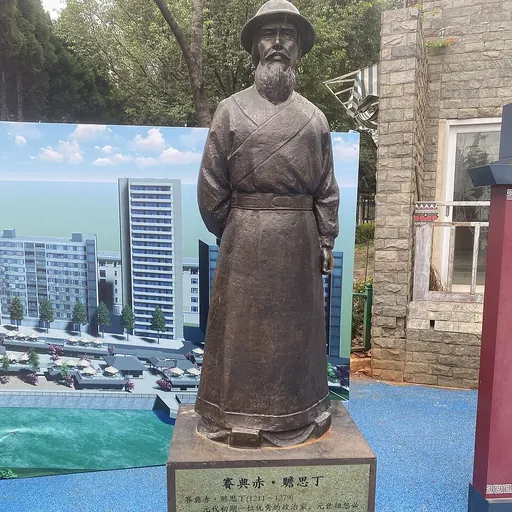
About Sayyid Ajjal Shams al-Din Omar
Lived 1211 – 1279 (aged 67–68). Sayyid Ajjal Shams al-Din Omar was a Chinese and Mongolian politician.
Sayyid Ajall Shams al-Din Omar al-Bukhari (; ; 1211–21 August 1279 being a Muslim Khwarezmian from Bukhara (in present-day Uzbekistan). When Genghis Khan attacked the city during the war between the Khwarizmi Shah and the Mongols, Sayyid Ajall Shams al-Din Omar's family surrendered to him. He was allegedly descended from Ali ibn Abi Talib and Muhammad, Sayyid Ajall's father was Kamāl al-Dīn and his grandfather was Shams al-Dīn 'Umar al-Bukhārī. According to Marshall Broomhall, Shams al-Din, "who was a native of Bokhara, is said to have been a descendant of Mohammed (twenty-seventh generation)." Sayyid participated in Mongke Khan's conquest of Sichuan and was in charge of logistics. Later, he was in charge of Imperial finances in 1259, sent to Yunnan by Kublai Khan after conquering the Kingdom of Dali in 1274. After his death, Sayyid was given the posthumous name Zhongyi (忠懿). Later, the imperial court conferred the title "Prince of Xianyang" (咸陽王) and the posthumous name Zhonghui (忠惠) on him.
The Yuanshi gives many biographies of distinguished Muslims in the service of the Mongols. A number of them occupied high offices. In chap, cxxv, we find the biography of Ajall Shams ad-Din Omar (in Chinese: 赛典赤·赡思丁 Sai-dien-ch'i shan-sse-ding, called also 烏馬兒 Wu-ma-r). He was a Hui and descendant of the Prophet Muhammad (别菴伯爾 Bie-an-bo-r). In his country Sai-dien-ch'i has the same meaning as 貴族 (noble family) in Chinese. There is a long biography of Sai-dien-ch'i.
Policy during Governorship
Sayyid Ajall founded a "Chinese style" city where modern Kunming is today, called Zhongjing Cheng. He ordered that a Buddhist temple, a Confucian temple, and two mosques be built in the city. Advocating Islam, Christianity, Buddhism, Daoism and Confucianism was part of the Mongolian religious policy. The Confucian temple that Sayyid Ajall built in 1274, which also doubled as a school, was the first Confucian temple ever to be built in Yunnan.
Both Confucianism and Islam were promoted by Sayyid Ajall in his "civilizing mission" during his time in Yunnan. Sayyid Ajall viewed Yunnan as "backward and barbarian" and utilized Confucianism, Islam, and Buddhism for "civilizing" the area.
In Yunnan, the presence of Islam is credited to Sayyid Ajall's work.
Sayyid Ajall was first to bring Islam to Yunnan. He promoted Confucianism and Islam by ordering construction of mosques and temples of Confucianism. Sayyid Ajall also introduced Confucian education into Yunnan. He was described as making "the orangutans and butcherbirds became unicorns and phonixes [sic] and their felts and furs were exchanged for gowns and caps", and praised by the Regional Superintendent of Confucian studies, He Hongzuo.
Shams al-Din constructed numerous Confucian temples in Yunnan, and promoted Confucian education. He is best known among the Chinese for helping sinicize Yunnan province. He also built multiple mosques in Yunnan as well.
Confucian rituals and traditions were introduced to Yunnan by Sayyid Ajall. Several Confucian temples and schools were founded by him. Chinese social structures, and Chinese style funeral and marriage customs were spread to the natives by Sayyid Ajall. The natives of Yunnan were instructed in Confucian ceremonies like weddings, matchmaking, funerals, ancestor worship, and kowtow by Sayyid Ajall. The native leaders had their "barbarian" clothing replaced by clothing given to them by Sayyid Ajall. It has been suggested that Yachi was Dali City (Ta-li). Dali had many Hui people.
His son Nasir al-Din became Governor of Yunnan in 1279 after Sayyid Ajall died.
The historian Jacqueline Armijo-Hussein has written on Sayyid Ajall's Confucianization and Sinicization policies, in her dissertation Sayyid 'Ajall Shams al-Din: A Muslim from Central Asia, serving the Mongols in China, and bringing 'civilization' to Yunnan, the paper The Origins of Confucian and Islamic Education in Southwest China: Yunnan in the Yuan Period, and The Sinicization and Confucianization in Chinese and Western Historiography of a Muslim from Bukhara Serving Under the Mongols in China. He repaired and built many mosques, such as the Daxuexi Mosque and great Mosque in Xi'an. The Daxuexi Alley Mosque in Xi'an has a stele erected in 1523, indicates to the reforms and construction of the mosque by him.
Sayyid Ajall's oldest son was Nasir al-Din. Sayyid Ajall's seventh generation descendant was Sai Hazhi.
Sayyid Ajall was a 26th generation descendant of the Prophet Muhammad and fifth generation descendant of Su fei-erh. In total, he had five sons. He had two tombs, one in Wo-erh-to in Yunnan and another memorial which contained his clothes in Xi'an in Shaanxi province. The author of "The Magnetic Needle of Islam", Ma Chu (1630–1710), was a descendant of Sayyid Ajall. The d'Ollone expedition during the Qing dynasty recorded that Imam Na Wa-Ch'ing was the leader of the family of descendants of Sayyid Ajall. Ma repaired Sayyid Ajall's tomb. Another romanization of Ma Chu is "Ma Zhu". Sayyed Ajall's descendants included 15th generation- Ma Zhu and 25th generation- Ma Dexin.
Sayyid Ajall is the ancestor of many Muslims in areas all across China. Yunnan contained the greatest number of his descendants.
One of his most prominent descendants was Zheng He.
In the thirteenth century the influence of individual Muslims was immense, especially that of the Seyyid Edjell Shams ed-Din Omar, who served the Mongol Khans till his death in Yunnan AD 1279. His family still exists in Yunnan, and has taken a prominent part in Muslim affairs in China.
He is identified as the ancestor of many Chinese Hui lineages in Yunnan's Panthay Hui population as well as in Ningxia and Fujian provinces.
A Hui legend in Ningxia links four surnames common in the region - Na, Su, La, and Ding - with the descendants of Shams al-Din's son named Nasruddin, who "divided" their ancestor's name (Nasulading, in Chinese) among themselves. The Ding family of Chendai, Fujian claims descent from him. The Ding family has branches in Taiwan, the Philippines, and Malaysia among the diaspora Chinese communities there, no longer practicing Islam but still maintaining a Hui identity.
It was the Ming loyalist Confucian Hui Muslim scholar Ma Zhu (1640-1710) from Yunnan who traced many Hui lineage's ancestry back to Sayyid Ajall, constructing genealogies for them, specifically claiming that Hui who were not surnamed Ma were descended from Sayyid Ajjall, like Hui surnamed Na, Su, La, and Ding, while tracing his own ancestry and other Hui in Yunnan who were surnamed Ma to the Ming Muslim official Sai Haizhi.
The deputy secretary-general of the Chinese Muslim Association on Taiwan, Ishag Ma (馬孝棋), has claimed "Sayyid is an honorable title given to descendants of the Prophet Mohammed, hence Sayyid Shamsuddin must be connected to Mohammed". The Ding (Ting) family in Taisi Township in Yunlin County of Taiwan, traces descent from him through the Ding of Quanzhou in Fujian.
Su fei-erh is alleged by the Fa-hsiang to be the ancestor of Sayyid Ajall, however, some were skeptical of this claim and think it was a forgery to mask Sayyid Ajall's arrival to China with the Mongols. Chuan-Chao Wang of Fudan University studied the Y chromosomes of Sayyid Ajall's present descendants, and found they all have haplogroup L1a-M76, proving a southern Persian origin.
Don’t just read it —
keep it.
Full-length biographies made to live with: read them, listen on the way to work, watch them tonight.
- E-book
- Audio
- Video
Instant download · yours to keep · every purchase keeps this site free
Important facts
Family & relationships
People in Sayyid Ajjal Shams al-Din Omar's life
Named in this biography and alive at the same time
Related people
Same field, nearest in time

Contemporaries
People whose lives overlapped Sayyid Ajjal Shams al-Din Omar's


Frequently asked questions
Who was Sayyid Ajjal Shams al-Din Omar?
Governor of Yunnan (1211-1279)
When was Sayyid Ajjal Shams al-Din Omar born?
Sayyid Ajjal Shams al-Din Omar was born in 1211 in Bukhara.
When did Sayyid Ajjal Shams al-Din Omar die?
Sayyid Ajjal Shams al-Din Omar died in 1279 in Yunnan.
What was Sayyid Ajjal Shams al-Din Omar's occupation?
Sayyid Ajjal Shams al-Din Omar was a politician.
What nationality was Sayyid Ajjal Shams al-Din Omar?
Sayyid Ajjal Shams al-Din Omar was Chinese and Mongolian.
Sources & further reading
· Wikipedia: Sayyid Ajjal Shams al-Din Omar
· DBpedia: Ajall Shams al-Din Omar
Cite this page
APA: Biography.guide. (2026). Sayyid Ajjal Shams al-Din Omar. https://biography.guide/sayyid-ajjal-shams-al-din-omar/
MLA: "Sayyid Ajjal Shams al-Din Omar." Biography.guide, https://biography.guide/sayyid-ajjal-shams-al-din-omar/.
Chicago: "Sayyid Ajjal Shams al-Din Omar." Biography.guide. https://biography.guide/sayyid-ajjal-shams-al-din-omar/.
Data last updated: 2026-10-01 · Spot an error? Report a correction.
Portrait: Wikimedia Commons · author & licence
Page generated 2026-10-04 14:33 UTC