
Satti Majid
Sudanese Islamic leader
About Satti Majid
Lived 1883 – 1963 (aged 79–80). Satti Majid was a Sudanese.
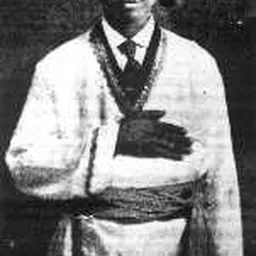
Imam Satti Majid (; 1883 – 17 March 1963), also known as Shaykh al-Islam in North America, was a Sudanese Islamic leader who is considered as one of the first Muslim missionaries in the United States and known for establishing Islam as an organised religion in the United States during the interwar period. Satti Majid Muhammad al-Qadi Suwar al-Dhahab was from a Dongolawi family of religious judges and clerics. He studied Islam in a khalwa, then pursued education at al-Azhar University in Egypt. With intentions to spread Islam, he moved to England, where he co-founded the Islamic Missionary Society with fellow Dongolawi and Yemeni men, delivering speeches and lectures across Britain, where he used his knowledge in Quran and Hadith while his associates translated to English.
Satti Majid's influence extended to the United States, where he settled in the Yemeni community in Brooklyn, New York, and became an imam around 1904. He played a crucial role in organising Sudanese expatriates and formed national associations. His impact stretched from New York to Detroit, establishing organisations like the United Moslem Society and the African Moslem Welfare Society of America, aimed at promoting Islamic identity and community coordination.
An orthodox (Sunni) Muslim, Satti Majid had a dispute with the Ahmadiyya movement, and in 1929 he attempted to condemn Noble Drew Ali's teachings with Al-Azhar's support but was not able to return to the US from Egypt. He later returned to Sudan, engaged in Islamic conventions, and founded the Islamic Unity Association.
Satti Majid's efforts to convert African Americans to Islam were recognised and celebrated, and he left a lasting impact on American Islam, emphasising unity, education, and community building. His influence on figures like Shaykh Daoud Ahmed Faisal and Elijah Muhammad, and his indirect impact on Malcolm X reshaped American Muslim history.
Biography
Early life Satti Majid Muhammad al-Qadi Suwar al-Dhahab was born in 1883 in in Old Dongola, Turco-Egyptian Sudan. He belonged to Suwar al-Dhahab family, a family of religious judges and clerics, that is part to the Danagla people. NoteTag|Zubaid section of the Bedaria tribe
Satti Majid pursued Islamic studies under local shaykhs, aligning with family tradition. He began his education at the khalwa of Shaykh Awad at al-Ghaddar, then he continued his education in memorising the Qur'an and studying the principles of jurisprudence in the khalwa of Shaykh Ahmed Wedidi in the village of Romi al-Backry, few miles from al-Ghaddar. that Satti Majid 's journey to the US was driven by his mission to combat islamophobia, sparked by derogatory writings about Islam by an Italian priest in the New York Times. This led to a publicised debate, where Satti Majid aimed to defend Islam. After the debate, Satti Majid was stabbed by an assailant, yet forgave him, leaving a "profound impact". This incident played a role in converting numerous individuals to Islam.
While striving for prominence in Detroit, he also worked to build his influence in New York. By 1921, he had established an office near the Rector Street mosque, advocating for financial aid for Muslim seamen in the city. Notably, he gained recognition among the Sudanese community in New York. Simultaneously, he continued his work in Detroit and established the Moslem Welfare Society in 1922, partly motivated by addressing criticisms of Islam. During that time, Satti Majid viewed Ali as part of an attempt to spreading sceptical views about the finality of Prophet Muhammad's message. This is because prophet Muhammad is known as the Seal of the Prophets to Muslims. Satti Majid was especially concerned about Noble Drew Ali's claims of being a prophet and his creation of a book named Circle Seven Koran. However, there's no evidence that the fatwa reached the United States before Noble Drew Ali's death on 20 July 1929.
Satti Majid died on 17 March 1963,
Legacy and influence
According to Patrick D. Bowen, Satti Majid was "one of the most influential Muslims in the United States during the interwar period." Satti Majid was dubbed Shaykh of Buffalo, for his work to convert African Americans to Islam, in which he achieved notable success in this endeavour.
Daoud Faisal Satti Majid played an influential role introducing large parts of New York city to mainstream Sunni Islam. born David A. Donald in Grenada in 1891. He also helped found the International Muslim Society in Harlem, which linked African-American Muslims with their Somali, Yemeni, and South Asian co-religionists.
Faisal and his wife Khadija converted an apartment into the Islamic Mission of America (IMA) in Brooklyn in 1939, creating a thriving mosque and mission for indigent Muslims. Satti Majid sought to convince Malcolm X through his followers to adopt Sunni Islam and leave Nation of Islam. Satti Majid advised his followers in Egypt to approach Malcolm X and offer guidance. Upon learning of Malcolm X's return to Sunni Islam, Satti Majid expressed happiness and gratitude.
Don’t just read it —
keep it.
Full-length biographies made to live with: read them, listen on the way to work, watch them tonight.
- E-book
- Audio
- Video
Instant download · yours to keep · every purchase keeps this site free
Important facts
People in Satti Majid's life
Named in this biography and alive at the same time

Contemporaries
People whose lives overlapped Satti Majid's





Frequently asked questions
Who was Satti Majid?
Sudanese Islamic leader (1883–1967)
When was Satti Majid born?
Satti Majid was born in 1883.
When did Satti Majid die?
Satti Majid died on 17 March 1963.
What nationality was Satti Majid?
Satti Majid was Sudanese.
Sources & further reading
Cite this page
APA: Biography.guide. (2026). Satti Majid. https://biography.guide/satti-majid/
MLA: "Satti Majid." Biography.guide, https://biography.guide/satti-majid/.
Chicago: "Satti Majid." Biography.guide. https://biography.guide/satti-majid/.
Data last updated: 2026-09-20 · Spot an error? Report a correction.
Page generated 2026-09-27 05:19 UTC