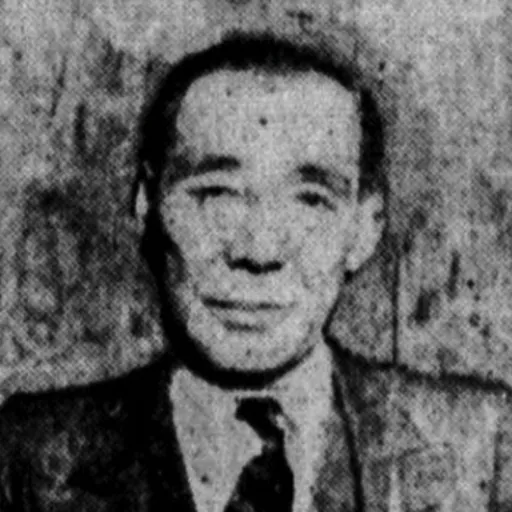
Satokata Takahashi
Founder of the Pacific Movement of the Eastern World
About Satokata Takahashi
Lived 1870 – 1945 (aged 74–75). Satokata Takahashi was a Japanese military personnel.
, Satokata Takahashi, was a Japanese-born businessman who became known as a pro-Japanese agitator among Midwestern African-Americans in the 1930s and early 1940s.
Nakane was born to a well-off family in Kitsuki and set out to become a Methodist pastor, but immigrated to Canada in 1903 following personal and professional setbacks. Settling in Moose Jaw, he raised a family, opened multiple businesses, and became an occasional advocate for Japanese Canadian rights. He moved to Tacoma, Washington in 1921 and disappeared in 1926, only to reemerge under a new name in Detroit in the early 1930s, where he became an agitator and activist in the city's black community.
Affiliated with the Black Dragon Society, he worked with leaders of the Nation of Islam and other black organizations to promote Japan as an ally of the black cause in the United States. He also founded and exercised influence over several pro-Japanese organizations, including the Pacific Movement of the Eastern World, and married black activist Pearl Sherrod. Nakane's activities attracted FBI scrutiny; he was deported in 1934 and arrested in 1939 after returning to Detroit. Following internment during World War II, he died in Detroit in 1954.
Early life and career Takahashi was born Naka Nakane in Kitsuki, Empire of Japan in 1870. He was a member of a prosperous former Samurai family, and was educated by American Methodist missionary Samuel Wainright in his youth. He attended Kwansei Gakuin University as a member of its inaugural class, and initially was a pastor, founding a church in his hometown. However, possibly due to sexual impropriety, he was expelled from the parish he founded, and became an English teacher at a junior high school. An affair with a local woman which bore two children may have contributed to his decision to immigrate to Canada in 1903.After arriving in Victoria, he moved to Moose Jaw, then the largest city in Saskatchewan, and joined its burgeoning East Asian community. He became a naturalized British subject and married an English woman, Annie Craddock, in Saint John in 1910. They had four children while living in Canada. Nakane was listed as proprietor of Moose Jaw's Carlton Cafe in 1912 and La Hale Lodge in 1918.
In 1912, the Saskatchewan Legislature voted to forbid “any Japanese, Chinaman or other Oriental person” from employing white women. Prior to the passage of the bill, Nakane wrote a letter to Saskatchewan Attorney General William Turgeon stating that the bill's passage "would be a great dishonour to our nation in general”. Nakane's complaints to the Saskatchewan and Japanese governments are believed to have contributed to a meeting between Turgeon and Japanese consul to Vancouver, Chonosuke Yada, in turn ensuring the exemption of Japanese businessmen from the law in 1913.
In 1921, Nakane moved to Tacoma, Washington, where his brother had lived since 1911. In Tacoma, he worked as a life insurance agent and had another child with Annie. He abruptly fled in 1926, leaving behind his family and massive debts.
Pro-Japanese activism Nakane reemerged in Detroit six years after his disappearance from Tacoma under the name Satokata Takahashi. He described himself as a former Major of the Imperial Japanese Army. Nakane began making speaking appearances at black churches, writing articles in black papers, and eventually became affiliated with the Nation of Islam. He had, probably after his disappearance from Tacoma, become affiliated with the Black Dragon Society, and the society channeled financial aid to Black Muslim groups in the US through him.
He was close with early NOI member Abdul Muhammad after his arrival in Detroit, even living with him for a few weeks. He also spoke at United Negro Improvement Association (UNIA) meetings across the Midwest, sometimes posing as a Japanese consul. At one of these meetings, he met Policarpio Manansala, Mimo de Guzman, a Filipino immigrant who would begin a close association with Nakane. Nakane helped found the Pacific Movement of the Eastern World (PMEW) in Chicago in 1932, and The Development of Our Own (TDOO) in Detroit in 1933. Both organizations, dedicated to black-Asian unity, would eventually generate several front organizations, although their membership and mission would remain the same.
TDOO would grow to include thousands of members, mostly African Americans but including members of the small Filipino and East Asian diaspora in the Midwest. The "Five Guiding Principles" of the group were "Freedom, Justice, Equality, Liberty, and Honour." He married activist Pearl Sherrod in Toledo in February 1934, and the pair would collaborate as leaders in TDOO. While Nakane would remain instrumental in the running of TDOO and the PMEW, he would more closely manage TDOO in Detroit and the Midwest as Manansala and others attempted to expand the PMEW nationwide. TDOO would hew more closely to the "Moorish" ideology exemplified by the UNIA. He would also reassert his involvement in the PMEW.
Arrest, internment, and later life Nakane and McIntyre were arrested by federal agents in 1939. Upon this arrest, authorities ascertained his actual identity. Having been charged with illegal entry and attempted bribery of federal officers, Nakane was fined $4,500 and sentenced to three years in federal prison.
In the early 1940s, Selective Service registrars noticed African Americans in Chicago, Detroit, and several other large cities were refusing to register under religious grounds and described themselves as Muslim. They also were not seeking an exemption as conscientious objectors. This provoked a federal reaction: in 1942, the FBI raided several Black Muslim organizations after a lengthy infiltration campaign, arresting many activists including Elijah Muhammad and Policarpo Manansala. The FBI uncovered Nakane's myriad connections with the black organizations, and arranged to keep him jailed. Interviews with Black Muslim leaders confirmed their suspicions; Elijah Muhammad claimed that he and Takahashi discussed the NOI and that Takahashi approved of his teachings, even describing him as a friend.
Don’t just read it —
keep it.
Full-length biographies made to live with: read them, listen on the way to work, watch them tonight.
- E-book
- Audio
- Video
Instant download · yours to keep · every purchase keeps this site free
Important facts
People in Satokata Takahashi's life
Named in this biography and alive at the same time


Related people
Same field, nearest in time





Contemporaries
People whose lives overlapped Satokata Takahashi's



Frequently asked questions
Who was Satokata Takahashi?
founder of the Pacific Movement of the Eastern World
When was Satokata Takahashi born?
Satokata Takahashi was born in 1870.
When did Satokata Takahashi die?
Satokata Takahashi died in 1945.
What was Satokata Takahashi's occupation?
Satokata Takahashi was a military personnel.
What nationality was Satokata Takahashi?
Satokata Takahashi was Japanese.
Sources & further reading
· Wikipedia: Satokata Takahashi
Cite this page
APA: Biography.guide. (2026). Satokata Takahashi. https://biography.guide/satokata-takahashi/
MLA: "Satokata Takahashi." Biography.guide, https://biography.guide/satokata-takahashi/.
Chicago: "Satokata Takahashi." Biography.guide. https://biography.guide/satokata-takahashi/.
Data last updated: 2026-09-23 · Spot an error? Report a correction.
Portrait: Wikimedia Commons · author & licence
Page generated 2026-09-27 05:05 UTC